
Your Custom Instant Meditation Timer
Welcome to the ultimate tool for focused practice, the Ryan Zofay Online Meditation Timer.
Whether you are new to mindfulness or an experienced meditator, a good timer for meditation is helpful. It helps you stay focused and consistent. Our free online meditation timer tool is designed to be your distraction-free companion. It helps you stop watching the clock and focus on your practice. It offers customizable features, such as interval chimes and ambient sounds, all controlled through a simple and intuitive interface. Start building your streak today!
Here are some pionters to get you started while using the meditation timer:
- Remember, mindfulness is a cornerstone of self-mastery—discover practical daily tips in my personal development workshops.
- Regular mindful practice supports growth. Adapt your growth and transformation plan to reach your goals.
- For guided prompts and deeper focus, check out my best intentions for a person’s life guide.
Ryan Zofay – Meditation Timer
Ground yourself, breathe, and begin.
Tips, Advice & Insights
- Posture: Sit tall but relaxed. Imagine a thread gently lengthening the spine.
- Breath: Inhale through the nose, exhale longer than you inhale to settle the nervous system.
- Anchor: If your mind wanders, label it kindly (“thinking”) and return to breath or sound.
- Compassion: Progress is consistency, not perfection. One minute counts.
- After: Note one word describing how you feel. This builds awareness and motivation.
Your Progress
Below, you’ll find step-by-step directions, along with helpful tips and insights. Along with finding the best time of day for relaxing, deep breathwork, utilize your custom, free Online Meditation Timer. Continue below for clear instructions. Utilize the online meditation timer for a 5-minute morning meditation or other mindfulness sessions.
Building discipline is a skill I unpack further in my success coach guide. For strategies to gently redirect your focus, read steps to getting what you need. Uncover Discover how conscious self-reflection can transform your routine in our perseverance quotes collection.
Jump To
Table of Contents
How To Use the Ryan Zofay Online Meditation Timer
Follow these steps to customize and use your personal Meditation Timer for a seamless practice.
Step 1
1. Set up Your Meditation Timer Session
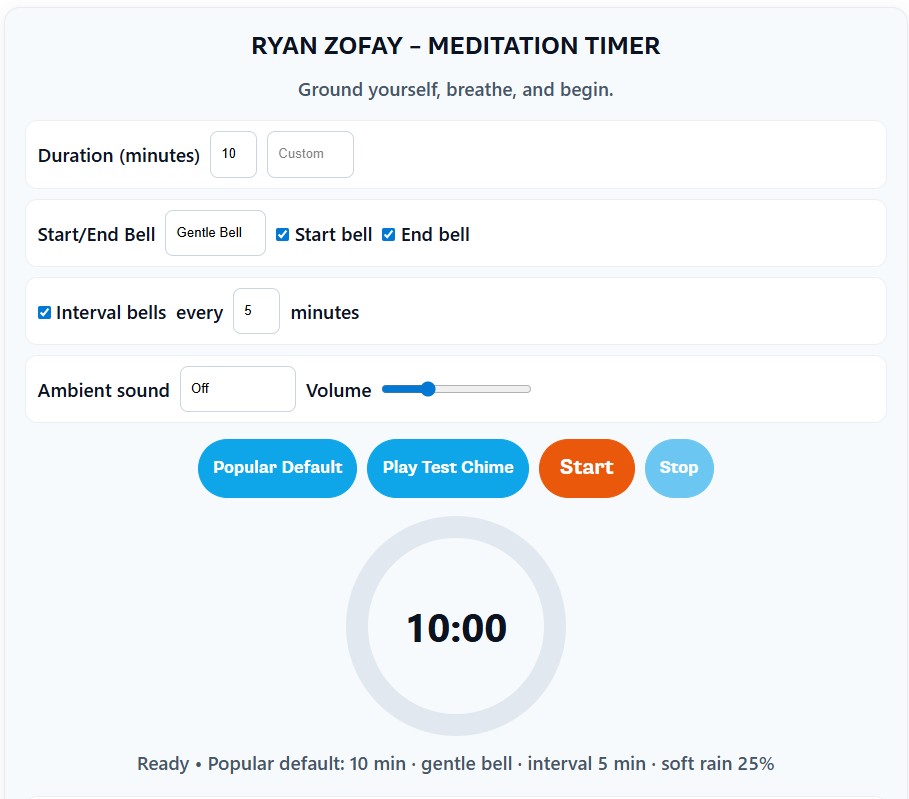
The control panel at the top allows you to fine-tune your meditation experience:
- Duration (minutes): Use the dropdown menu to select from standard times (5, 10, 15, etc.). Or use the Custom input box for any specific length you desire.
- Start/End Bell:
- Choose your sound: Gentle Bell or Deep Gong.
- Check the boxes to enable the bell at the start and/or the end of your session.
- Interval bells: Check this box to enable recurring chimes during your session. Then, select the interval time (e.g., “every 5 minutes”) to gently re-anchor your attention.
- Ambient sound: Select a background track, such as Soft Rain or Ocean Waves. Use the Volume slider to set the level.
Step 2
2. Testing & Starting
- Play Test Chime: (Recommended First Step) Click this button to unlock the audio on your device. Ensure that your chosen bells and ambient sounds are functioning properly. Your live site will likely block audio until a user interacts with it.
- Start (Orange Button): Once your settings are configured, click the prominent orange Start button to begin the timer. The circle progress bar will animate, and the countdown will begin.
- Stop (Blue Button): Click the Stop button if you need to end your session early.
Step 3
3. Tracking Your Progress
The bottom section of the timer keeps track of your consistency:
- Sessions and Total Minutes completed.
- Current Streak (days) and Best Streak, helping you stay motivated toward a daily practice.
- Use the Reset Progress button at the very bottom to clear your local history (this data is only stored in your browser).
How I Use Mediation Timers
In my role as the founder of We Level Up detox centers and a leadership trainer, I utilize meditation timers. They are a simple but powerful tool for me and the people I help.
I incorporate short, timed activities into team meetings, coaching sessions, and strategic work. This helps us pause, breathe, and reset before decision-making.
By starting or ending sessions with a 5- to 10-minute timer, I help leaders calm down. This helps them stop reacting to reconnect with their values. Using the Meditation Timer helps me stay grounded as a founder. It also gives our teams a useful tool they can use every day.
Wondering How to Meditate?
I want to invite you to join me for a moment. Whether you’re sitting down or lying back, just find a comfortable space and allow yourself to take a deep breath. Let’s connect right here, right now. I will guide you through a calming meditation with soft music. This will help you relax, clear your mind, and enjoy the beauty of a new day.
Here are insights you can use today:
- I always tell people that the goal isn’t to “win” at meditation. It’s just to be present when the timer starts and stay until it ends. That small act of keeping your word to yourself builds real self-esteem.
- When I’m overwhelmed, I don’t wait for the “perfect” moment—I set a 3–5 minute timer and sit anyway. Short, imperfect sessions done consistently beat long, occasional ones every time.
- I use the interval bells as a reminder. Every chime tells me to ask, “Where did my mind go?” I then gently refocus without judging myself. That same skill carries over into tough conversations and leadership decisions.
- On high-stress days, I set a timer with one clear, good intention or goal. I might say, “Today I will be patient” or “Today I will first understand to be understood (or listen more than I speak).” When the bell rings at the end, I recommit to that intention before I stand up.
- I tell our teams that if you only use the timer when life is calm, you’re missing its biggest gift. Real change occurs when you start on the days you least want to. This is when meditation becomes a true leadership tool. It is more than just a wellness habit.
The Perfect Online Meditation Timer
This is more than just a simple timer for meditation. It’s a personal assistant for your mindfulness journey. You canTake your mindful routines even further by exploring my proven growth and transformation plan.
With this online meditation timer, you can customize every aspect of your silent meditation session. You can change the duration, interval chimes, and background sounds. The bright orange and blue colors make the Start button highly visible. This helps you focus on getting started with your practice. You can use this online meditation timer for a quick 5-minute reset or a longer 60-minute timer for meditation. It is made for reliability and helps you focus deeply without distractions.
How I Structure My Day Around Mindful Time
When I first began meditating, I believed I needed the perfect room, cushion, and timer to find peace.
What I eventually discovered is this: It’s not about having a perfect practice. It’s about having consistent time meditation built into your day—and a simple, reliable timer to anchor you.
In this guide, I’ll explain how I use the Ryan Zofay Meditation Timer method. This method helps me answer questions like:
- When is the best time to meditate?
- What’s the ideal meditation time each day?
- How many times a day should you meditate?
- What about night time meditation for deep sleep?
I’ll also share practical tips, comparison tables, and step-by-step routines you can use immediately.
Why a Meditation Timer Matters More Than You Think
A meditation timer seems simple, but it changes everything:
- It frees your mind from clock-watching.
- It creates a ritual: when the timer starts, the world pauses.
- It turns “I’ll meditate someday” into “I meditate at this time, every day.”
You can use an online meditation timer, the Insight Timer app, or a timer on your phone. The important thing is to be consistent and intentional.
The Science Behind Mediation Timers
Over the years, I’ve seen something simple make a massive difference in people’s lives: brief, timed meditation sessions. Not “move to a mountain and chant all day” — just 5–10 minutes with a timer you actually stick to.
Here is how the research aligns with what I’ve observed in real people. I also share how I use timers to improve focus, self-control, and leadership from within.
What the Science Says (and How I Use It)
| Study & Source (Link) | My Take (Ryan’s Insight) |
|---|---|
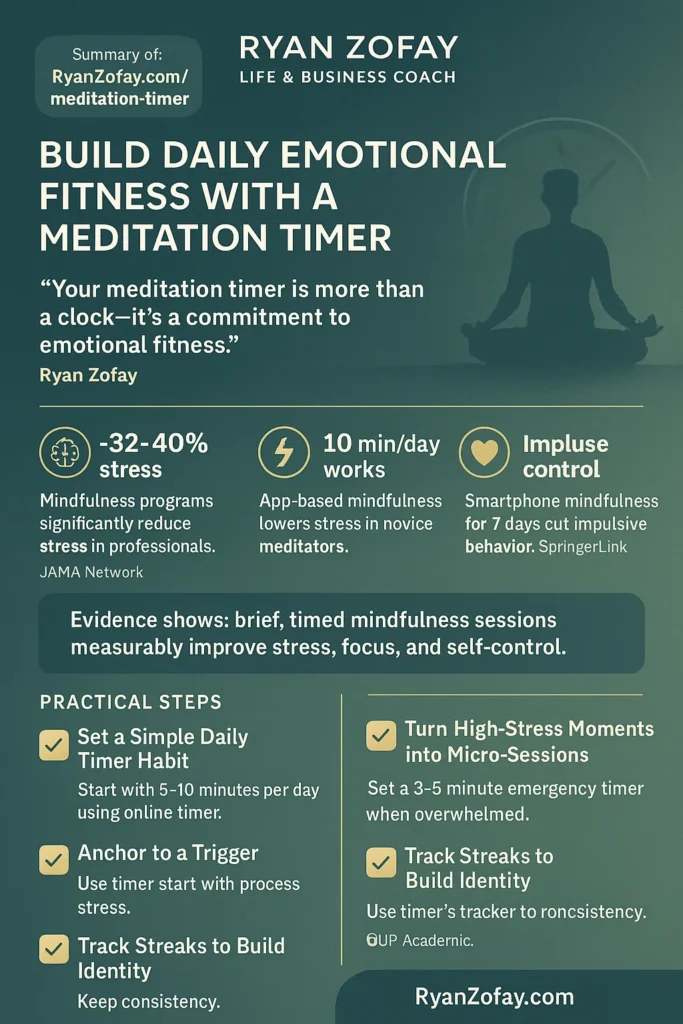
| Brief mindfulness cuts stress by ~32–40% – JAMA Network. Findings: Short workplace mindfulness programs significantly reduce stress and anxiety compared to controls. | When I coach leaders and teams, I don’t start with an hour a day. I start with tiny, consistent, timed sessions. The data backs it up. Even brief, guided practice can lead to a measurable decrease in stress. Consistency beats intensity. |
| 10 minutes/day actually works – OUP Academic. Findings: App-based mindfulness (similar to using a timer) reduces daily subjective stress in novice meditators over 8 weeks. | I love this because it makes the goal feel doable. You don’t need to be “good at meditation.” You just need 10 minutes on a timer and the willingness to show up. Over a few weeks, your nervous system starts to learn “this is my reset time.” |
| Impulse control improves with 10 minutes/day – SpringerLink. Findings: 10 minutes/day of smartphone-based mindfulness for 7 days reduced impulsive behaviors in a randomized trial. | This is huge for anyone who reacts, snaps, or self-sabotages. I use timed sessions as “response training” — every time I come back to my breath at the bell, I’m practicing not reacting. That skill shows up later in tough conversations, cravings, and conflict. |
| Mindfulness boosts leadership & decision-making – Harvard Business Review. Findings: Mindfulness is associated with enhanced emotional intelligence, improved executive function, better decision-making, and increased presence. | Leadership is an inner game first. A simple timer becomes a daily lab where you practice emotional regulation, presence, and clarity. When the pressure hits, that training is why you respond with intention instead of panic. |
Practical Steps / Tips
Step 1: Daily Habit Timer
1. Set a Simple Daily Timer Habit
- Start with 5–10 minutes of practice once a day, using the online timer.
- Choose a gentle bell and one ambient sound (such as soft rain or ocean waves) to reduce distractions.
My advice: I don’t wait for motivation. I set my timer, sit down, and let the habit carry me. If you can spend 5 to 10 minutes, your view changes from “I should meditate” to “I’m someone who takes time to reset my mind.”
Step 2: Find your Anchor
2. Anchor to a Trigger
- Pair a timer with something you already do (after brushing your teeth, before your first email, after lunch).
- Treat it like a non-negotiable meeting with yourself.
My insight:
Anchors are what make habits stick. When you incorporate meditation into an existing routine, you eliminate decision fatigue. It becomes, “I brushed my teeth, so I meditate” — just like “I buckle my seatbelt when I get in the car.”
Step 3: Internal Bells for Checkins
3. Use Interval Bells as Emotional Check-ins
- Set bells every 3–5 minutes.
- At each chime, silently ask: “Where did my mind go?”
- Gently return to your breath or sound — no judgment.
My insight:
Those micro check-ins are emotional reps. You’re training the muscle of self-awareness without self-attack. Over time, you catch yourself sooner when you’re spiraling, triggered, or zoning out.
Here are my 5 How to Practice Mindfulness Regularly Steps.
Step 4: Track
4. Track Streaks to Build Identity
- Utilize the built-in sessions, total minutes, and streak tracker to observe your consistency improve.
- Celebrate days completed, not minutes “missed.”
My insight:
I focus on identity, not perfection. When you see your streak growing, you start to think, “I’m the kind of person who shows up for myself.” That identity is worth more than a perfectly executed 30-minute session.
Step 5: Reset
5. Turn High-Stress Moments into Micro-Sessions
- Overwhelmed? Set a 3–5 minute emergency timer instead of scrolling or venting.
- Use that short pause to reset your tone before crucial conversations or decisions.
My insight:
Some of my best decisions came after a 3–5 minute pause, not before it. One short, timed session can be the difference between reacting out of fear and responding with clarity.
Step 6: Set Your Intention
6. Intention Before You Start
- Before pressing “Start,” set a one-sentence intention, like:
- “Today I will listen more than I speak.”
- “I will respond, not react.”
My insight:
Intentions aim your mind. The timer creates the space, but your intention gives that space direction. When your day goes sideways, that simple sentence becomes your anchor.
Evidence-Based Facts
Stress & Burnout: Brief workplace mindfulness programs significantly reduce stress, anxiety, and emotional exhaustion in professionals vs. “life-as-usual” controls. (JAMA Network)
Everyday Functioning & Self-Regulation:
App-based or timer-based mindfulness practices have been shown to reduce subjective stress. Improving everyday coping. Even for beginners who only commit to short daily sessions. (OUP Academic)
Leadership & Emotional Intelligence: Research from HBR and leadership studies shows that mindfulness is helpful. It improves emotional flexibility. It also leads to better decision-making. Additionally, it supports values-based leadership. This is especially true when it is combined with self-awareness and emotional skills. Leading to emotional agility, better decision-making, and values-based leadership. Especially when combined with self-awareness and emotional skills. (Harvard Business Review / Harvard Business Impact)
Why I Rely on Timers
For me, meditation timers are not about perfection or “being spiritual.”
They’re about practical, measurable change:
- Less stress in my body
- More space between trigger and response
- Better presence in conversations and leadership
- A daily reminder that my inner world is worth scheduling time for
If you can spend just a few minutes each day with a timer, both science and my experience show the same thing: You will feel a difference in your stress, focus, and self-control.
When Is the Best Time to Meditate?
People ask me all the time:
“Ryan, when is the best time to meditate?”
The real answer:
The best time to meditate is the time you can commit to on a daily basis. However, I do follow a morning routine checklist, which I find helps set up my whole day for success.
That said, different times of day create different benefits. Here’s how I think about the best time of day to meditate.
Chart for the Best Time of Day for Meditation
| Time of Day | Benefit Focus | Suggested Timer Length |
|---|---|---|
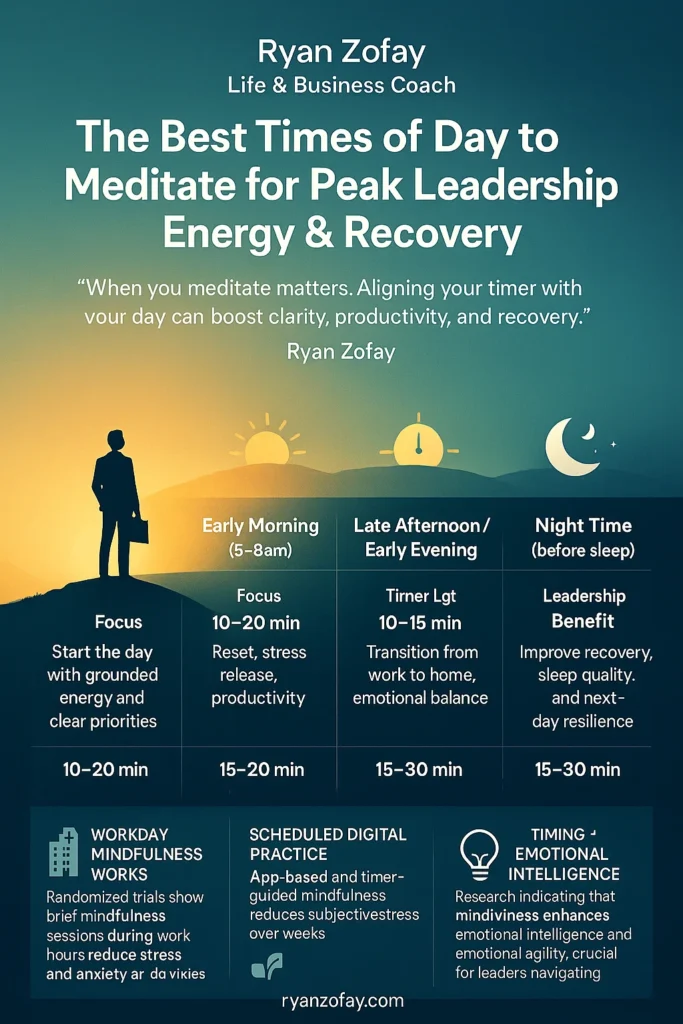
| Early Morning (5–8 am) | Clarity, intention, calm focus | 10–20 minutes |
| Midday / Lunch Break | Reset, stress release, productivity (apply my Circle of Influence Tips) | 10–15 minutes |
| Late Afternoon / Early Evening | Transition from work to home, emotional balance | 15–20 minutes |
| Night Time (before sleep) | Relaxation, nervous system down-regulation | 15–30 minutes |
I like to use a 10-minute meditation timer in the morning. I also use a 20-minute meditation timer at night. Morning sets my energy; nighttime resets my nervous system.
How Many Times a Day Should You Meditate?
Another common question I hear:
“How many times a day should you meditate?”
Here’s my simple framework:
Practical Steps / Tips
Practical Day-Part Time Slots
1. Build a “3-Slot Leadership Meditation Schedule”
- Morning: 10 min – set focus, gratitude, and top 3 priorities. Apply the Positive Images of Thankful Thursday or an attitude of gratitude and gratitude journaling prompts.
- Midday: 5–10 min – quick reset before crucial meetings or decisions.
- Night: 20 min – release tension, process emotions, and prepare for deeper sleep.
2. Use Different Timer Lengths with Intent
- 10 min – quick grounding before work or between meetings.
- 20 min – deeper emotional processing or night-time decompression.
- 30+ min – weekend/reflection or leadership retreats for deeper insight.
3. Leader’s Night Routine (Sample)
- Set a 20-minute timer.
- 0–5 min: slow breathing + body scan.
- 5–15 min: repeat grounding phrases like “I am safe. I am learning.”
- 15–20 min: simply watch the breath; allow sleepiness without forcing it.
- Here’s my Top Meditation Teacher Training for Transformational Growth guide for more.
4. Protect the “No-Excuse Time”
- Choose one time block that never moves (e.g., 7:00 am or 9:30 pm).
- Treat it like a board meeting with your future self.
5. Use Timers with Your Team
Use interval bells as reminders to return to the agenda with clarity.
Start meetings with a 3–5 minute timer to pause, breathe, and reset.
- Beginners:
- Once a day, 10 minutes.
- Intermediate:
- Twice a day:
- Morning: 10–15 minutes
- Night time: 15–20 minutes
- Twice a day:
- Deep Practitioners:
- Two or three sessions a day, totaling 30–60 minutes.
A great starting structure:
- Morning: Use a 10 minute meditation timer to set your intention.
- Evening: Use a 20 minute meditation timer for deeper release and reflection.
Evidence + Ryan Zofay Coaching Suggetions
Short, science-backed mindfulness tiles paired with Ryan Zofay’s leadership-focused coaching insights help viewers connect credible research to practical, real-world behavior change in work, business, and daily life.
| Study, Stats, Findings & Source | My Evidence-Based Suggestions |
|---|---|
| Workday Mindfulness Works • Randomized trials show that brief mindfulness programs delivered during work hours significantly reduce stress, anxiety, and emotional exhaustion versus life-as-usual controls in healthcare and mental-health professionals. Source highlights: JAMA Network (Mindfulness-based self-care at work), Frontiers in Psychology, Journal of Psychiatric Research. | Workday Mindfulness Works. “Even short, structured mindfulness sessions during work hours cut stress and anxiety for professionals in randomized trials. Leaders who protect a 5–15 minute workday mindfulness block are not being ‘soft’. They’re using the same strategy proven in hospital and mental-health staff.” “Add a daily 10-minute timer session at work. Between meetings or mid-shift as a non-negotiable emotional fitness appointment.” |
| Scheduled Digital Practice: App-based mindfulness (e.g., Calm, Headspace, or similar mobile interventions) over 6–8 weeks leads to significant reductions in perceived stress, and anxiety. With improvements in coping and well-being vs. controls in students, employees, and other adults. Source highlights: Oxford Academic (Annals of Behavioral Medicine), Applied Psychology: Health and Well-Being (Wiley/OUP Academic), JMIR mHealth & uHealth / JMIR Mental Health, UCSF digital mindfulness trial. | Scheduled Digital Practice. “Studies show app-based, scheduled mindfulness reduces stress and improves coping—even with just a few minutes a day. When you use a meditation timer or app at set times, you’re mirroring protocols used in clinical trials, Rather than just ‘trying to relax’. Leaders can create a digital habit loop. Set a daily timer notification (morning, midday, evening) and track streaks, minutes, and mood shifts over 6–8 weeks.” |
| Timing + Emotional Intelligence • Harvard Business Review’s Emotional Intelligence series and related pieces show that mindfulness supports better performance, creativity, self-awareness, and presence while emotional intelligence (EQ) is the mechanism that makes mindfulness truly effective in leadership. Harvard Business Review Findings: Mindfulness + EQ → more emotional agility, better navigation of triggers, and improved values-based leadership and team psychological safety. | Timing + Emotional Intelligence: “HBR research shows mindfulness boosts leadership most when it is tied to emotional intelligence and emotional agility. Not used in isolation. Use your timed meditations before high-stakes conversations to create space between trigger and response. This is where EQ and values-based leadership live. Before a crucial meeting, set a 3–5 minute timer to breathe, notice your emotional state, and choose 1 value. For example, curiosity, compassion, and courage, to bring into the room.” Find my Emotional Intelligence Test Free Online and refine your EQ. |
Night Time Meditation: The Secret to Better Sleep and Recovery
For many people I work with, night is the hardest time. The mind races, the body is tired, and emotions from the day show up all at once. For more help see, How to Master Your Emotions Step-by-Step Guide.
That’s where nighttime meditation becomes helpful. Using a meditation timer lets you relax completely.
How I Use Night Time Meditation for Deep Sleep
At night, I like to blend elements you might recognize from:
- “Night time meditation Louise Hay”-style affirmations (gentle self-love and healing)
- “Abraham Hicks night time meditation”-style alignment (releasing resistance before sleep)
I’m not trying to copy their exact scripts, but I do borrow the principles. Let go, forgive, and set a peaceful tone for the subconscious.
Sample Night Time Routine
- Set a 20 minute meditation timer (or use an online meditation timer).
- Lie down or sit comfortably.
- For the first 5 minutes, breathe slowly and notice your body.
- For the next 10 minutes, repeat a grounding phrase:
- “I am safe. I am loved. I am healing.”
- For the final 5 minutes, simply observe your breathing and allow yourself to drift toward sleep.
If you stay awake: great—you’ve meditated.
If you fall asleep: also great—you’ve used night time meditation for deep sleep.
Comparing Meditation Timer Lengths
Sometimes people overthink the length of their sessions. Here’s a simple comparison:
How to Choose Your Meditation Timer Length
| Timer Length | Ideal For | Example Use Cases |
|---|---|---|
| 10 minute meditation timer | Busy mornings, beginners, midday reset | Quick grounding before work; a calm reset between meetings |
| 20 minute meditation timer | Deeper emotional work, night time sessions | Processing stress from the day; longer night time meditation for deep sleep |
| 30+ minute timer | Retreat-like practice, weekends, advanced practitioners | Extended insight practice, trauma healing work (with support), deep spiritual exploration |
Your ideal meditation time is the one you can sustain and look forward to, not the one that looks impressive on paper.
The Insight Timer Meditation Approach (And How I Adapt It)
Apps like Insight Timer are popular for meditation. They offer an insight meditation timer with gentle bells, guided practices, and community features.
I love the concept, so with my own Ryan Zofay Meditation Timer method, I focus on three things:
- Simplicity:
The timer should be easy to start—no complicated setup is required. - Flexibility:
Whether you’re practicing insight timer guided meditation, breathwork, or gratitude, the same timer works. - Accessibility:
You can use a meditation timer online or a simple phone timer. Don’t let tech be your excuse.
Behr Meditation Time: Color, Environment, and Mood
You may have heard people mention “Behr meditation time.” This refers to using calming Behr paint colors to create a peaceful mood.
While the color on your walls won’t replace your meditation timer, it can support your practice:
- Soft blues and greens encourage relaxation.
- Warm neutrals feel grounding and safe.
- Minimal visual clutter helps your mind settle faster.
Think of your environment as a silent partner to your timer.
Sample Daily Meditation Schedule
| Time | Practice Type | Timer Length | Intention |
|---|---|---|---|
| 7:00 am | Morning mindfulness | 10 minute meditation timer | Set focus, gratitude, and emotional tone for the day |
| 1:00 pm | Midday reset | 10 minute meditation timer | Release stress, reset your nervous system |
| 9:30–10:00 pm | Night time meditation for deep sleep | 20 minute meditation timer | Let go of the day, calm the mind and body |
You don’t have to be perfect. Start with one of these and build from there.
Practical Tips to Make Your Meditation Timer a Daily Habit
Here are some concrete ideas you can use today:
1. Pair Your Timer With a Daily Anchor
- Start your morning meditation right after brushing your teeth.
- Start your night time meditation right after turning off the TV or putting your phone on airplane mode.
2. Use Multiple Timers for Different Purposes
- Morning: 10 minutes – gratitude and intention.
- Midday: 5–10 minutes – stress reset.
- Night: 15–20 minutes – release and relaxation.
3. Track Your Streaks
Use your phone, journal, or an online meditation timer with tracking features. Seeing your streak grow can be incredibly motivating.
For more ways to build habit consistency, visit my free DISC assessment to better understand your personality’s strengths.
4. Make It Permission-Based, Not Punishment-Based
You’re not using a timer to punish yourself for not being “spiritual enough.”
You’re using it to give yourself permission to pause, breathe, and reconnect.
What’s a Good Time for Meditation?
People love to ask, “What is the best time of day for meditation?” Well, it’s anytime you choose yourself. But let’s dig in more…
My honest answer:
The best time for meditation is the moment you decide you matter enough to sit down, set your timer, and take a deep breath.
You can find inspiration from different sources. This includes Insight Timer meditation, Louise Hay’s night time meditation, and Abraham Hicks night time meditation. You can also rely on your own wisdom. The real magic occurs when you commit to practicing every day.
Final Thoughts
Your meditation timer is more than a clock—it’s a commitment. Every time you press “start,” you’re telling yourself:
“I deserve this time. I deserve peace. I deserve to heal.”
Start small. Be consistent. Experiment with morning and night time meditation, play with different timer lengths, and find what works for you. If you’re still unsure how to begin, try my mindfulness practice steps for building an effortless habit. Thereafter, consider a free emotional intelligence test to track how your mood and awareness shift after regular practice. Finaly, strengthen gratitude post-meditation with a weekly Thankful Thursday ritual.
And remember: you don’t have to do it perfectly. You just have to do it—one breath, one session, one timer at a time.

More Mindful Living & Performance Tools
- Personal Development Workshops – Build resilience and mental clarity.
- Growth and Transformation Plan – Start a holistic journey to become your best self.
- Best Intentions for a Person’s Life – Harness the power of intention for daily focus.
