
By Ryan Zofay, Author, Business and Life Coach, Mental Health Advocate and NLP – Neuro-Linguistic Programming Specialist.
How to stop overthinking
Anxious thinking, deep-rooted beliefs and negative self-limiting beliefs compound. Leaving you entangled in worry, leading to overthinking anxiety. I’ll dive into NLP (Neuro-Linguistic Programming) plus personal development strategies to overcome adversity of overthinking chaos. You’ll discover how to combat overthinking self-sabotage and burnout. With lessons on how to build resilience by adopting good intentions with clarity to set your mind at ease.
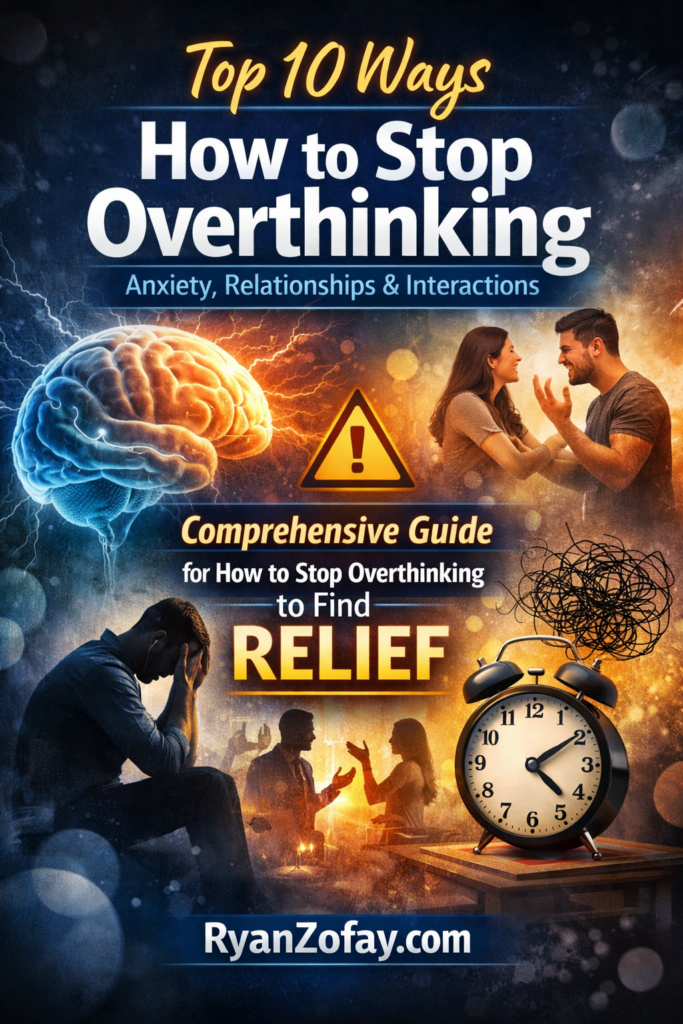
Comprehensive Guide for How to Stop Overthinking to Find RELIEF
I’m blessed to be here to share my story, and I hope that in the process, I can impact and change someone’s life. First off, I’m extremely grateful to be here. There was a time in my life when that was not the case. Feelings like “I don’t know what to do with my life“, wondering “what is my purpose” filled my days. I was trapped in my own head, a prisoner of my own thoughts.
If you are reading this, you probably know that feeling. It’s that 3 AM panic where your brain won’t shut off. It’s replaying a conversation from three years ago. It’s the crippling self-doubt before you send a text message. I know that pain intimately. Before I built a 9-figure rehab organization helping thousands level up their lives, I was pronounced dead at 17. I had multiple felonies derived as a teenage addict. And at the root of my addiction was a mind that wouldn’t stop screaming that I wasn’t enough. I was a victim of childhood trauma.
Overthinking isn’t just a bad habit; it’s a thief. It steals your joy, your presence, and your potential. But I’m here to tell you that you can break the cycle. You can rewire your brain. Today, I will show you the top 10 ways to stop overthinking. So, you can reclaim your peace and step into your potential.
My Story with Overthinking, Anxiety, and Self-Sabotage
How Overthinking Nearly Cost Me Everything
I know overthinking intimately. Not from a textbook. Not from theory alone. Because I lived it.
Before I became a life coach and NLP practitioner, my mind was my worst enemy. I replayed conversations. I obsessed over rejection. I questioned my worth in relationships. I overthought business decisions until opportunities passed me by. At night, my thoughts raced. During the day, anxiety followed me everywhere.
Overthinking almost destroyed my relationships, my confidence, and my future.
My Experience on How to Stop Overthinking in a Relationship, Negative Thoughts, Anxiety, and Interactions
What changed my life was learning how the mind actually works. Neuro-Linguistic Programming, emotional regulation, nervous system science, and radical self-honesty helped me take control of my thoughts. Now, I can lead myself better.
This guide on how to stop overthinking is not a theory. It is a lived experience.
If you are searching for how to stop overthinking anxiety, how to stop overthinking in relationships, how to stop negative overthinking, or how to stop being an overthinker, this guide will give you practical tools you can apply today.
Jump To
Table of Contents
The Cost of Living in Your Head
When we talk about how to stop overthinking everything, we have to look at the cost. Overthinking is often a trauma response. For me, growing up in chaos, I learned to hyper-analyze everything to stay safe. If I could predict every outcome, I thought I could protect myself. But that safety mechanism eventually became my cage.
Overthinking leads to analysis paralysis. It destroys relationships. It fuels anxiety. It keeps you stuck in the past or terrified of the future, robbing you of the only thing you actually have: the present moment. Whether you are wondering how to stop being an overthinker in business or in love, the mechanism is the same. It’s fear dressed up as logic.
Top 10 How to Stop Overthinking Everything Steps for Relief
Let’s get to how to stop overthinking everything. Here are my top strategies to shut down the noise and level up your life.
1. Interrupt the Anxiety Loop with Action
The moment you catch yourself spiraling, you need a pattern interrupt. When people ask me how to stop overthinking anxiety, I tell them: You cannot think your way out of a thinking problem. You have to act your way out.
Anxiety lives in the mind; reality lives in the body. When I feel that familiar tightness in my chest, I don’t sit there and negotiate with it. I move. I take a cold shower. I do breathwork. I hit the gym.
The Science Behind It:
When you are overthinking, your amygdala (the fear center) is hijacked. Physical movement forces your brain to shift resources from fear processing to motor function.
- Tip: Use the 5-Second Rule. If you have an impulse to do something positive, count down 5-4-3-2-1 and move before your brain can talk you out of it.
- Resource: Learn more about shifting your state in my Personal Development Coach guide.
- Guides: Figure out what you are passionate about. Whether you’re making a career change at 40, or looking to start a small business no money down. Follow my guides for insights in how to stop being an overthinker.
Here’ are more ways to “shift your state” or “change your state quickly”:
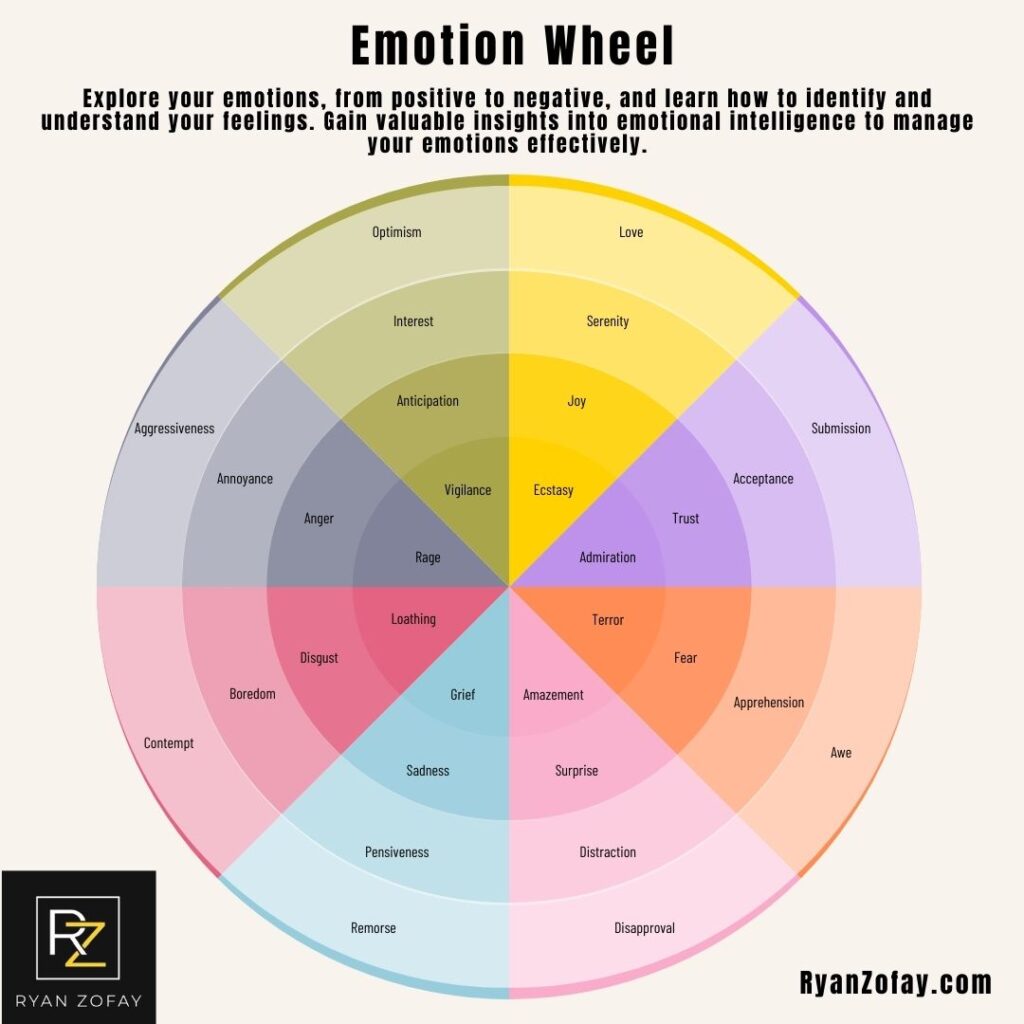
Here’s more on “building momentum”. Turning action into consistent progress:
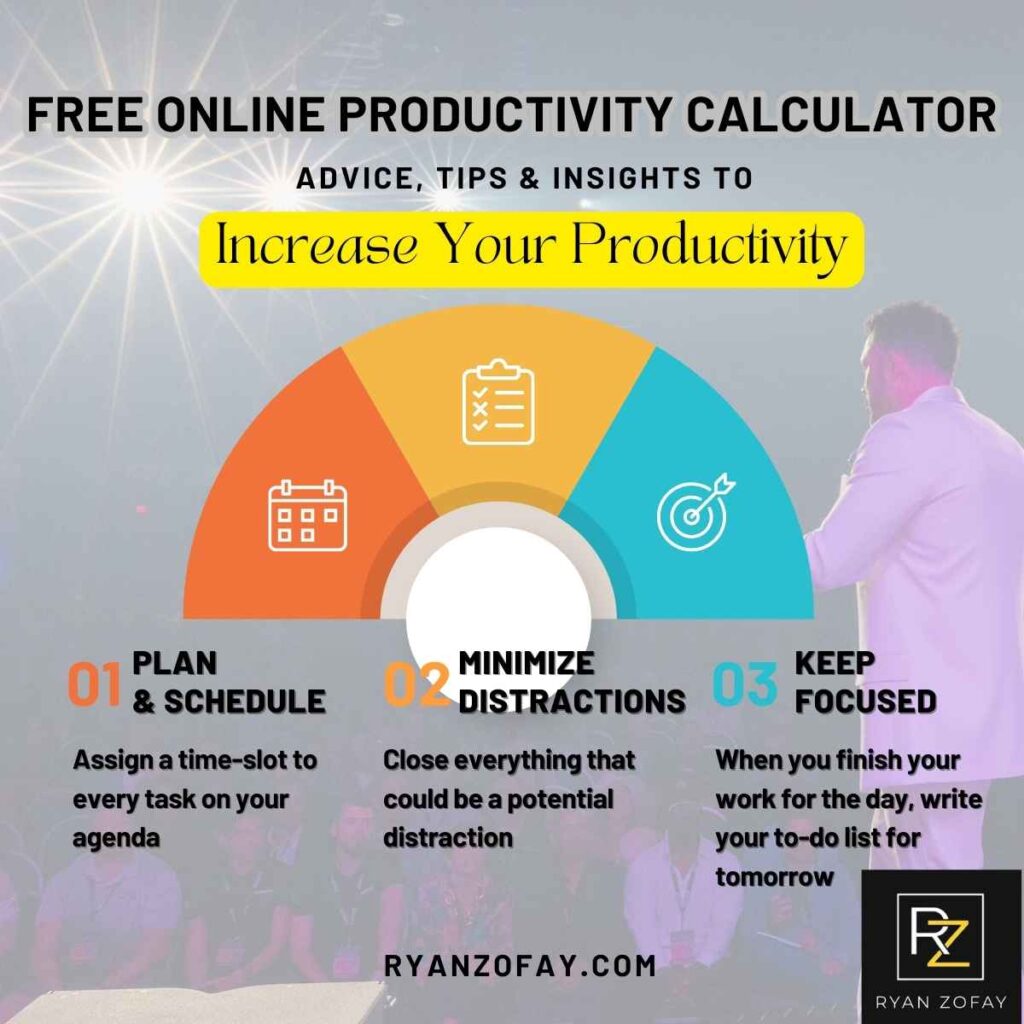
2. Master Your Morning to Conquer the Night
Many people ask how to stop overthinking at night. The truth is that your night is a reflection of your day. If you spend your day reacting to emails, social media, and other people’s demands, your brain is overstimulated. When your head hits the pillow, that’s the first time your brain has had a moment to process, so it dumps everything on you at once.
To fix the night, you fix the morning. I have a strict morning routine checklist that grounds me. Meditation, prayer, and gratitude prime my brain for peace, not chaos.
Activity: Before bed, do a “Brain Dump.” Write down every worry, task, or fear on a piece of paper. Tell your brain, “I have captured this. I don’t need to hold it while I sleep.”
Exercise: Get overthinking relief through self‑care journaling. Transform nightly reflection via a personal development plan.
Adapt a morning routine for clarity and focus. Clear your mind day or night:

3. Rewrite the Narrative in Relationships
How to stop overthinking relationships is one of the most common questions I get. I used to sabotage every relationship I was in because I was waiting for the other shoe to drop. I blamed others for my internal state.
If you always analyze your partner’s tone or how long they take to reply, you are acting from fear. You may worry about losing them. You need to shift from “Do they like me?” to “Do I like myself?”
When you build your own self-esteem, you stop needing constant validation from others to feel safe.
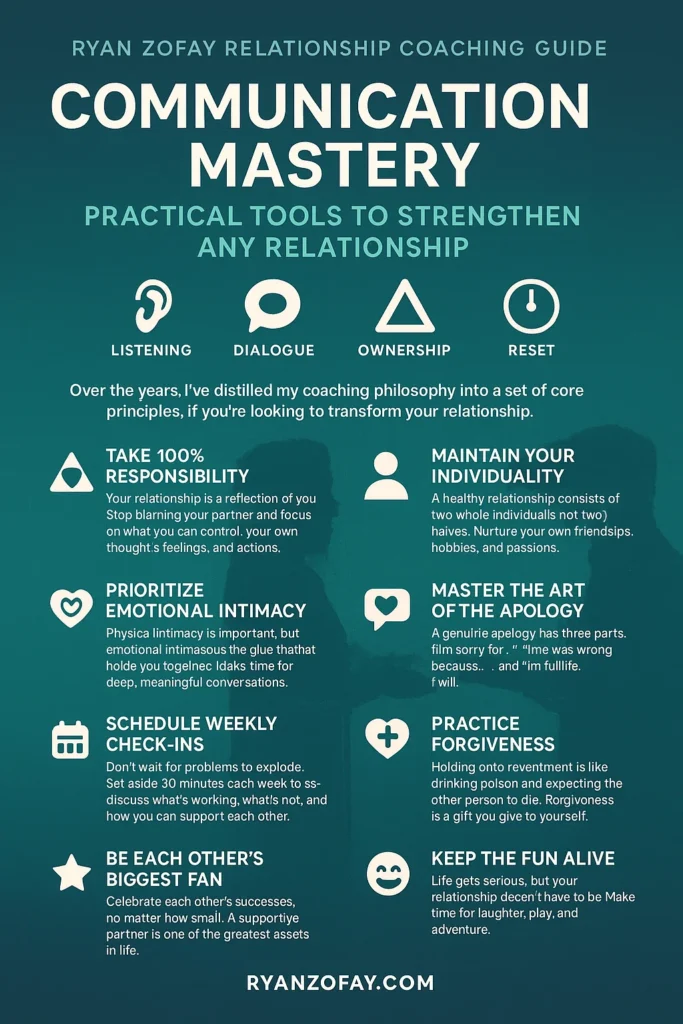
Exercise: Read the relationship coaching guide for more guidance. Take my free relationship quiz to get ideas on how to improve them for lessened negative overthinking.
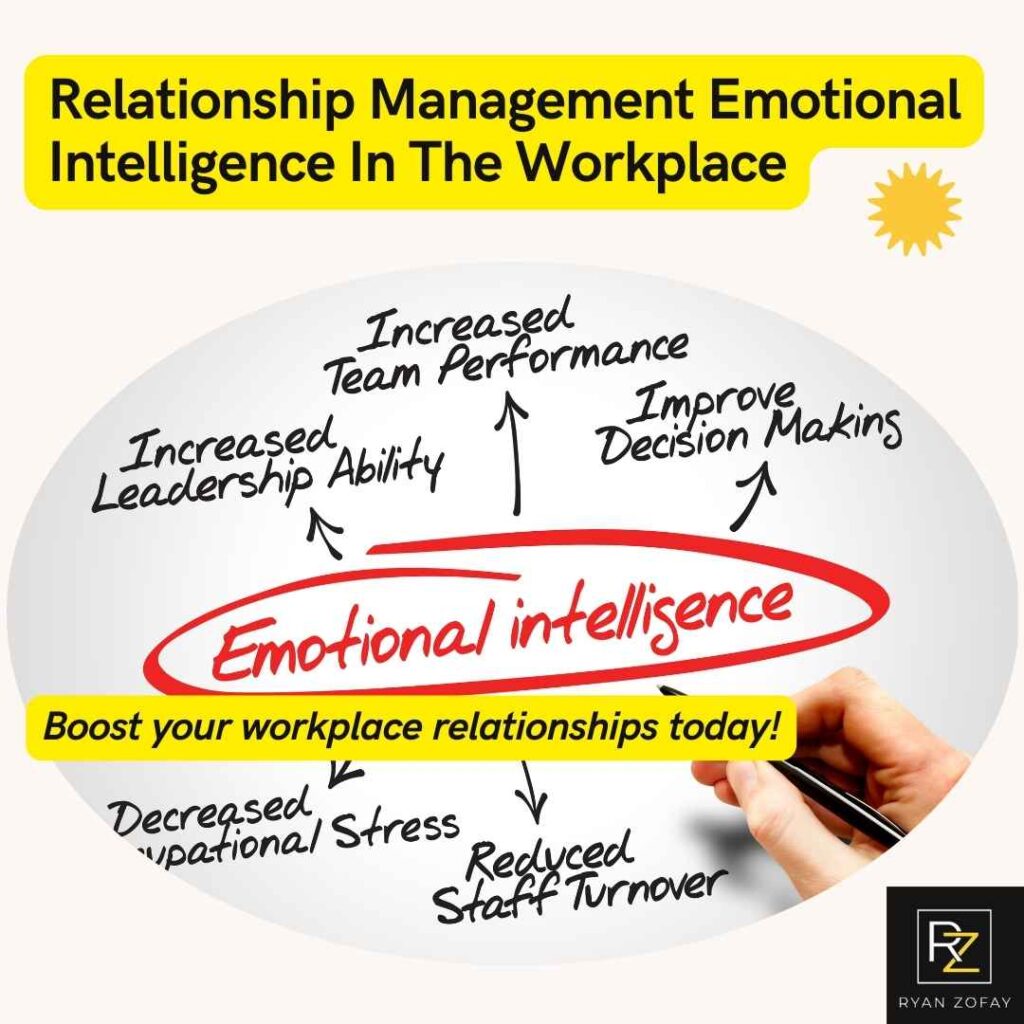
Build “emotional intelligence in relationships”. Shift from ‘Do they like me?’ to ‘Do I like myself?
4. How to stop overthinking in a relationship (without becoming cold
Overthinking in relationships often comes from fear of abandonment or betrayal. It’s not “crazy.” It’s protective. But it can become controlling fast.
The relationship overthinking cycle
- Trigger: late reply, tone shift, social media story, change in intimacy.
- Meaning: “They don’t love me,” “They’re cheating,” “I’m not enough.”
- Behavior: checking, accusing, interrogating, reassurance-seeking.
- Outcome: more distance, more anxiety, more overthinking.
My rule: reassurance is like sugar. It works fast, then crashes you harder.
Exercise: Embrace self-esteem worksheets to empower your growth.
If you’re searching for a great “how to stop overthinking book”, consider my life story. It’s an inspiring tale of how to stop overthinking relationships and so much more.
If you suffer from childhood wounds or inner child symptoms, take the childhood trauma test. When trust is broken, your brain goes into hyper-vigilance.
5. Healing After Betrayal
This is a heavy one. How to stop overthinking after being cheated on requires deep vulnerability. When trust is broken, your brain goes into hyper-vigilance. You become a detective of your own misery, looking for clues that you are going to get hurt again.
You have to accept that you cannot control another person. You can only control your boundaries and your healing. Overthinking the past won’t prevent future pain; it only extends the present pain.
- Insight: Forgiveness isn’t for them; it’s for you. It’s cutting the tether to the pain so you can stop dragging it into your future.
- Resource: Use these gratitude journaling prompts to rebuild your sense of worth.
- Guides: Build your self-confidence. Use my curated self-esteem books list. Follow my guides for insights into how to stop being an overthinker.
Still wondering how to stop anxiety and overthinking? Consider adopting an attitude of gratitude. In the interim apply the Marine Corps improvise, adapt, and overcome framework and you’ll survive whatever comes at you.
6. Stop Future-Tripping (Paranoia vs. Intuition)
There is a fine line between intuition and paranoia. If you want to know how to stop being paranoid and overthinking, you have to look at the evidence. Paranoia is fear-based storytelling without facts. Intuition is a calm knowing.
When I was building my business, I had moments of paranoia that I was going to lose it all. That was my trauma speaking. I had to look at the data. I had to trust the work I had put in.
The Exercise: Ask yourself: “Is this thought a fact, or is it a fear?” If it’s a fear, acknowledge it and let it pass. If it’s a fact, make a plan to address it.
Tip: Build self-discipline and mental resilience via short daily positive affirmations. They’ll help you land in a better place.
Want more ways how to stop overthinking and anxiety? This is about thought quality, fear vs. fact. Uproot “negative deep‑rooted beliefs”. Discover how to connect overthinking about the future on a deeper level. Write a letter to your future self. Arrive at a happy place through your vision quest.

7. Navigating Social Interactions
Social anxiety is a massive trigger. How to stop overthinking social interactions starts with realizing that people aren’t thinking about you. As much as you think they are. They are too busy thinking about themselves!
When I walk into a room to speak, I stop thinking, “How do I look?” and start thinking, “How can I serve?” When you shift your focus from your ego to your contribution, the anxiety dissolves.
- Resource: Improve your confidence with public speaking workshops.
- Activity: Join business networking events. These are useful and practical environments to practice not overthinking socially.
- Tips: Arm yourself with the best persuasive speaking topic to make interactions easy. So you have something to talk about at all times.
Searching for how to stop overthinking in relationships? Build rapport quickly. When you shift your focus from your ego to your contribution, the anxiety dissolves. This adds depth to human connection and social skills.

8. Being Present in Intimacy
It’s uncomfortable to talk about. Many people struggle with how to stop overthinking during sex or intimate moments. This is the ultimate disconnect between mind and body. If you are in your head, you aren’t in the room.
This usually stems from body image issues or performance anxiety. The cure is mindfulness. Focus on sensation. Focus on breath. Ground yourself in the physical reality of the moment rather than the mental movie you are creating.
- Resource: Learn how to master your emotions to stay present. Learn to break out of your shell in the breaking the habit of being yourself guide.
- Extra Support: If you want an identity and growth framework that supports this, start with your own Personal Development Coach.
For how to stop overthinking my relationship consider you can improve body image issues or performance anxiety. Try self improver habits DIY strategies. They really help. Mreover, know that you are 3-part human, mind, body and spirit. Sustain your spiritual growth.
9. Challenge Your “Belief Systems” (BS)
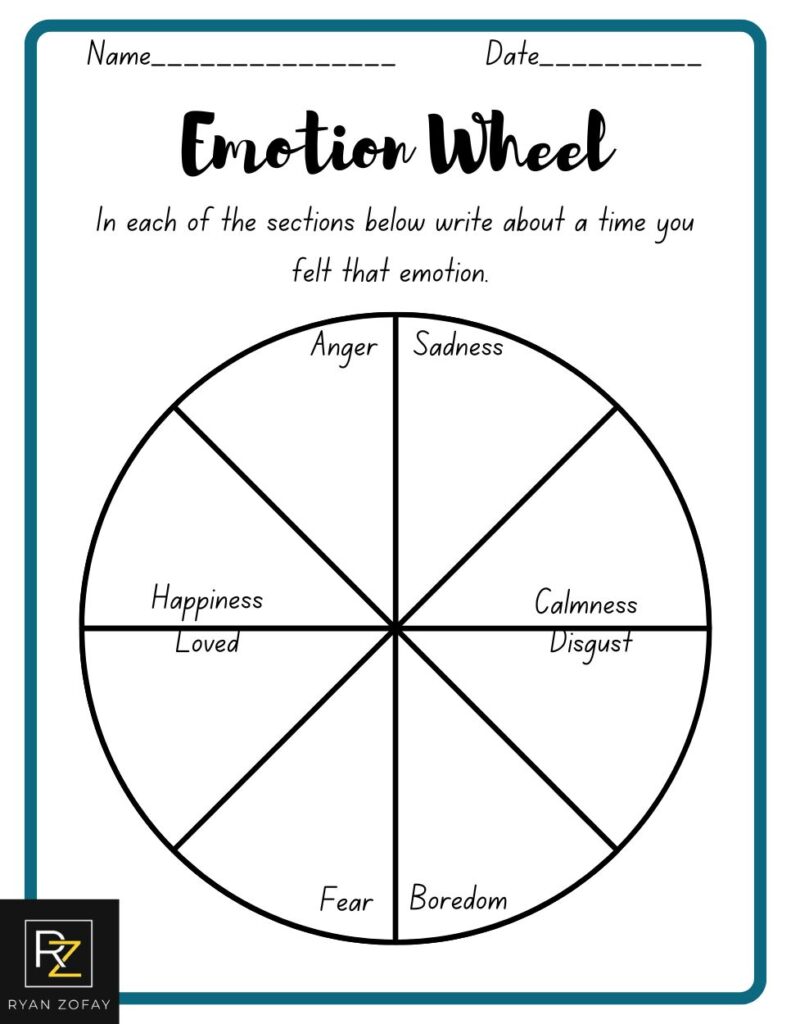
How to stop negative overthinking requires you to audit your beliefs. We all have “BS”—Belief Systems—that hold us back. Thoughts like “I’m not good enough,” “I always mess up,” or “People will hurt me.”
These are limiting beliefs. You have to catch these thoughts and replace them with empowering truths.
Flipping the Script
| Negative Thought (The Lie) | Empowering Truth (The New Belief) |
|---|---|
| “They haven’t texted back; they must hate me.” | “They are busy, and my worth is not tied to a text.” |
| “I’m going to fail at this presentation.” | “I am prepared, I am capable, and I have value to give.” |
| “If I open up, I’ll get hurt.” | “Vulnerability is my strength, and I trust myself to handle the outcome.” |
10. Embrace Uncertainty
The root of how to stop anxiety and overthinking is the desire for certainty. We overthink because we want to guarantee the outcome. But life is uncertain. Business is uncertain. Love is uncertain.
Faith is the antidote to fear. Whether that is faith in God, the Universe, or just faith in your own resilience. You have to trust that no matter what happens, you will be okay.
- Resource: Check out my review on the how to stop overthinking book, Don’t Believe Everything You Think.
We all have limiting beliefs (excellent). But you can further reinforce mindset and build confidence. Remember, you have to trust that no matter what happens, you will be okay. Embrace an abundance mindset vs scarcity to meet uncertainty at anytime.
If you’re ready for more support, consider working with a personal development coach like myself. You can also join one of my live events and mindset seminars. Work through these patterns in a high‑energy, supportive environment.
Download my free time management worksheet if overthinking is wasting your day.
Bonus: Get More Outside Support
Sometimes, you can’t do it alone. If you want advice on how to stop overthinking reddit threads or reading books, information is just the first step. Transformation happens in the community.
I have a coach. I have mentors. I have a support network. If you are struggling with how to stop overthinking about someone you love or how to manage your business stress, reach out.
- Resource: Consider joining a personal development workshop to find your tribe.
Practical Activities to Stop the Spiral
Here are three quick activities you can do right now when the noise gets too loud.

Claim Your Call
Claim your free next level strategy call. Select your date and time. Get guidance and insights. Find answers to your questions. Gain focus, and belief in yourself with No excuses holding you back.

Join the 1%
Seize opportunity. Make the Most of Your Life! Live Without Limitations. Overpower Challenges. Grasp Opportunities to make the Most of Each Moment. Propel & Surpass Others.
1. The 5-4-3-2-1 Grounding Technique
This brings you back to your senses.
- Acknowledge 5 things you see.
- Acknowledge 4 things you can touch.
- Acknowledge 3 things you hear.
- Acknowledge 2 things you can smell.
- Acknowledge 1 thing you can taste.
2. The “Worst Case Scenario” Game
We usually stop at the fear. Push past it. Ask yourself, “What would I do if the worst happened?” You will often find that you can handle even the worst situation. This takes the power away from the fear.
3. Gratitude Journaling
You cannot be fearful and grateful at the same time. It is physiologically impossible.
- Resource: Use these 5-minute gratitude journal prompts.
The Science Behind Overthinking (Why Your Brain Does This)
Overthinking is not weakness.
It is a threat response.
When the nervous system perceives danger, the brain activates the default mode network. This network loops memories, imagined futures, and worst-case scenarios to “protect” you. The problem is that protection becomes paralysis.
From an NLP perspective:
- Thoughts create emotional states
- Emotional states reinforce thoughts
- Repetition hardwires identity
Overthinking anxiety becomes a habit, not a personality trait.

How to Stop Overthinking + Self-Doubt Through Science-based Best Practices
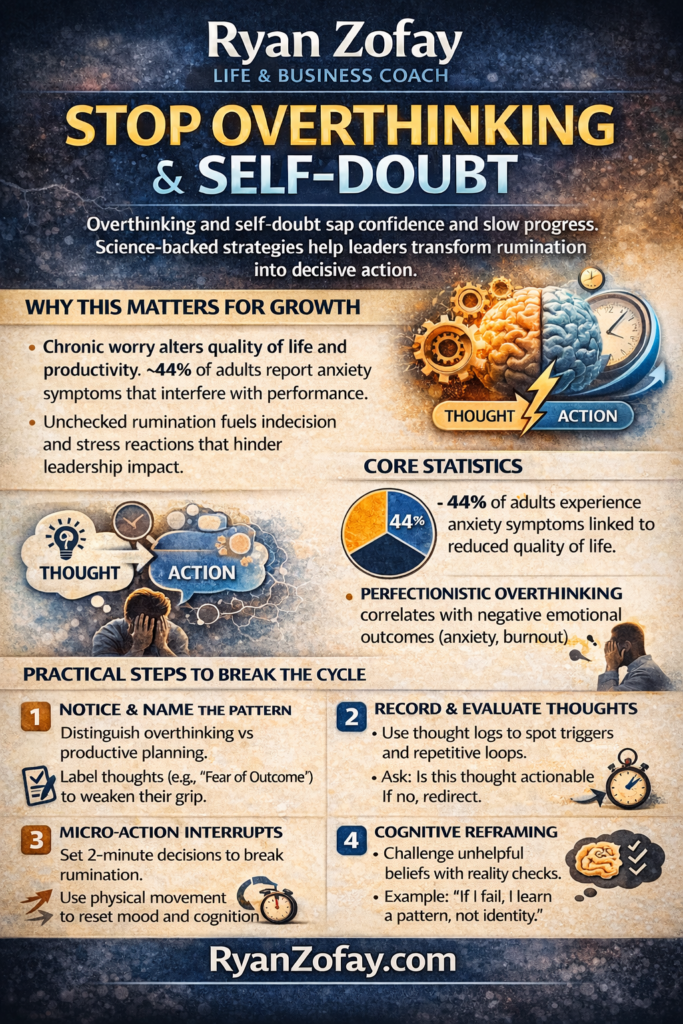
Overthinking and self-doubt sap confidence and slow progress. Science-backed strategies help leaders transform rumination into decisive action.
Overthinking is not a lack of intelligence—it is a misdirected survival response. When left unchecked, repetitive negative thinking drains cognitive bandwidth, delays action, and reinforces self-doubt. Research from psychology, neuroscience, and performance science shows that structured awareness, small actions, and cognitive reframing reliably reduce rumination and restore momentum.
Science-Backed Research + Practical Application
| Science & Research Findings | Insights, Tips, Guides & DIY Exercises |
|---|---|
| Study: Anxiety Disorders & Quality of Life. Source: Journal of Affective Disorders. Key Finding: ~44% of adults report anxiety symptoms that significantly reduce quality of life and productivity. Stat: Anxiety strongly correlates with impaired decision-making and daily functioning. | My Insight: Overthinking is often a signal—not a flaw. Awareness is the first interruption. Tip: Normalize the response, then redirect it. DIY Exercise: Daily “Thought Check” — write the top worry, then list one controllable action. |
| Study: Rumination & Emotional Outcomes. Source: Behavioral Sciences (MDPI). Key Finding: Perfectionistic rumination is linked to anxiety, burnout, and emotional exhaustion. Stat: Higher rumination predicts poorer emotional regulation. | Insight: Perfectionism disguises fear as preparation. Tip: Replace “perfect” with “progress.” DIY Exercise: Set a 2-minute decision rule—decide fast, refine later. |
| Study: Cognitive Load Theory. Source: Educational Psychology Review. Key Finding: Excessive mental processing overloads working memory and reduces decision quality. Stat: High cognitive load impairs problem-solving and action execution. | My Insight: Overthinking is a bandwidth problem, not a motivation problem. Tip: Simplify choices to preserve mental energy. DIY Exercise: Limit daily priorities to three non-negotiable actions. |
| Study: Rumination-Focused CBT & Brain Activity. Source: University of Utah Health / Translational Psychiatry. Key Finding: Targeted interventions reduce rumination and alter neural activity patterns linked to worry. Stat: Measurable changes in brain regions associated with emotional regulation. | My Insight: Thought patterns can be trained like muscles. Tip: Repetition rewires response. DIY Exercise: Cognitive Reframe Journal — write the fear, then a neutral alternative explanation. |
| Study: Behavioral Activation & Anxiety Reduction. Source: Science Direct Clinical Psychology Review. Key Finding: Purposeful, time-bound actions reduce worry and depressive rumination. Stat: Action precedes motivation—not the other way around. | My Insight: Movement breaks mental loops. Tip: Act before confidence appears. DIY Exercise: Physical reset—5 minutes of movement immediately after noticing rumination. |
Overthinking thrives in uncertainty, but it weakens when met with structure, awareness, and action. The science is clear. Naming your thoughts, lowering mental strain, and taking small, careful steps can help your nervous system and boost your confidence. Leaders who master these skills move faster, make better decisions, and build resilience that compounds over time.
Benefits of Stopping Overthinking
| Area | What Changes |
|---|---|
| Relationships | Less jealousy, paranoia, and emotional reactivity |
| Anxiety | Improved sleep, calmer nervous system |
| Confidence | Clear decision-making |
| Sex & Intimacy | Presence replaces performance anxiety |
| Business | Faster execution, less self-doubt |
| Social Interactions | Authentic connection |
Recommended Videos
Here are some resources from my channel to help you dive deeper into mindset and overcoming internal obstacles.


Frequently Asked Questions (FAQs)
How do I stop overthinking in a relationship immediately?
To stop immediately, communicate. Vulnerability is the antidote to shame and fear. Instead of analyzing their behavior, ask for clarity. Focus on building rapport and trust rather than seeking control.
Is there a specific how to stop overthinking book you recommend?
Yes, I highly recommend Don’t Believe Everything You Think by Joseph Nguyen. It offers a radical perspective on the cause of suffering. You can read my full review here.
How to stop overthinking at night when I can’t sleep?
Establish a wind-down routine that doesn’t involve screens. Use a positive thought journal before bed to get the thoughts out of your head and onto paper.
Can overthinking cause physical anxiety symptoms?
Absolutely. The mind-body connection is powerful. Overthinking triggers the stress response (cortisol), leading to rapid heartbeat, sweating, and fatigue. Mindfulness exercises can help regulate this.
How to stop overthinking social interactions after they happen?
Practice self-compassion. Remind yourself that everyone makes mistakes and that people are generally focused on themselves. Refrain from “post-game analysis.” Once the event is over, let it go.
How to stop being paranoid and overthinking about my partner’s loyalty?
If there is no evidence of betrayal, this is likely a projection of your own insecurities or past trauma. Work on your self-esteem and consider therapy or coaching to address the root cause of your trust issues.
What is the best way on how to stop negative overthinking permanently?
Permanence comes from practice. You must consistently challenge your limiting beliefs and replace them with empowering ones. It is a daily discipline, not a one-time fix.
Conclusion: It’s Time to Level Up
Learning how to stop overthinking isn’t about emptying your mind; it’s about taking charge of it. It’s about deciding that your peace is more important than your need to control.
I’ve been in the darkness. I’ve been in the cell—both the physical one and the mental one. I broke out, and so can you. You are not your thoughts. You are the observer of your thoughts.
Start today. Pick one of these strategies. Take one small action. Stop thinking about it, and just be about it.
If you are ready to take this work deeper, explore my coaching center or check out our events.
Let’s get to work.
Resources and Citations
For more tools to help you on your journey, explore these resources on RyanZofay.com:
- Personal Development Coach Guide
- Mindfulness Exercises & Techniques
- How to Master Your Emotions
- Morning Routine Checklist
- Relationship Quiz
- Self-Esteem Worksheets
- The Art of Public Speaking
- Childhood Trauma Test
- Mindset & Limiting Beliefs Guide
- Best Personal Development Books
- Making SMART Goals
- Positive Thought Journal Before Bed
- Daily 5-Minute Gratitude Journal Prompts
- Coaching Center
- Events & Workshops
- Don’t Believe Everything You Think Book Review
- Public Speaking Workshops Near Me
- Building Rapport Guide
- Best Self Esteem Books
- We Level Up Treatment Centers
