
Welcome to your guide to expert time management training for managers, employees, and first-time leaders. Inside, you’ll get proven frameworks, free time management worksheets, and coaching insights from a 9-figure business founder.
By Ryan Zofay. Hi, I’m a neuro-linguistic specialist and leadership coach. I help managers and teams master time management tools with structured, repeatable systems. As a 9-figure business founder, I trained executives, entrepreneurs, and organizations across industries. My coaching helps reduce overwhelm, improve execution, and build high-performance habits that last. I teaches practical frameworks, offer free worksheets, and coaching resources.
Time Management Training That Actually Works: An Expert Guide for Managers & Teams
I help lead a 600+ team, coach countless executives, and train various teams across multiple disciplines. But here’s what nobody tells you about time management training: most of it fails. Because it focuses on tactics, not the real problem—lack of real repeatable systems.
If your managers feel overwhelmed, motivation is not the problem. If your employees miss deadlines, motivation is not the problem. If your teams struggle to prioritize, motivation is not the problem. You have a time management system problem. And that’s exactly what I’m going to help you solve.
Jump To
Table of Contents
The Ryan Zofay Time Management Training System
I didn’t build a nine-figure organization just by working more hours. I built it by installing systems that made every hour count. The Ryan Zofay Time Management Training System is a five-pillar framework. I still use it to run my day. I also use it to train managers. It helps overwhelmed teams regain their time and focus.
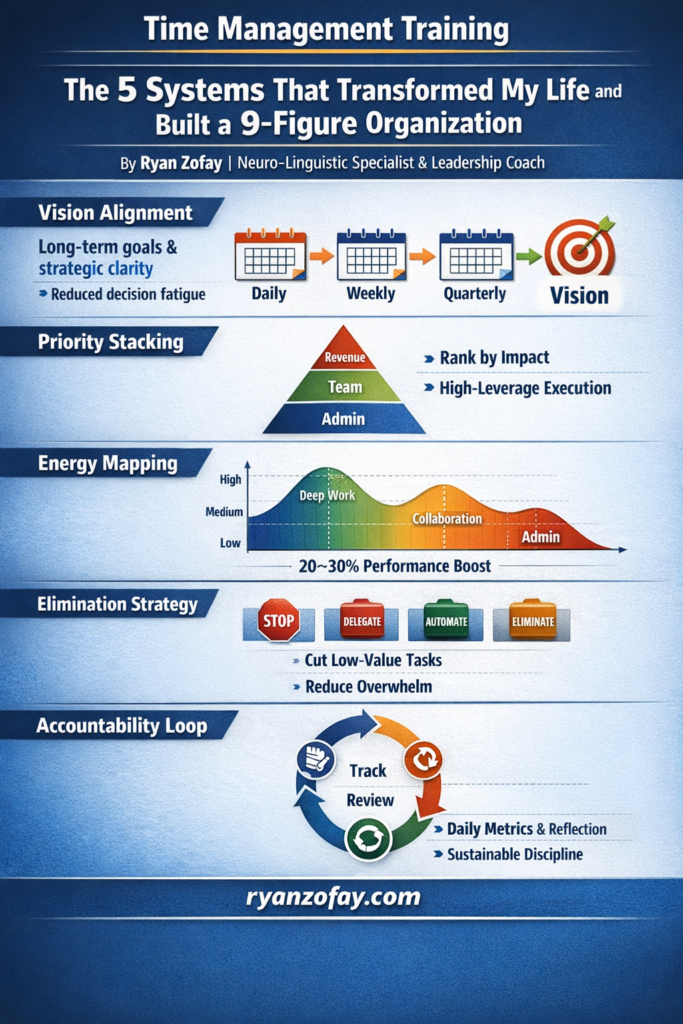
My Professional System for Effective Time Management Training
I teach what I practice. When I rebuilt my life and businesses, I installed 5 core systems:
| Pillar | Description | Outcome |
|---|---|---|
| Vision Alignment | Daily tasks tied to long-term goals | Strategic clarity |
| Priority Stacking | Ranking tasks by revenue & impact | High leverage output |
| Energy Mapping | Scheduling around biological peaks | 30% performance boost |
| Elimination Strategy | Removing low-value tasks | Reduced overwhelm |
| Accountability Loop | Daily performance tracking | Sustainable discipline |
These principles form the foundation of my time management training course and executive coaching programs.
The 5 Training Pillars That Actually Work
When I train managers and teams, we don’t chase hacks—we install my system. That’s why it works for new leaders, seasoned executives, and frontline employees. It’s structured and repeatable. It’s built on the same principles I used. They helped me go from chaos to running a nine-figure business.
Pillar 1
Pillar 1: Vision Alignment
Most managers try to manage tasks; I teach them to manage direction. Every week, we connect daily tasks to quarterly and annual goals so nothing important gets lost in the noise. This turns “I’m busy” into “I’m moving the business forward on purpose.”
On a practical level, that means:
- I define 3–5 annual outcomes that matter most.
- I break them into quarterly targets.
- I map weekly and daily actions that support those targets.
When your daily tasks are tied to a clear vision, you get:
- Strategic clarity (you know why you’re doing what you’re doing)
- Reduced decision fatigue (you stop asking “What should I work on?” all day long)
Think of it like this flow: Daily → Weekly → Quarterly → Vision
If you feel like you’re always working and never arriving, you don’t need more willpower — you need stronger vision-to-task alignment.
Pillar 2
Pillar 2: Priority Stacking
Not all work is equal. Most leaders know this; very few live it. I train leaders to stack their day around three lenses: revenue impact, team impact, and strategic leverage. When you schedule around these, your calendar shifts from low-value admin work to high-impact execution that moves KPIs.
I rank tasks by:
- Revenue impact – Does this drive growth, sales, or capacity to generate revenue?
- Team impact – Does this unlock my team, remove a bottleneck, or accelerate their results?
- Strategic leverage – Does this build systems, assets, or relationships that keep paying off?
When you plan your day with these three lenses, you focus on work that matters most.You spend less time on reactive busywork. You can visualize it like a pyramid:
- Top: Revenue
- Middle: Team
- Base: Admin
If you’re spending most of your energy at the base (admin), you’ll feel exhausted but strangely unfulfilled. The higher you live on that pyramid, the more your time becomes an investment instead of an expense.
Priority stacking is how I make sure my best time is invested in what actually moves the needle, not what just screams the loudest.
Pillar 3
Pillar 3: Energy Mapping
Time management fails when you ignore energy. I help managers and employees match peak focus hours to deep work. I help them use mid-energy hours for collaboration. I help them save low-energy hours for admin work. This simple shift often creates 20–30% performance gains without adding a single extra hour.
I stopped asking, “How many hours do I have?” and started asking, “What kind of energy do I have and where does it belong?”
Here’s how I map my day:
- Peak cognitive hours → Deep work (strategy, vision, problem-solving, creation)
- Mid-energy hours → Collaboration (meetings, coaching, team syncs)
- Low energy → Admin (email cleanup, approvals, light tasks)
When you match your work to your energy level, you can boost performance by 20–30% without working more hours. That’s how you get more done as a 9-figure founder, manager, or executive without sprinting toward burnout.
If your calendar constantly forces you to do deep, strategic work during your lowest energy window, your results will always feel harder than they need to be.
Pillar 4
Pillar 4: Elimination Strategy
Before we optimize, we eliminate. Together, we cut low-value meetings, reactive email loops, and non-essential commitments with a simple filter. Stop, delegate, automate, or eliminate. The result is less overwhelm and more mental space for real work.
I run every recurring commitment through four filters:
- Stop – Does this need to exist at all?
- Delegate – Is someone else better suited to own this?
- Automate – Can a system or tool handle this reliably?
- Eliminate – What happens if this never gets done?
Practically, this means aggressively removing:
- Low-value meetings that exist out of habit, not necessity
- Reactive email cycles that keep you stuck in other people’s priorities
- Non-essential commitments that don’t support your core outcomes
The result is reduced overwhelm and reclaimed mental bandwidth. You stop feeling like “there’s never enough time” because you’ve stopped giving time to the wrong things.
Remember, you can’t “optimize” a calendar that’s already packed with the wrong things.
One of the most powerful time management decisions I ever made was not what to do better, but what to stop doing completely.
Pillar 5
Pillar 5: Accountability Loop
Systems only stick if you can see whether they’re working. I have teams track three things: deep work hours, completion of daily priorities, and a short weekly reflection. This feedback loop builds discipline, exposes time leaks, and makes improvement continuous instead of one‑and‑done.
Here’s what I track consistently:
- Deep work hours completed (not just total hours worked)
- Completion of my top 3 priorities for the day
- Weekly reflection on what worked, what didn’t, and what needs to change
I treat this like a feedback loop, not a judgment session. The goal is not perfection; it’s adjustment. Over time, this loop creates sustainable discipline because you’re constantly learning from your week instead of repeating it.
When you run this loop consistently, you:
- Catch time leaks early
- Course-correct faster
- Turn time management from a struggle into a habit
Remember, discipline isn’t a personality trait I was born with. It’s a system I built.
The Accountability Loop is how I make sure the first four pillars don’t stay theory.
If you apply these five pillars consistently, your calendar stops being a source of stress and becomes a strategic tool. That’s how you protect your energy, multiply your impact, and build something that lasts.
Explore deeper here:
My Journey: From Chaos to Clarity
How I Mastered My Time, Rebuilt My Life, and Now Teach Leaders to Do the Same
Time management training didn’t just improve my productivity — it saved my life. Before I became a business and life coach, I was overwhelmed, reactive, and constantly chasing the next crisis. I built and lost businesses. I battled addiction. I felt like time controlled me.
Everything changed when I realized this truth:
If you don’t control your time, your time will control you.
There was a time when I couldn’t manage five minutes, let alone a full day. I was homeless, battling addiction, and incarcerated—about as far from “productive” as you can get. But I learned something critical during my transformation: time management isn’t about doing more. It’s about doing what matters with structure.
My journey form Kaos to Clarity
Today, I lead time management training programs that have transformed organizations. I teach time management training for managers, employees, executives, entrepreneurs, and new leaders. I use real-world systems I’ve used in my own life and businesses. Not because I teach some secret technique, but because I focus on building sustainable systems. The same frameworks helped me go from rock bottom to building We Level Up, a multi-million dollar mental health hospital. Now, they help managers and employees take back their days.
This guide is comprehensive. It includes:
- My personal framework for effective time management training
- Structured programs for managers and employees
- A table of skill competencies
- Workshops, online training models, and free resources
- Industry-specific training (sales + customer service)
- Activities and implementation exercises
- 20+ curated RyanZofay.com resources
- YouTube videos to integrate into your learning journey
Let’s dive in.
Why Traditional Time Management Training Fails
After decades of coaching high-stakes entrepreneurs and corporate leaders, I’ve seen the same patterns repeatedly. Organizations invest in time management training courses, send their teams to workshops, and nothing changes. Why?
Because most time management training for employees treats symptoms, not root causes. Your team doesn’t need another productivity hack. They need frameworks that work with their brain, not against it.
The data backs this up: Poor time management links to 60% of work hours spent on interruptions and context-switching. That’s not a discipline problem. That’s a structural problem that requires systematic solutions.

The Time Management Training Framework That Works


Training for First Time Managers: The Leadership Transition
First time manager training should start with a fundamental truth: managing your time is different from managing others’ time.
When you move into management, your productivity metric changes. You’re no longer measured by tasks completed but by how well you enable your team to execute. This requires a completely different approach to time management and organizational skills training.
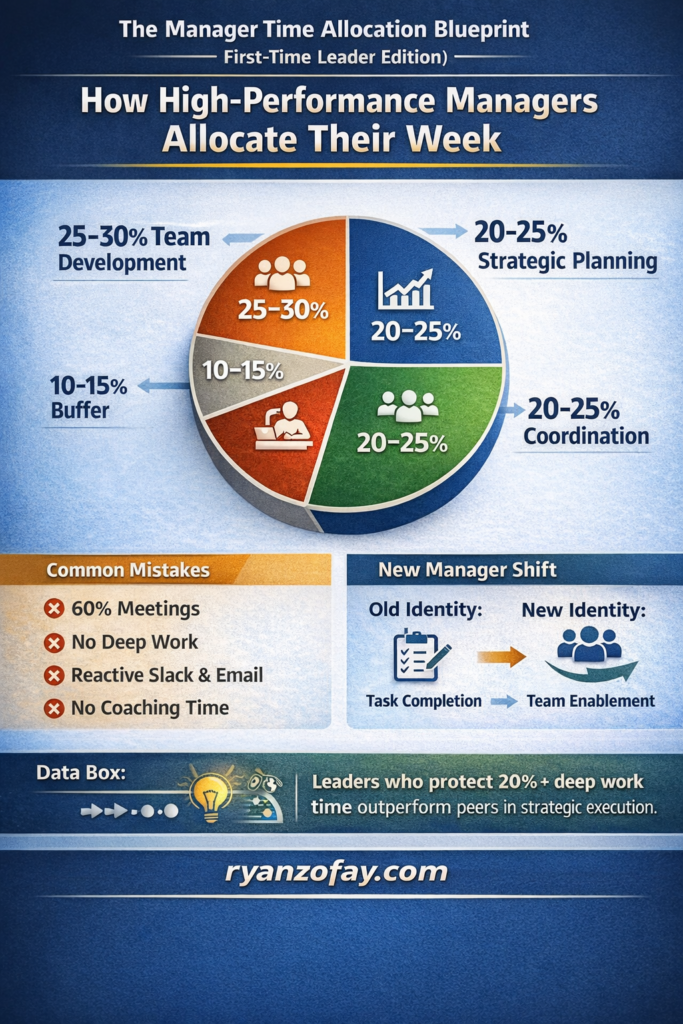
The First-Time Manager Time Blueprint . This is How High-Performance Managers Allocate Their Week:
| Priority Area | Time Allocation | Key Activities |
|---|---|---|
| Deep Work (Strategic Planning) | 20-25% | OKRs, quarterly planning, strategic initiatives |
| Team Development | 25-30% | 1-on-1s, coaching sessions, feedback meetings |
| Coordination & Communication | 20-25% | Team meetings, cross-functional alignment |
| Individual Contribution | 15-20% | High-impact tasks only you can do |
| Buffer Time | 10-15% | Unexpected issues, reflection, learning |
Action Step for New Managers: Block your calendar based on these percentages for one week. Track where your time actually goes using time management worksheets. The gap between intention and reality will reveal your first optimization opportunity.
Avoid these common mistakes:
❌ 60% Meetings
❌ No Deep Work
❌ Reactive Slack & Email
❌ No Coaching Time
Adapt a “New Manager Shift”
Old Identity: Doer
New Identity: Multiplier
Your visual: Task Completion → Team Enablement
“Leaders who protect 20%+ deep work time outperform peers in strategic execution.” Based on our work at the We Level Up organization.
Core System for Effective Time Management Training for Managers
Managers struggle because they move from “doing” to “leading.”
Effective time management training for managers must center on three pillars:
1. Capture & Prioritization
Most managers drown in open loops—unfinished tasks floating in their heads, creating constant mental drag. The solution? External capture systems.
- Tool: Use Todoist to capture everything—every task, idea, and commitment
- Categories: Today, This Week, Waiting/Follow-Up
- Daily practice: 5-minute brain dump each morning
2. Strategic Time Blocking
Time blocking isn’t just scheduling—it’s protecting your team’s most valuable resource. Here’s how I teach managers to structure their days:
Deep Work Blocks (90 minutes)
- One high-value task
- No meetings, no messages
- Morning hours preferred
Admin Blocks (60 minutes)
- Email, follow-ups, small tasks
- Batch similar work
- Afternoon energy dip
Team Time (Clustered)
- Back-to-back meetings
- Specific days or windows
- Predictable availability
Buffer Time (30 minutes)
- White space for the unexpected
- Between major blocks
- Non-negotiable recovery time
3. Data-Driven Adjustment
This is where most time management training courses fail—they don’t build in measurement and adjustment. I require managers to track their time for 7 days using just three categories: Deep Work, Meetings, Admin.
When I coach leaders, I focus on managers time management skills training. Including:
- Delegation mastery
- Meeting compression techniques
- KPI-based calendar blocking
- Decision batching
- Strategic thinking time
First Time Manager Training Focus
New leaders require structured support. My first time manager training program includes:
- 30-60-90 day leadership roadmap
- Delegation scripts
- Time-block templates
- Emotional regulation training
- Conflict management timing
First Time Manager Training Program: Building Leadership Capacity
My first time manager training program focuses on servant leadership principles combined with tactical time management. New managers must learn to:
Balance Individual Contribution with Team Development
- Protect 25-30% of time for coaching and development
- Schedule recurring 1-on-1s (non-negotiable)
- Use meetings to develop others, not just share information
Delegate Effectively
- Time spent training others now = time saved forever
- Apply the 70% rule: If someone can do it 70% as well as you, delegate it
- Track delegation wins in a personal reflection worksheet
Create Predictability
- Consistent availability hours
- Regular team rhythms (weekly syncs, monthly reviews)
- Transparent calendar = reduced interruptions
The insights are always shocking. Leaders who believe they spend 50% of their time on strategy discover they’re getting 2-3 hours of actual deep work per week. That data creates change faster than any motivational speech.
Time Management Skills Training for Employees
Time management training for employees requires different tools because their constraints differ. They typically have less control over their schedules but more focused execution requirements.
The Employee Productivity System:
Step 1: Morning Prioritization (5 minutes)
- Identify your Top 3 priorities
- One critical task that moves the needle
- Two supporting tasks
- Everything else is optional
Step 2: Energy Management
- Schedule hardest work during peak energy (usually morning)
- Batch low-energy tasks (email, admin) during afternoon slump
- Take actual breaks—productivity increases with recovery
Step 3: Communication Boundaries
- Set specific times for checking messages
- Use “Do Not Disturb” during focus blocks
- Communicate your availability to teammates
My time management training for employees teaches:
- Daily prioritization framework
- Inbox zero method
- 2-minute execution rule
- Task segmentation
- Focus sprint cycles (90-minute power blocks)

Employee Time Management Skills Matrix
| Skill | Beginner | Intermediate | Advanced |
|---|---|---|---|
| Task Prioritization | To-do lists | Eisenhower Matrix | Revenue Impact Index |
| Focus | 30 min blocks | 60 min blocks | 90 min deep work |
| Planning | Daily planning | Weekly planning | Quarterly strategic mapping |
Real-World Application: One of my clients, a customer service team, implemented these principles. We created the best ways to train customer service representatives on time management by giving 90-minute morning blocks. They used this time for complex cases before opening chat support. Response quality improved 40% while stress decreased significantly.
Time Management Training for Sales Professionals
Sales teams face unique time management challenges. Priorities often change fast. Client needs can be hard to predict. Many feel pressure to be “always on.”
The Sales Time Framework:
- Prospecting Blocks: Daily 60-90 minute focused outreach (no interruptions)
- Client Time: Clustered calls and meetings (preserve momentum)
- Admin Time: End-of-day batch processing (CRM updates, follow-ups)
- Learning Time: Weekly skill development and market research
Sales-Specific Tools:
- Use TickTick for habit tracking (daily prospecting consistency)
- Implement the Eisenhower Matrix to separate urgent client requests from high-value business development
- Track time with Clockify to identify time leaks

Sales professionals confuse activity with productivity.
My training emphasizes:
- Revenue-first scheduling
- Power-hour outbound structure
- CRM batching
- Objection-handling time control
- Follow-up sequencing system

Daily Sales Time Framework
| Time Block | Activity |
|---|---|
| 8:00–9:00 | Outbound Calls |
| 9:00–10:00 | Follow-ups |
| 10:00–12:00 | Appointments |
| 1:00–2:00 | Prospecting |
| 3:00–4:00 | CRM & Admin |
Next level performance resource: Guide to Achieving Next Level Performance results.
Online Time Management Training: Making It Stick Virtually
Online time management training requires different engagement strategies. Here’s what works:
Structure for Virtual Success:
- Pre-Work: Participants complete a time tracking worksheet for one week
- Live Session: 90-minute workshop covering frameworks (not lecture-heavy)
- Practice Period: 7-day implementation challenge with daily check-ins
- Follow-Up: Group review session to troubleshoot and refine
Digital Workplace Training for Time Management Skills:
- Teach tool-specific workflows (Google Calendar + Todoist + Slack integrations)
- Create team norms around communication (asynchronous by default)
- Implement time blocking templates shared across teams
Free Time Management Training Resources
I believe effective time management training shouldn’t require a massive budget. Here are resources I provide:
Free Tools:
- Time Management Worksheets – 10+ printable templates.
- Productivity Calculator – Measure your time ROI.
- Morning Routine Checklist – Start your day with intention.
Online Time Management Training vs Workshop Model
I offer both formats.
Online time management training is best for:
- Distributed teams
- Digital workplace environments
- Self-paced learners
Includes:
- Video modules
- Templates
- KPI trackers
- Performance assessments
Whereas a Time Management Training Workshop is best for:
- Corporate retreats
- Sales teams
- Manager onboarding
Includes:
- Live exercises
- Role play
- Calendar audits
- Behavioral restructuring
Explore workshops:
The 7-Day Time Management Training Challenge
Want to test these frameworks? Try my proven 7-day challenge:
Day 1: Capture & Assess
- Set up Todoist with three categories
- Complete brain dump of all tasks
- Track your time in three categories: Deep Work, Meetings, Admin
Day 2: Prioritize & Plan
- Choose 1-3 priorities for the week
- Time block them in Google Calendar
- Protect your first deep work block
Day 3-6: Execute & Refine
- Follow your time blocks (adjust as needed)
- Continue tracking actual time spent
- Take notes on friction points
Day 7: Review & Optimize
- Analyze your time data
- Identify one improvement for next week
- Celebrate wins (even small ones)
Time Management Training Workshop Activities
When I run live workshops, these activities create breakthrough moments:
Activity 1: The Priority Audit (15 minutes)
Instructions:
- List everything on your plate right now
- Sort using the Eisenhower Matrix (Urgent/Important quadrants)
- Identify what you should: Stop doing, Delegate, Schedule, Do now
Debrief: Most participants discover 30-40% of their workload sits in “Not Urgent/Not Important.” That’s where time management training creates immediate ROI.
Activity 2: The Calendar Reality Check (20 minutes)
Instructions:
- Review last week’s calendar
- Color-code by type: Deep Work (green), Meetings (yellow), Reactive/Admin (red)
- Calculate percentages for each category
Insight: The gap between what you think you do and what you actually do is usually massive. This visual makes it undeniable.
Activity 3: The Energy Mapping Exercise (15 minutes)
Instructions:
- Map your energy levels hour by hour for a typical day
- Overlay your current schedule
- Identify mismatches (hard work during low energy, easy work during peak energy)
Action: Redesign your schedule to align work intensity with energy levels. This single change often yields 20-30% productivity gains.
Advanced Time Management and Organizational Skills Training
For teams ready to level up, integrate organizational skills training with time management:
Organizational Excellence Framework:
- Information Management: Build a central source of truth (Notion for documentation, processes, SOPs)
- Communication Protocols: Define when to use email vs. chat vs. meetings
- Project Management: Implement Asana or Trello with clear ownership and deadlines
- Knowledge Sharing: Create systems for capturing and sharing institutional knowledge
Team Training Components:
- Shared language around priorities and urgency
- Consistent frameworks everyone uses (same tools, same methods)
- Accountability structures with weekly reviews
- Continuous improvement mindset built into workflows
My Time Management Coaching Philosophy
My approach to business coaching is grounded in lived experience. I went from homeless and hopeless to building an organization that transforms lives. That journey taught me:
Systems beat willpower, every single time.
You can’t motivate your way to better time management. You need frameworks that reduce friction and make the right choices automatic.
Mindset shapes everything.
The best time management training won’t help if your team believes, “I’m just bad with time.” It also won’t help if they think, “I work better under pressure.” We address limiting beliefs before tactics.
Continuous improvement is non-negotiable.
Time management isn’t something you master once. It’s a practice you refine constantly based on data, feedback, and changing circumstances. Build continuous improvement into your culture.
Measuring Time Management Training Success
Don’t just train—measure impact. Track these metrics:
Individual Level:
- Deep work hours per week
- Priority completion rate
- Self-reported stress levels
- Energy/engagement scores
Team Level:
- Project delivery timeliness
- Meeting efficiency (time spent vs. value created)
- Response time to critical requests
- Cross-functional collaboration quality
Organizational Level:
- Revenue per employee
- Customer satisfaction scores
- Employee retention rates
- Innovation output (new initiatives launched)
Common Time Management Training Mistakes to Avoid
After years of leadership training, I’ve seen these mistakes repeatedly:
Mistake 1: Too Many Tools, Too Fast
Start with the Simple Stack: Google Calendar + Todoist + Clockify. Master these before adding complexity.
Mistake 2: One-and-Done Training
Time management training workshops without follow-up fail. Build in 30-day and 90-day check-ins.
Mistake 3: Ignoring Cultural Factors
If your culture rewards “always on” behavior, no training will stick. Leadership must model boundaries.
Mistake 4: Generic Solutions
Sales professionals need different frameworks than customer service reps. Customize training for roles.
Mistake 5: Focusing Only on Individuals
Time management is a team sport. Train groups together and create shared systems.
Taking Action: Your Next Steps
Time management training works when you commit to systematic implementation. Here’s how to start:
For Individual Contributors:
- Download the time management worksheet
- Track your time for one week
- Implement the Morning Prioritization practice
- Join my upcoming training events for group support
For Managers:
- Run the 7-Day Challenge with your team
- Schedule weekly time management check-ins
- Model the behavior you want to see (protect your deep work time)
- Review my Success Ed program for comprehensive leadership development
For Organizations:
- Conduct a time audit across departments
- Identify high-impact training opportunities
- Implement shared tools and frameworks
- Measure progress with quarterly reviews
The Bottom Line on Time Management Training
Here’s what I’ve learned after transforming my own life and coaching thousands of others: Time management isn’t about time. It’s about choice, clarity, and consistency.
You already have 24 hours. The question is: are you investing them in what matters most?
Effective time management training for managers, employees, and teams gives you frameworks to answer that question daily with confidence. It’s not sexy. It’s not a hack. It’s disciplined systems that compound over time.
And if I can go from living in my car to leading a nine-figure organization, you can too.
Ready to transform how your organization manages time? Start with one framework, track your results, and build from there. The compound effect of better time management will shock you.

Additional Time Management Resources
Free Tools & Worksheets:
Mindset & Leadership Development:
- Mindset Coaching Strategies
- Personal Development Guide
- Leadership Training
- Building Emotional Intelligence
Success Programs:
