From Self-Sabotage to Self-Mastery: Top 10 Ways to Overcome Your Inner Limits
As a former self sabotaging pro, I’m extremely grateful to be here with you today. If you know my story, you know I wasn’t always the man I am today. I am now an author, entrepreneur, and founder of a successful business. When I finally let go of destructive self sabotaging behavior I found We Level Up’s Mental Health Treatment Centers. Now a 9-figure organization.
There was a time when I felt the world owed me. I was homeless, struggling with addiction, and trapped in a cycle of self-sabotage and pain. I went from overdosed to multimillionaire, but that journey wasn’t a straight line. It was a battle against the one person who stood in my way: myself.
We often look for external enemies, but the truth is, self-sabotage is the biggest barrier to our success. It’s that voice that whispers, “You aren’t ready,” or “You don’t deserve this,” right when you’re about to level up.
In this guide on changing self-sabotaging behaviors to self-mastery, I will explain what self-sabotage is. We’ll examine the reasons why we self-sabotage. Then I’ll walk you through the top 10 ways to break these patterns. So, join me as we dive into how to stop self sabotaging to achieve the self-mastery you deserve.
Jump To
Table of Contents
What is Self Sabotaging?
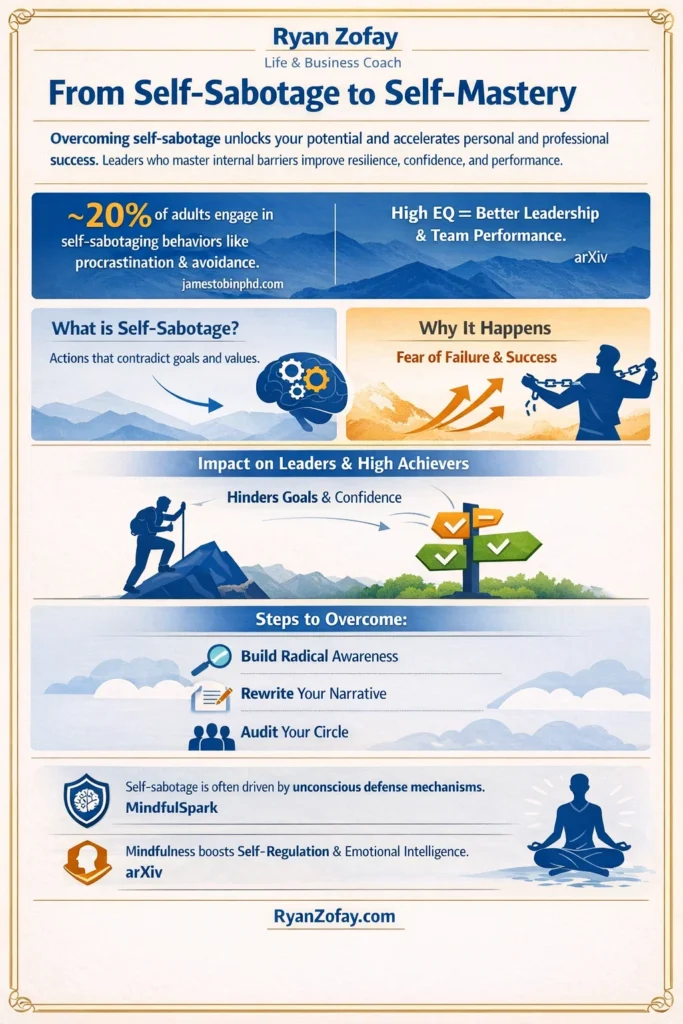
Before we can fix it, we have to define it. The self sabotaging meaning is when your conscious mind wants something like success, love, or health. However, your subconscious mind pushes you to do the opposite.
Whereas, the self sabotage definition in psychology is similar to “self-handicapping.” This is when a person makes things harder for themselves. You’re probably wondering, why do people self sabotage? They do this so they can blame the obstacles for their future failures instead of their own abilities. It’s a protection mechanism gone wrong.
We see self sabotaging behavior in many forms, like procrastination, perfectionism, negative self-talk, and avoiding risks. But what does self sabotaging mean for your life? It means staying stuck in the status quo. It means settling for good enough when you were built for greatness.
Why Do People Self Sabotage?
You might ask, “Ryan, why do I self sabotage if I want to be successful?”
It usually comes down to fear. Not just fear of failure, but fear of success. Success brings change, responsibility, and visibility. If your mind believes that “safety means being invisible,” you will unknowingly hurt your chances of being noticed. This is a topic I cover extensively in my personal development workshops because it is the root of stagnation.
Identifying the Signs: Are You Standing in Your Own Way?
Self sabotaging behaviors can be subtle. You might think you’re just “being realistic” or “waiting for the right time,” but you’re actually holding yourself back.
Here is a look at the difference between a Growth Mindset and a Self Sabotage Mindset:
| Area of Life | Growth Mindset | Self Sabotage Behavior |
|---|---|---|
| Career | I will ask for the promotion because I earned it. | I won’t apply; I’m probably not qualified enough anyway. |
| Relationships | I will communicate my needs clearly. | I’ll pick a fight or withdraw because self sabotaging relationships feel safer than vulnerability. |
| Health | I nurture my body to fuel my success. | I’ll skip the gym today; I’m too tired (repeatedly). |
| Goals | I embrace failure as data for improvement. | I won’t start until it can be perfect (Perfectionism). |
If you recognize these patterns, don’t judge yourself. Awareness is the first step to change. I discuss this pattern of subconscious limiting beliefs in my article on how your subconscious is preventing you.
Top 10 Ways for How to Stop Self Sabotaging
If you are asking, “how do I stop self sabotaging?”—you are ready for transformation. Here are the 10 strategies that helped me rebuild my life and business.

1. Cultivate Radical Awareness (The Pause)
You cannot change what you do not acknowledge. Self-sabotaging happens on autopilot. You need to interrupt the pattern. When you feel the urge to procrastinate or lash out, pause. Ask yourself: Is this action serving my highest self, or is it feeding my fear?
Practicing mindfulness exercises is crucial here. Breathwork allows you to step out of the reactive mind and into the responsive mind.
2. Rewrite Your Narrative
I used to tell myself I was broken. That narrative kept me in addiction. Today, I tell myself I am a leader who serves others. Self sabotage quotes often say, “You are your own worst enemy,” but you can also be your own best advocate.
You must challenge the inner critic. If you struggle with self-doubt, you need to actively replace those thoughts with evidence of your capability. Check out my guide on overcoming self-doubt to start rewriting your script.
3. Audit Your Circle
They say you are the average of the five people you spend the most time with. If your circle is full of people who settle, you will settle. Self sabotaging in relationships often looks like staying loyal to people who anchor you to your past self.
To reach the next level, you need to be around people who challenge you to grow. This is why I created my events and seminars—to build a community of high achievers who refuse to let each other fail.
4. Heal Your Relationships
What is self-sabotaging relationships? It’s pushing love away because you don’t believe you deserve it. It’s starting conflicts when things are going too well. Self sabotaging relationship patterns stem from deep-seated insecurities.
To stop this, you must learn to communicate effectively and be vulnerable. My relationship coaching focuses on breaking these barriers so you can build deep, authentic connections.
5. Hire an Accountability Coach
Willpower is a muscle, and sometimes it gets tired. That is why do people self sabotage—they run out of steam. Having a coach changes the game.
When I started my journey, I didn’t do it alone. I had mentors. An accountability coach sees your blind spots. They call you out when you are hiding and lift you up when you are falling.
6. Build a Routine That Protects Your Energy
Chaos breeds sabotage. Structure breeds freedom. If you don’t have a routine, you are reactive to the world.
I am a huge believer in routine habit building. Wake up, meditate, exercise, prioritize your tasks. When you win the morning, you win the day.
7. Embrace Imperfect Action
Perfectionism is just procrastination in a fancy suit. It is a major self sabotage meaning. We think, “If I can’t do it perfectly, I won’t do it at all.”
Take messy action. Launch the business. Write the book. Speak up in the meeting. If you are looking to build a business but fear is stopping you, look at my 9-figure business blueprint. Success favors speed and action, not perfection.
8. Master Your Communication
Often, we sabotage our professional success because we are afraid to use our voice. We stay quiet in meetings or downplay our achievements. This is a form of self-handicapping.
Learning to speak with confidence is transformative. Whether it’s one-on-one or on a stage, your voice is your power. If this is a struggle for you, explore public speaking classes near me to find your voice.
9. Invest in Personal Development
The moment you stop learning is the moment you start dying. How to stop self sabotage permanently? Fall in love with growth.
Read books. Attend workshops. Listen to podcasts. I curate the best resources in personal development because I know that your business/career will only grow as fast as you do.
10. Forgive Yourself
This is the hardest one. You will mess up. You will slide back into old habits. That is part of being human. Self sabotaging behaviors thrive on shame. If you beat yourself up for slipping, you create a cycle of shame that leads to more sabotage.
Forgive yourself quickly and get back on track.
Practical Activity: The Trigger Journal
To truly understand what is self sabotage in your personal life, try this activity for 7 days.
Every time you feel the urge to procrastinate, eat poorly, or snap at a partner, write it down.
- The Trigger: What happened right before? (e.g., “I received a difficult email.”)
- The Emotion: What did I feel? (e.g., “Fear, inadequacy.”)
- The Sabotage: What did I want to do? (e.g., “Scroll social media for an hour.”)
- The Alternate Action: What is the high-value action? (e.g., “Take 5 deep breaths and reply to the email.”)
This simple practice moves you from self sabotaging to self-mastery.
The Science Behind Self Sabotage and How to Overcome It
Self-sabotage is not just a lack of discipline or motivation. It is a learned response. This response often happens without us knowing. It comes from fear, trouble managing emotions, and bad habits. Studies in psychology show that certain habits can harm performance. These habits include procrastination, avoidance, perfectionism, and negative self-talk. Leadership and behavior change research also support these findings. They also lower confidence and long-term success. For leaders, entrepreneurs, and high achievers, these internal barriers can slow down progress. This can happen even when they have the right skills and opportunities.
My coaching bridges science and self-mastery by translating evidence-based insights into practical, real-world tools. By raising awareness, improving emotional intelligence, and setting up simple accountability systems, people can break self-sabotaging habits. They can replace these habits with positive, high-performance behaviors.

| Science / Statistics (Study + Stats) | My insights + DIY activities |
|---|---|
| Chronic procrastination / avoidant delay (self-sabotage pattern) • Ferrari et al. report adult “types” of procrastination (arousal vs. avoidant), aligning with self-sabotage via avoidance and delay; their U.S. sample reports 11.5% arousal and 9.9% avoidant procrastination. Study PDF | My core definition + pattern interrupt: self-sabotage is when your conscious goals conflict with subconscious fear/defense patterns (procrastination, perfectionism, negative self-talk). DIY – “The Pause” (30–90 seconds): 1) Stop. 2) Breathe (4–6 breathing). 3) Ask: “Is this feeding fear or serving my highest self?” 4) Take the smallest next action in 2 minutes. Self-Sabotage → Self-Mastery Guide → Mindfulness Exercises (Somatic breathing + micro-pauses) |
| Emotional intelligence (EI) and leadership outcomes • Meta-analysis (Miao et al.) finds EI is strongly related to authentic leadership (overall about r ≈ 0.49). Meta-analysis PDF by ResearchGate. | Ryan’s EI translation (leadership-ready): self-awareness + self-regulation reduces reactive decisions and improves communication (a frequent sabotage point in careers and teams). (Ryan Zofay) DIY – “Emotion Label → Choose” drill (2 minutes): 1) Name the emotion. 2) Rate intensity 1–10. 3) Pick a response that matches your values (not the feeling). 4) Communicate one clear need. How to Master Your Emotions (step-by-step) (Ryan Zofay) Self-Mastery: Mind & Emotions (Ryan Zofay) |
| Tracking progress improves follow-through (goal monitoring) • Harkin et al. meta-analysis: goal monitoring improves goal attainment (d ≈ 0.40), stronger when progress is recorded and/or reported publicly. APA PDF (apa.org) | Ryan’s “Trigger Journal” activity (built into the self-sabotage guide): identify triggers, patterns, and replacement actions. (Ryan Zofay) DIY – Trigger Journal (7 days): 1) Trigger (what happened). 2) Story (what you told yourself). 3) Behavior (how you sabotaged). 4) Cost (impact). 5) Replacement (next best action). 6) Proof (one past win that contradicts the sabotaging story). Trigger Journal (within the guide) (Ryan Zofay) Journaling for Self-Growth (methods + prompts) (Ryan Zofay) |
| If–then planning increases goal achievement (implementation intentions) • Gollwitzer & Sheeran meta-analysis: implementation intentions improve goal attainment (d ≈ 0.65). (ResearchGate) Meta-analysis PDF (Decision Skills) | Ryan’s anti-sabotage reframe: pre-decide “imperfect action” and move anyway (perfectionism = procrastination in disguise). DIY – Sabotage-proof If–Then plan (write 3): 1) “If I feel resistance, then I do 2 minutes.” 2) “If I start perfectionizing, then I ship a draft.” 3) “If I want to avoid a hard conversation, then I schedule it in 24 hours.” Embrace Imperfect Action (within guide) |
| Coaching/accountability improves outcomes • Theeboom et al. meta-analysis (organizational coaching): positive effects across outcomes; goal-directed self-regulation shows meaningful gains (reported up to g ≈ 0.74 depending on outcome category). Meta-analysis PDF (Wholebeing Institute) | Ryan’s coaching point: willpower fatigues; a coach reveals blind spots, provides structure, and enforces accountability. DIY – Accountability system (no coach required): 1) Pick one “keystone” habit. 2) Choose a weekly scorecard (0–7). 3) Text/report results to a partner every Friday. 4) Add a consequence and a reward. Accountability Coach: 10 Tips & Strategies (See accountability quotes) |
| Routines + habit formation (automaticity builds over time) • Lally et al. habit formation study: habit automaticity increases over time; widely cited median time to automaticity is about 66 days (varies by behavior/person). Study PDF (Metalearn) | Ryan’s routine stance: “Chaos breeds sabotage; structure breeds freedom”—protect energy with a repeatable routine. (Ryan Zofay) DIY – “Protect Your Energy” morning routine (15 minutes): 1) 2 min breathwork. 2) 5 min journal (wins + intention). 3) 5 min movement. 4) 3 min plan: Top 3 priorities. Breaking the Habit of Being Yourself (habit/mindset guide) (guidie to brekaing the habit of being yourself) 5-Minute Gratitude Journal Prompts (resilience routine) |
| Mindfulness/self-reflection supports self-regulation • Evidence base consistently links mindfulness practice with improved attention and self-regulation; example RCT-style training protocols (short daily practice) show measurable changes in attention and stress outcomes. (Ryan Zofay) | Ryan’s “Awareness → Acceptance → Aligned Action” method: train awareness to stop autopilot, then choose aligned behavior. (Mindfulness exercises) DIY – 10-second micro-pause (repeat 5x/day): inhale, exhale longer than inhale, relax shoulders, pick the next aligned action. Mindfulness Exercises (micro-pause + DBT-style tools). Your Subconscious Is Preventing You (belief pattern awareness) (Ryan Zofay) |
The science is clear: self-sabotage follows predictable psychological patterns—and those patterns can be changed. Research shows that emotional intelligence is linked to good leadership. Tracking progress helps people reach their goals. Having routines can lower reactive behavior. Being accountable greatly improves follow-through. Mindfulness and self-reflection further strengthen self-regulation, enabling individuals to respond intentionally rather than reactively.
My frameworks turn these findings into practical strategies. These include trigger journaling, if-then planning, micro-pauses, routine design, and accountability systems. They help people take charge of their growth. When awareness meets structure, self-sabotage loses its power. The result is greater clarity, resilience, confidence, and consistent progress toward personal and professional goals.
See The Transformation
Don’t just take my word for it. The transformation from self-sabotage to success is real, and it’s happening for people just like you every day.
Watch this video to see how deep this work goes:
[YouTube Video Placeholder: Ryan Zofay Reviews Testimonial Video – “…Beautiful – Amazing – Transformational”]
And here is what happens when you commit to the process:
[YouTube Video Placeholder: Ryan Zofay Reviews “I Just Love Everything…I Love the Energy”]
For more inspiring stories, you can check out my reviews page.
Your Past Does Not Define Your Future
Self sabotaging is a survival mechanism that has outlived its usefulness. You are no longer that scared child or that struggling young adult. You are a powerful creator capable of building a life of abundance.
How to stop self sabotage isn’t about fighting yourself; it’s about loving yourself enough to stop settling. It is about deciding, right now, that you are worth the effort.
If you are ready to break these patterns and step into your full potential, I want to help you. I’ve walked this path, and I can show you the way.
Book a call with my team today. Let’s create a plan to turn your self-sabotage into your success story.
Resources
Here are some resources from my site to help you continue your journey:
Change Your Life: A step-by-step guide to transformation.
Ryan’s Story: Learn more about my journey from adversity to success.
My Book: “An Unlikely Businessman”—the blueprint for my transformation.
Confidence Coach: Build the self-esteem necessary to stop self-handicapping.
Communication Coach: Master the art of connecting with others.
Business Coach Near Me: Scale your business by scaling your mindset.
Online Life Coach: Transform your life from the comfort of your home.
Motivational Quotes: Daily inspiration to keep your mindset strong.
Fear Motivation: Learn to use fear as fuel.
