
Build Stronger Bonds: My Guide to Relationship Coaching
Hey, I’m Ryan Zofay, a relationship coaching pro. I’m a best-selling author, speaker, and entrepreneur. Most importantly, I am a life and relationship coach. I have dedicated my life to helping others change for the better. My journey wasn’t a straight line to success. It was forged through addiction, childhood trauma, and hitting rock bottom. At 24 years sober, I can say my most significant change was not in my business or money. It was in my relationships.
There was a time when I hated my life with a burning passion. Life sucked, and I blamed everyone else for my problems—my parents, my circumstances, my partners. These negative limiting beliefs kept me trapped in a cycle of pain and disconnection. It wasn’t until I took radical responsibility through building self-discipline that I overcame self-doubt. I finally mastered my emotions and actions. That’s when things started to change. I learned that my quality of life is reflected in the quality of my relationships. The most important relationship is with myself.
Today, I can attribute my success in part to great relationship coaching advice. I gained real-world connections through rapport-building, business events, and personal development workshops. These experiences, coupled with intentional learning, led me to found We Level Up, thriving depression centers worth nine figures.
Jump To
Table of Contents
As a relationship coach, I don’t just offer theories from a textbook. I share the real, hard-won lessons from my own life. I’ve been in the trenches, faced the demons of my past, and learned how to build healthy, loving, and resilient connections. Whether you want a relationship coach nearby or an online certified coach, I aim to provide you with practical tools. My goal is to help you heal, grow, and build the fulfilling relationships you deserve. This isn’t just about saving a partnership; it’s about transforming your entire life from the inside out.

Why Relationship Coaching Is Transforming How People Create Love, Connection, and Healing
Most people searching for a relationship coach, relationship coaching near me, or relationship communication coach want one thing:
Clear, practical, and compassionate guidance they can apply right now to improve their relationship.
Relationship coaching has become one of the fastest-growing forms of personal support because it focuses on:
- Action
- Accountability
- Communication mastery
- Emotional intelligence
- Personal responsibility
- Results
Unlike long-term therapy, relationship coaching services provide tools to change patterns right away. Uncover my relationship coaching methods. You’ll soon discover that great relationship coaches combine personal experience, emotional breakthroughs, and leadership-focused personal growth. We’ll dig into:
- What relationship coaching is
- How to apply relationship coaching principles in your daily life
- Step-by-step exercises to improve communication
- How relationships change when both partners practice accountability
- How relationship coaches — including relationship coaches online — help clients transform
- How to become a relationship coach if you feel called to serve others
You will find insights from my story of rebuilding relationships after trauma and loss that inspire my mission. I want to help people heal and lead with love.
What Is Relationship Coaching?
Relationship coaching is a structured process that focuses on goals. It aims to improve communication, emotional awareness, and relationship skills. This is different from therapy, which often looks at the past. Relationship coaching centers on actionable progress and present-moment mastery.
People hire relationship coaches because they want:
- Stronger communication tools
- Breakthroughs in intimacy and connection
- Conflict resolution approaches that actually work
- Clarity on relationship patterns
- Accountability and step-by-step guidance
Clients can work with a relationship coach online or find relationship coaches near me. The results depend on using practical tools and personalized strategies.
What is a Relationship Coach?
So, what exactly is a relationship coach? Think of me as a guide and a strategist for your love life. Unlike therapy, which looks at past wounds and diagnoses issues, relationship coaching focuses on the future and takes action. My job is to help you and your partner find the problems in your relationship. I will help you build strong communication skills. Together, we will create a shared vision for your future.
A relationship life coach helps you understand the dynamics at play. We look at limiting beliefs, communication breakdowns, and emotional patterns that are sabotaging your connection. I provide a neutral, supportive space where both partners can be heard without judgment.
A coaching relationship is best done in a partnership. I’m not here to take sides or tell you what to do. I’m here to empower you with the tools to find your own answers. We can work together through online coaching or in-person sessions. Our goal is to build trust, respect, and deep emotional closeness.
Source of my Passion for Relationship Coaching
My Journey: From Brokenness to Breakthrough
My passion for relationship coaching comes from a deeply personal place. I grew up in a chaotic environment, and by my teenage years, I was already on a path of self-destruction. Addiction took hold, and for years, I lived a life of isolation and despair. My relationships were a mess because I was a mess. I didn’t know how to love myself, so how could I possibly healthily love someone else?
Hitting rock bottom was the best thing that ever happened to me. It forced me to confront the truth about who I was and the choices I was making. Getting sober was the first step, but the real work began when I started to rebuild my life from the ground up. This meant repairing the relationships I had damaged, especially with my family.
I had to learn to communicate without blaming others. I needed to listen with empathy. I also had to be vulnerable, even when it was scary. It was a long and challenging process, but it taught me the fundamental principles of what makes relationships work. I realized that my struggles gave me a special gift. I can connect with others in pain and help them find a way out. I became a certified relationship coach to share these lessons and help others avoid the mistakes I made.
My Philosophy as a Relationship Coach
My Philosophy as a Life and Relationship Coach
As Coach Ryan, I follow a simple yet powerful belief:
If you can understand your patterns, you can change your life.
If you can communicate your truth, you can transform your relationships.
My methods combine:
- Human behavior psychology
- Practical communication frameworks
- Emotional intelligence building
- Breakthrough immersion work
- Accountability coaching
How Does a Relationship Help?
A relationship coach helps people and couples communicate better. They deepen emotional connections and repair trust. They also help break toxic patterns. Coaches increase self-awareness and build healthier relationship habits.
A relationship coach is not a therapist.
They are a development-focused guide, offering:
- Communication techniques
- Boundary-setting tools
- Emotional regulation strategies
- Mindset shifts
- Step-by-step frameworks
- Accountability practices
Many people looking for a relationship coach near me or a relationship coach online want someone who can offer:
- Immediate clarity
- Real-world tools
- Neutral guidance
- A structured growth plan
Core Communication Strategies for a Stronger Partnership
Communication is the lifeblood of any relationship. When it breaks down, everything else follows. As a relationship coach, I have seen how small changes in how we talk and listen can lead to significant breakthroughs. Here are some of the most effective strategies I teach.
1. Active Listening: The Art of Truly Hearing Your Partner
How often do we listen to respond? Active listening means being fully present with your partner. It involves trying to understand their point of view without planning a response.
Simple Exercise: The 5-Minute Share
- Set a Timer: Each partner gets five minutes of uninterrupted time to talk about their day, their feelings, or anything on their mind.
- Listener’s Role: The listener’s only job is to listen—no interruptions, no advice, no defending. You can nod and make eye contact to show you’re engaged.
- Reflect: When the timer goes off, the listener repeats what they heard. They start with, “What I heard you say is…” This shows the speaker they are understood.
- Switch Roles: Now, the other partner gets their five minutes.
This exercise builds empathy and stops the reactive cycle that so many couples get stuck in.
2. “I” Statements: Owning Your Feelings
Blame is a relationship killer. When we start sentences with “You always…” or “You never…”, we immediately put our partner on the defensive. “I” statements help us share our feelings. This makes it easier for our partner to listen without getting defensive.
| Instead of This (Blame) | Try This (“I” Statement) |
|---|---|
| “You never help around the house.” | “I feel overwhelmed and unsupported when the housework piles up.” |
| “You’re always late.” | “I feel disrespected and anxious when I have to wait.” |
| “You don’t care about my feelings.” | “I feel hurt and disconnected when we don’t talk about what’s bothering me.” |
Using “I” statements isn’t about being soft; it’s about being clear and taking responsibility for your own emotions. It’s one of the most potent tools in relationship coaching.
3. The Ownership Triangle
A tool to shift clients from blame → to ownership → to empowered action.
| State | Symptoms | Solution |
|---|---|---|
| Victim | “They made me feel…” | Awareness & emotional labeling |
| Rescuer | Fixing others to avoid self-reflection | Boundary-building |
| Persecutor | Blaming, attacking, shutting down | Communication resets |
| Empowered Adult | Self-awareness, clarity, and intentional communication | Coaching integration |
Activity: Write down a recurring relationship conflict. Identify which role you step into and practice reframing it into empowered ownership.
4. The 5-Minute “Reset Conversation.”
A communication strategy that prevents arguments from escalating.
Steps:
- Pause the conversation.
- Each person gets 2 minutes to speak uninterrupted.
- Use this script:
- “What I’m feeling is…”
- “What I need right now is…”
- One final minute is dedicated to validating each other.
This method alone has helped thousands of couples avoid emotional spirals.
5. Value-Based Boundary Mapping
People often ask me: “How do I know if I’m setting healthy boundaries?”
I tell them: Your boundaries should reflect your values—not your fears.
Try this:
- List your top 5 relationship values.
- Next to each, identify one boundary that honors that value.
- Communicate the boundary using a neutral tone and an explicit request.
These are the tools I rely on consistently—whether coaching couples, individuals, or leaders.
Practical Exercises for Rebuilding Connection
Sometimes, words aren’t enough. We need to create shared experiences that remind us why we fell in love in the first place. These activities are designed to break you out of your routine and foster a sense of playfulness and intimacy.
1. The “Appreciation Jar” Activity
It’s easy to focus on what’s wrong in a relationship. This exercise intentionally shifts the focus to gratitude and appreciation.
Instructions:
- Find a large jar and some small slips of paper.
- Each day, both you and your partner write down one thing you appreciate about the other person. It can be something big or small—from “I appreciate that you made me coffee this morning” to “I appreciate your strength and resilience.”
- Fold the paper and put it in the jar.
- At the end of the week or month, sit down together and read the notes aloud.
This simple ritual can profoundly change the emotional climate of your home, creating a culture of kindness and appreciation.
2. The “Shared Goals” Vision Board
Are you and your partner rowing in the same direction? Creating a shared vision for your future can be a compelling bonding experience.
Instructions:
- Get a large poster board, magazines, scissors, and glue.
- Individually, take 15 minutes to think about your dreams for the next one, five, and ten years. Think about career, family, travel, health, and personal growth.
- Come together and share your visions. Where do they overlap? What excites both of you?
- Start cutting out images and words from magazines that represent your shared goals, then create a collage together.
- Place the vision board somewhere you’ll both see it every day.
This isn’t just a fun craft project. It’s a way to align your energies. You can work as a team toward a future that inspires you both.
3. Use Curiosity, Not Assumptions
Shift from:
- “Why did you do that?”
To: - “Help me understand what you were feeling in that moment.”
Curiosity reduces defensiveness by up to 80%.
4. The “Assume Positive Intent” Rule
Before reacting, assume your partner is trying—not attacking.
This simple mental shift immediately changes the emotional tone of conversations.
5. The Emotional Temperature Check
Once a week, ask each other:
| Question | Purpose |
|---|---|
| “How connected do you feel to me this week?” | Tracks emotional closeness |
| “Was there anything I did that hurt you?” | Repairs small ruptures early |
| “What could we do better next week?” | Encourages co-leadership |
These micro-conversations prevent macro-problems. Apply these communication strategies to strengthen any relationship.
Top 10 Tips from a Relationship and Life Coach
Over the years, I’ve distilled my coaching philosophy into a set of core principles. If you’re looking to transform your relationship, start here.
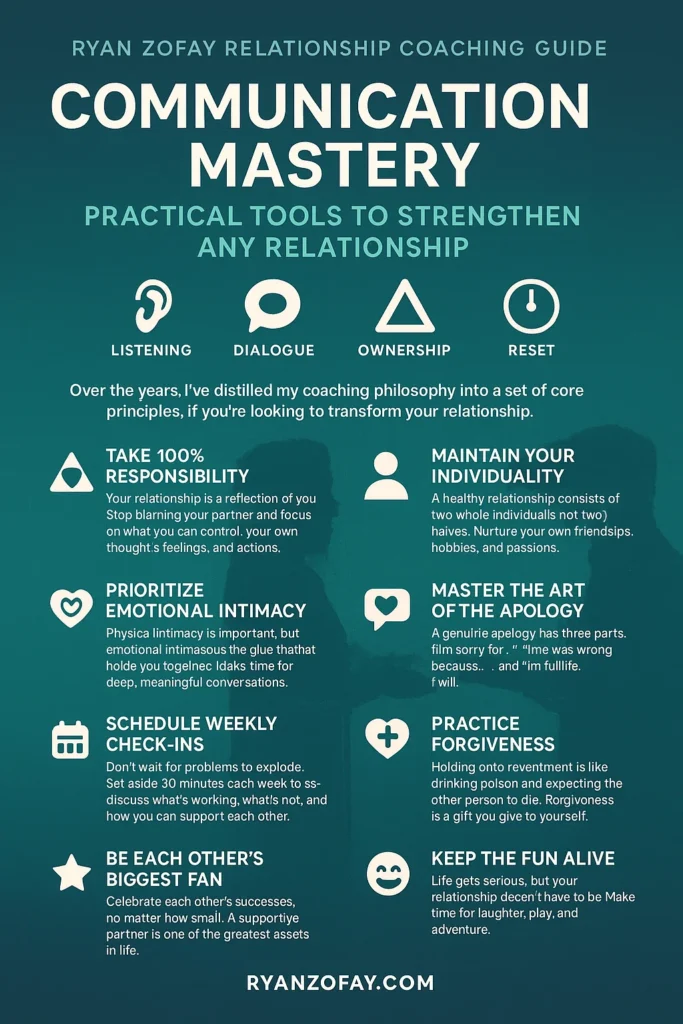
- Take 100% Responsibility: Your relationship is a reflection of you. Stop blaming your partner and focus on what you can control: your own thoughts, feelings, and actions.
- Prioritize Emotional Intimacy: Physical intimacy is important, but emotional intimacy is the glue that holds you together. Make time for deep, meaningful conversations.
- Schedule Weekly Check-Ins: Don’t wait for problems to explode. Set aside 30 minutes each week to discuss what’s working, what’s not, and how you can support each other.
- Fight Fair: Disagreements are inevitable, but they don’t have to be destructive. No name-calling, no bringing up the past, and always aim for resolution, not victory.
- Be Each Other’s Biggest Fan: Celebrate each other’s successes, no matter how small. A supportive partner is one of life’s greatest assets.
- Maintain Your Individuality: A healthy relationship consists of two whole individuals, not two halves. Nurture your own friendships, hobbies, and passions.
- Master the Art of the Apology: A genuine apology has three parts: “I’m sorry for…”, “This was wrong because…”, and “In the future, I will…”
- Practice Forgiveness: Holding onto resentment is like drinking poison and expecting the other person to die. Forgiveness is a gift you give to yourself.
- Keep the Fun Alive: Life gets serious, but your relationship doesn’t have to be. Make time for laughter, play, and adventure.
- Invest in Growth: Keep learning by reading books, attending workshops, or getting relationship coaching. Always invest in the health of your partnership.
Science-based Relationship Connection Building
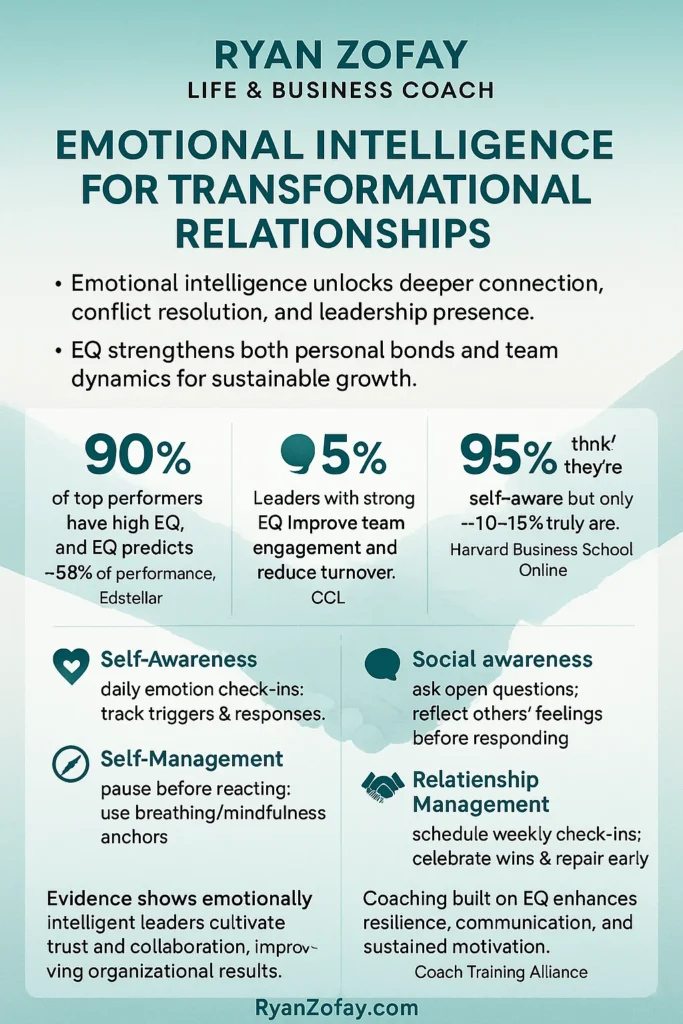
As a relationship coach, I often see that emotional intelligence and communication are not just “soft skills.” They are the key to trust, intimacy, and lasting success. When we understand our emotions, we can react more slowly. This helps us communicate clearly. As a result, we build stronger connections at home. It also improves our leadership at work.
Emotional Intelligence & Communication – Evidence + Coaching Insights
| Evidence, Stats & Studies (with URLs) | Coaching Insights, Tips & Guides (first-person voice) |
|---|---|
| Emotional Intelligence: Performance, Leadership & Self-Awareness | How I Coach EQ in Relationships & Teams |
| • Poor communication and relationship breakdown. Research shows that communication problems are a frequent root cause of relationship dissatisfaction and failure, undermining trust and intimacy. Source: The Role of Communication in Relationship Failures: A Review (IJIP) • Active listening and defensive reactions. Articles on mindful and active listening show that when people listen fully, reflect back, and stay non-reactive, it reduces defensiveness and increases understanding between parties. Sources: Mindful Communication: Deepen Connections with Active Listening (Our Mental Health), The Value of Active Listening as a Component of EQ (Psychology Today) • Active listening skills & benefits. Guides on active listening emphasize that these skills increase empathy, mutual understanding, and relationship satisfaction. Sources: Active Listening – Simply Psychology (Simply Psychology), Active Listening – Verywell Mind (Verywell Mind) • “I” statements & reflective listening. Evidence-informed communication tools show that “I” statements and reflective listening increase perceived support and reduce conflict escalation by shifting from blame to ownership. Sources: “I” Statements Worksheet (Therapist Aid), The Power of I Statements (Well Beings Counselling), “I” Messages Handout – BU (Boston University Medical Campus) • Frameworks, emotional regulation & effectiveness. Leadership and communication frameworks that combine self-reflection with structured conversations improve emotional regulation and interpersonal effectiveness in teams. Source: From Emotional Triggers to Values-Based Leadership: A Practical Framework (Harvard Business Impact) | When I’m coaching, I treat emotional intelligence as a daily practice, not a personality trait. Here’s how I guide people to apply it: 1. Self-Awareness (know what you feel, when you feel it) • I ask clients to do a 2–3 minute emotion check-in each morning and evening: “What am I feeling? Where do I feel it in my body? What triggered it?” • We track triggers and patterns – especially moments of conflict, withdrawal, or shame – so they can see what’s really driving their reactions instead of blaming their partner, team, or boss. 2. Self-Management (create space before you react) • I teach a simple rule: “Pause, breathe, then choose.” When you’re activated, take 3 slow breaths, relax your shoulders, and delay your response by at least 10 seconds. • We build micro-rituals: stepping away for a glass of water, walking around the block, or writing a quick note before replying to a heated text or email. 3. Social Awareness (tune into the other person) • In sessions, I model asking open-ended questions: “What’s really happening for you right now?” instead of “Why are you so upset?” • I ask clients to reflect back feelings before opinions: “It sounds like you feel ignored and unappreciated,” before defending themselves. 4. Relationship Management (build & repair intentionally) • I encourage weekly check-ins with partners or teams: 20–30 minutes where the only goal is to review the week, express appreciation, and address small issues before they grow. • We practice repair skills: owning our impact (“I see how my tone hurt you”), apologizing clearly, and offering one concrete change for next time. On ryanzofay.com, these principles can be turned into downloadable checklists, EQ journaling prompts, and guided reflection exercises to help people build daily emotional muscle – not just understand the concept in theory. |
| Communication, Conflict & Relationship Outcomes | How I Build Communication Frameworks that Feel Safe & Practical |
| • Poor communication and relationship breakdown. Research shows that communication problems are a frequent root cause of relationship dissatisfaction and failure, undermining trust and intimacy. Source: The Role of Communication in Relationship Failures: A Review (IJIP) • Active listening and defensive reactions. Articles on mindful and active listening show that when people listen fully, reflect, and stay non-reactive, it reduces defensiveness. Increasing understanding between parties. Sources: Mindful Communication: Deepen Connections with Active Listening (Our Mental Health), The Value of Active Listening as a Component of EQ (Psychology Today) • Active listening skills & benefits. Guides on active listening emphasize that these skills increase empathy, mutual understanding, and relationship satisfaction. Sources: Active Listening – Simply Psychology (Simply Psychology), Active Listening – Verywell Mind (Verywell Mind) • “I” statements & reflective listening. Evidence-informed communication tools show that “I” statements and reflective listening increase perceived support and reduce conflict escalation by shifting from blame to ownership. Sources: “I” Statements Worksheet (Therapist Aid), The Power of I Statements (Well Beings Counselling), “I” Messages Handout – BU (Boston University Medical Campus) • Frameworks, emotional regulation & effectiveness. Leadership and communication frameworks that combine self-reflection with structured conversations improve emotional regulation and interpersonal effectiveness in teams. Source: From Emotional Triggers to Values-Based Leadership: A Practical Framework (Harvard Business Impact) | In my coaching, I treat communication as a trainable skillset – not a talent you’re either born with or without. Here’s how I help clients turn proven tools into everyday habits: 1. Active Listening Drill (5-Minute Practice) • Partner A speaks for 5 uninterrupted minutes about something important (not an argument – just truth). • Partner B’s only job is to listen, maintain eye contact, and then reflect back what they heard: “What I’m hearing is…” • Then they check for accuracy: “Did I get that right?” and only after that do they share their own perspective. 2. “I” Statements Instead of Blame • I teach a simple template: “I feel… when… because… and I’d love…” – Example: “I feel anxious when texts go unanswered for hours because I start imagining the worst. I’d love a quick ‘busy, talk later’ message.” • We practice rewriting “You always / you never” into “I” statements so conflict de-escalates rather than explodes. 3. Ownership Triangle (Blame → Awareness → Action) • Step 1: Notice blame (“It’s their fault”). • Step 2: Shift to self-awareness (“What am I feeling and believing right now?”). • Step 3: Move to empowered action (“What’s one request, boundary, or behavior I can own today?”). • I ask clients to catch themselves 3 times a day moving from blame to ownership and to journal the shift. 4. 5-Minute Reset for Tough Moments • When tension spikes, I give couples and teams a 5-minute reset script: 1) “Here’s what I’m feeling…” 2) “Here’s what I’m afraid is happening…” 3) “Here’s what I actually want between us…” 4) “Here’s one step I’m willing to take.” • This short structure calms the nervous system and gets everyone back on the same side of the problem. 5. Weekly Check-Ins for Connection & Performance • I recommend a weekly 20–30 minute check-in with a partner or team: – 5 minutes: appreciations and wins. – 10–15 minutes: “What felt hard this week?” – 5–10 minutes: agreements for next week. • On ryanzofay.com this can become a printable “Weekly Check-In” worksheet to guide couples and leaders through the same process step-by-step. Over time, these simple frameworks create emotional safety. People start to believe: “I can tell the truth, we can handle conflict, and we come out stronger together.” That belief is the real breakthrough. |
When I review the research and the people I assist, I notice a common theme. Emotional intelligence and communication are critical. High EQ predicts performance and leadership; clear, compassionate communication protects intimacy and trust. When you practice self-awareness every day, control your reactions, and listen carefully, you improve your relationships. Using simple tools like “I” statements and weekly check-ins helps teams manage stress, grow, and share honest truths.
Becoming a Relationship Coach
(And Why This Career Is Growing Rapidly)
People search for terms like become a relationship coach, how to become a relationship coach, and relationship coaching certification. This is because coaching is one of the fastest-growing online careers.
Here’s why:
- High global demand
- No licensing barriers
- Flexible schedule
- Ability to work remotely
- Potential to scale online
Whether you choose in-person coaching or relationship coaching online, the opportunities are significant. Continue for the step-by-step process to become a relationship coach.
How Do I Become a Relationship Coach?
To become a certified relationship coach, follow the steps below.
Step 1
Step 1: Choose a Certification Program
Look for programs that include:
Business training
Ethics training
Relationship psychology
Coaching methodologies
Practice hours
Step 2
Step 2: Build Your Coaching Identity
Define your niche:
- Marriage coaching
- Communication coaching
- Dating coaching
- Life and relationship coach
- Breakup or divorce recovery
Step 3
Step 3: Start Coaching Clients
Begin with practice sessions, testimonials, or low-cost intro packages.
Step 4
Step 4: Learn How to Make Money Online as a Relationship Coach
Here are ways for relationship coaches to make money online:
- 1:1 coaching programs
- Group coaching
- Online courses
- Membership communities
- Digital downloads
- AI-assisted coaching tools
- Workshops or live events
(If you want, I can also draft a monetization roadmap.)
AI Relationship Coach
Using AI as a Relationship Coach
AI relationship coach tools can support:
- Intake questionnaires
- Emotional assessments
- Automated journaling prompts
- Client accountability tracking
But nothing replaces human connection, empathy, and lived experience.
Activities You Can Begin Today
Activity 1
Activity 1: The Truth Letter
A powerful clarity exercise:
Write a letter expressing everything you’ve been holding back—truth, fear, needs, gratitude.
You don’t need to send it; clarity alone creates transformation.
Activity 2
Activity 2: The Connection Ritual
Once a day, take 5 minutes to ask your partner:
- “What are you grateful for today?”
- “What’s something you need support with?”
- “What’s one thing I can do to make you feel loved?”
Small rituals change long-term relationships.
Activity 3
Activity 3: Pattern Recognition Mapping
Identify your:
| Trigger | Emotional Reaction | Behavioral Pattern | New Choice |
|---|---|---|---|
| Feeling ignored | Anger | Withdraw | Ask clearly for a connection |
| Feeling criticized | Shame | Defensiveness | Validate before responding |
Patterns become predictable—which means they become changeable.
Activity 4
Relationship Coaching Services I Offer
My holistic services include:
- Seminars and personal development coaching
- Breakthrough workshops
- Leadership training
- Communication intensives
- Relationship realignment sessions
Find Your Path Forward
My journey has taught me that no relationship is beyond hope if both people are willing to do the work. The pain of my past became the foundation for my purpose. I built a successful business worth nine figures and a life I never imagined. However, true wealth comes from the love I share with my family and the changes I see in my clients.
You have the power to create extraordinary relationships. It starts with a decision to stop settling and start creating. Whether you’re looking for a relationship coach online or searching for “relationship coaches near me,” the most crucial step is the first one. You can heal your past, rewrite your story, and build a future filled with love, connection, and joy.
If my story resonates with you, I invite you to explore the resources on my website. From my book, “An Unlikely Businessman,” to personal development events and coaching, there are many ways to work together. Let’s heal, grow, and succeed—together.
Whether you’re seeking to strengthen your relationship, elevate your communication, or become a relationship coach yourself, remember:
Transformation is not complicated.
It’s consistent.
And consistency creates breakthroughs.
- Read more about my story and transformation
- Explore my Personal Development Events & Workshops
- Discover how to Transform Your Life with a Premier Life Coach

