
What are the best public speaking tips? Public speaking tips are practical strategies. They help you build confidence. Plan clear and impactful talks. Manage stage fright. They help you engage your audience. The best public speaking tips help speakers prepare with purpose, manage nerves, speak clearly, and adjust to audience feedback.
Public Speaking Tips: A Complete Guide to Speaking with Confidence & Impact
I’m Ryan Zofay, a professional speaker and founder of the We Level Up behavioral health centers. Host of The Ryan Zofay Experience – Apple Podcasts. Represented by the All American Speakers Bureau. A full-service talent booking agency for speaking engagements, personal appearances, and corporate events.
If you want public speaking tips you can use now, you’re in the right place. This guide helps you build confidence, calm anxiety, create memorable talks, and influence any audience. It works for meetings, executive presentations, investor pitches, and keynote speeches.
When people search “public speaking tips,” they usually mean:
- “How do I stop feeling nervous?”
- “How do I structure a talk so people actually remember it?”
- “How do I sound confident without memorizing?”
- “How do I handle mistakes, Q&A, and unexpected moments?”
I’ve delivered keynote presentations, leadership talks, investor presentations, and corporate trainings across the country. What follows are the same systems I use personally and coach others through.
If you’re looking for actionable public speaking tips you can apply immediately — this guide is built for you. Get answers plus a simple step-by-step system you can use to prepare for any talk.
Jump To
Table of Contents
Best Public Speaking Tips For Confidence, Impact & Leadership
Public speaking is a fast way to build confidence, leadership presence, and influence. This is true in meetings, presentations, and keynotes. It upgrades how people experience you: your clarity, certainty, and authority.
Here’s what I want you to understand from the start:
Public speaking is not a personality trait. It’s a skill. And like any skill, it’s built with the right strategy and repetition.
In this guide, I’ll share my top 10 best public speaking tips as a professional speaker and coach. These are the same principles I use as a business leader and motivational speaker. I’ll also share a simple step-by-step how-to directions. You can use it to prepare for any talk as a beginner or experienced leader.
Public speaking tips can be invaluable, especially when you are first starting. We’ll delve into the art of public speaking as a leader, executive, business owner, and individual. You’ll learn how to:
- Convey a compelling engaging story and weave in you message.
- Use powerful stories, pauses, and body language to keep attention.
- Handle audience disappointments to outbreaks to bounce back like a pro.
Let’s jump right into it. I’ll share powerful speech delivery techniques and tricks. These follow evidence-based findings. They are proven to build confidence in public speaking on any stage.
I’ll Share The Public Speaking Tips That Transformed My Life
These public speaking tips for beginners changed my life
Hey there, I’m Ryan Zofay. There was a time when the thought of speaking in public made my palms sweat and my heart race like I was running a marathon. Today, I am a motivational speaker and the founder of We Level Up. It is a large behavioral health organization worth nine figures. I speak to audiences all over the world. I lead corporate events, and teach communication strategies as part of my work as a founder and speaker.
The journey from fear to a confident inspirational keynote speaker wasn’t easy, but it was absolutely worth it. That change didn’t come from trying to be perfect. It came from building a system—and practicing it until my nervous system stopped treating speaking like danger.
Key Takeaways
- Public speaking confidence comes from reps, not perfection.
- Openings and closings matter most because they shape attention and memory.
- Stories beat facts for retention when you want people to remember and feel your message.
- Pauses increase authority (and reduce filler words).
There was a time when speaking in public felt overwhelming. What changed everything was understanding that confidence comes from:
- Structure
- Repetition
- Purpose
- Service
Not personality. These principles helped me build leadership presence while growing We Level Up and speaking in increasingly larger rooms.
Let’s dive into the top 10 tips to overcome your fear of public speaking below. These tips come from my real business experience. I’ve used them in investor talks and leadership meetings. I’ve also used them in workshops and keynote-style talks. Join my coaching clients to master speaking & influence.
For ideas on the best persuasive speaking topics, check out my guide. Consider taking public speaking courses. If you take anything from this guide, follow these takeaways for smart, impactful on-stage performance.
Public Speaking Tips to Speak with Confidence: Step-by-Step Practice Plan
If your voice has shaken, your mind has gone blank, or your body has surged with adrenaline, you are not broken. You are not alone.
Public speaking triggers a “fear of negative evaluation” in many people. The brain sees judgment as a threat. The body reacts in response. That’s why people can feel panic symptoms in a room that is objectively safe.
The solution isn’t “never feel nerves.” The solution is learning how to speak well while nervous—and doing it enough times that your brain stops labeling speaking as danger.
Continue on for the best top 10 public speaking tips that helped me go from avoiding speaking to seeking out opportunities. These ideas are not just theories. They are proven strategies I use every day as a leader and entrepreneur. You will gain useful tools that you can apply immediately. This is true whether you have public speaking anxiety or want to improve your skills.
Understanding the Power of Public Speaking
Public speaking is one of the highest-leverage skills you can build. Because it affects everything downstream. From career growth, leadership influence, and confidence, sales, persuasion, and trust. Even when you’re not on a stage. The good news is that public speaking is a skill, not a personality trait. Anyone can improve with the right strategy and practice.
What most people get wrong about public speaking
Most people struggle because they focus on the wrong target.
- They try to “sound perfect” instead of connecting.
- They memorize word-for-word and panic when they forget.
- They focus on themselves instead of the audience.
When you flip those, speaking becomes simpler. You structure clearly, deliver confidently, and serve the audience.
What Causes Public Speaking Anxiety — and How to Overcome It
Public speaking anxiety is extremely common. Public speaking often brings a fear of negative judgment. It can feel like everyone is judging you. This fear is a key driver of social anxiety. Many people feel strong physical and emotional symptoms as soon as they think others are watching. They may also feel these symptoms when they imagine making a mistake.
Some estimates say public speaking anxiety affects about 40% of people (depending on how it’s measured and defined). We’ll break down how to overcome fear of public speaking. Go on for more on how to calm nerves when speaking.
Symptoms can include:
- Racing heart
- Shaking hands
- Mental blanking
- Rapid speech
- Tight breathing
Here’s the important truth, your body isn’t failing you. It’s activating you. Instead of trying to remove anxiety, the goal is to perform well while it is present. Keep doing this until your nervous system learns the stage is not dangerous.
If you are working through anxiety, my guide on communication coaching strategies explains how to build confident presence.
Public Speaking Anxiety Tips
Here’s how I coach people to move through it, not around it.
Mindset shifts before you speak
- See nerves as fuel, not proof you’re failing. Your body is giving you energy to perform. Instead of “I’m anxious,” try “I’m activated and ready.”
- Shift the spotlight from you to them. Ask: “What do they need to hear today?” When you focus on serving the audience, you stop obsessing over how you look and start caring about how they feel.
- Redefine success: Success isn’t “a perfect speech.” Success can be: “I stayed present,” “I shared one honest story,” or “I made one person feel less alone.”
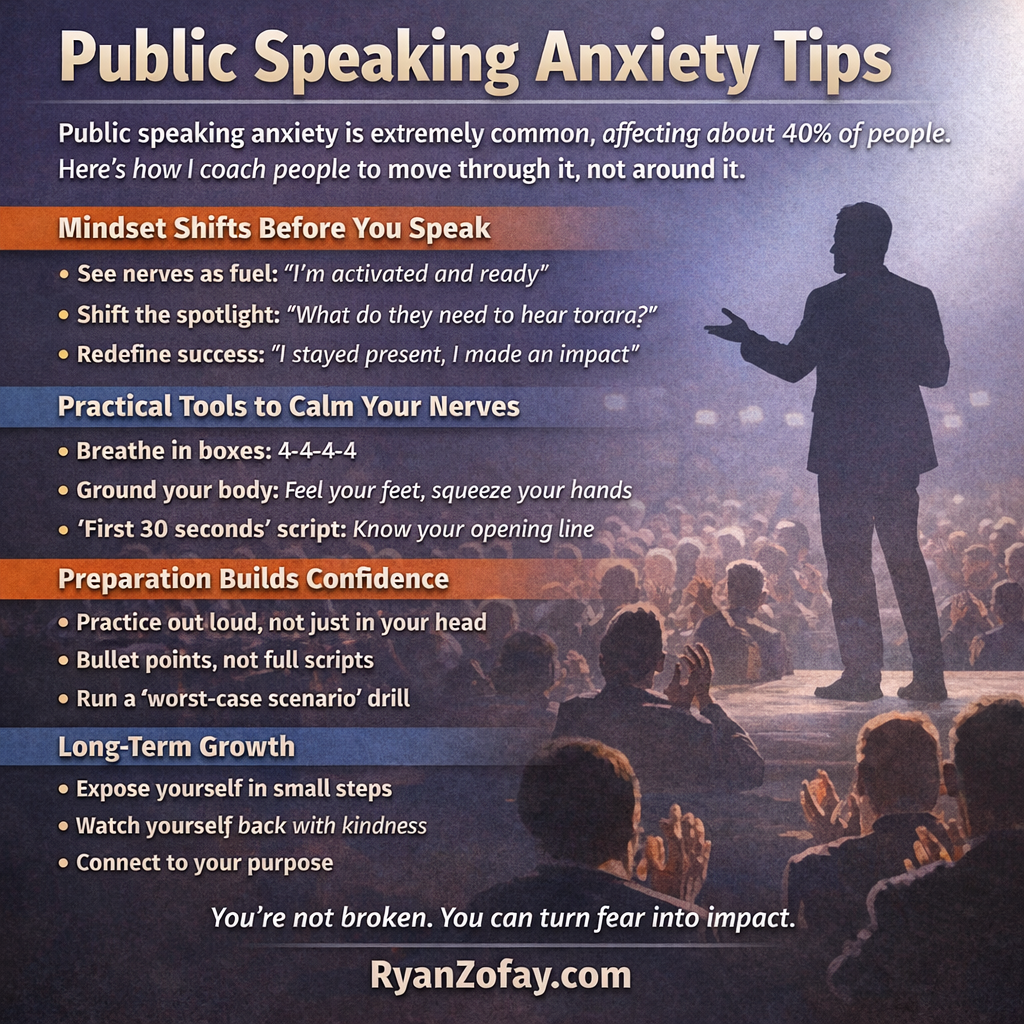
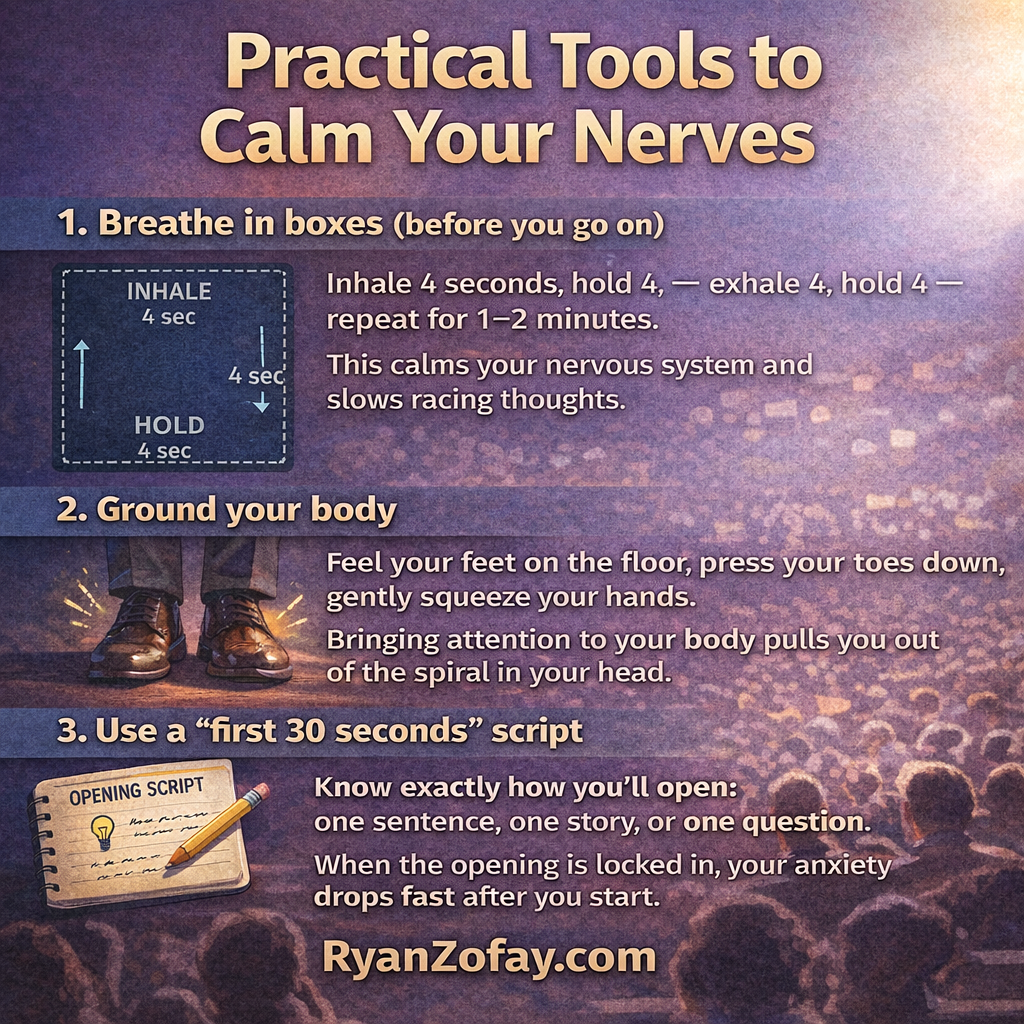
Practical tools to calm your nerves
- Breathe in boxes (before you go on). Inhale 4 seconds, hold 4, exhale 4, hold 4 — repeat for 1–2 minutes. This calms your nervous system and slows racing thoughts.
- Ground your body. Feel your feet on the floor, press your toes down, gently squeeze your hands. Bringing attention to your body pulls you out of the spiral in your head.
- Use a “first 30 seconds” script. Know exactly how you’ll open: one sentence, one story, or one question. When the opening is locked in, your anxiety drops fast after you start.
Preparation that builds real confidence
- Practice out loud, not just in your head. Stand up, speak to a wall or a camera. Your brain and body need to experience it; silent practice doesn’t prepare you for the real thing.
- Bullet your key points, don’t memorize every word. Memorizing every line increases pressure and fear of “messing up.” Bullets give you structure and freedom, which feels more natural on stage.
- Run a “worst-case scenario” drill. Ask: “If I forget a line, what will I do?” Plan: pause, breathe, smile, say, “Let me say that a different way.” When your brain knows there’s a plan for mistakes, it relaxes.
In-the-moment speaking strategies
- Start slower than feels natural. Anxiety makes you speed up. Commit to a slower first paragraph. Pauses make you sound confident and give your brain time to catch up.
- Make eye contact with friendly faces first. Find one or two people who look open or engaged. Talk to them as if you’re having a conversation, not delivering a performance.
- Name the elephant (when appropriate). Sometimes saying, “I’ll be honest. I felt a little nervous before this,” gets a laugh. It humanizes you. It also eases tension for you and them.
Long-term confidence building
- Expose yourself in small steps. Start with small meetings, then team presentations, then larger rooms. Confidence grows from reps, not from waiting until you “feel ready.”
- Watch yourself back with kindness. Record your talks. Instead of hunting for flaws, look for three things you did well and one thing to improve next time.
- Connect speaking to your purpose. Ask: “Why is this message important to my life and to theirs?” When your purpose is bigger than your fear, your fear stops being the one in charge.
If you’ve struggled with public speaking anxiety, you’re not broken — you’re human. With the right mindset, practical tools, and a focus on small, steady practice, you can turn the stage from panic into impact.
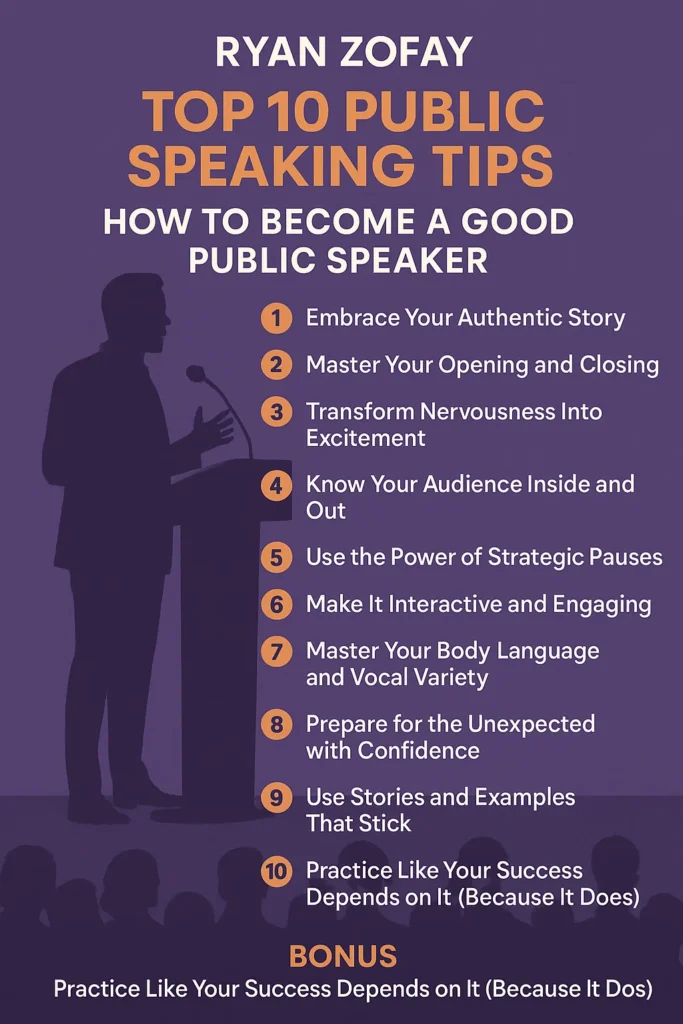
The Top 10 Public Speaking Tips That Changed Everything
Before we share the public speaking tips you have been waiting for, we want you to know something. We will also explain how experienced presenters can improve their public speaking. In the interim, I want you to know something important. Public speaking is a key skill for entrepreneurs, executives and leaders. When I started We Level Up, I saw that my skills in communication, inspiring teams were key to our success. This is where my favorite public speaking tips can really help shape you as a speaker.
Quick Summary of My 10 Best Public Speaking Tips
Below are the exact principles I use in leadership meetings, investor talks, workshops, and keynote-style presentations. These are practical strategies you can use right away, whether you’re a beginner or an experienced presenter.
- Be authentic and tell your story
- Nail your opening and closing
- Reframe nerves as excitement
- Know your audience
- Use strategic pauses
- Make it interactive
- Improve body language + vocal variety
- Prepare for the unexpected
- Use stories people remember
- Practice like it matters
Every successful business leader I know has mastered effective public speaking strategies. It’s not just about being comfortable on stage—it’s about being able to influence, inspire, and create meaningful connections. The confidence you gain from public speaking spills over into every area of your life and business.

Let’s dive in with the public speaking tips that can help transform your audiences.
The 10 Best Ways to Improve Public Communications
As a business coach and entrepreneur, I have learned that public speaking is more than just giving presentations. It is about connecting with people, sharing your vision, and inspiring change. No matter if you are pitching to investors, leading team meetings, or speaking at conferences, these skills can change your business and your life. I’ve personally used public speaking tips and my secret techniques to build my company and impact thousands of lives.
1. Embrace Your Authentic Story
The most effective speeches I’ve given were not about perfect delivery or technique. They were about sharing my true story. Your experiences, struggles, and victories are unique to you, and that’s your superpower.
I learned this lesson when I stopped trying to be someone else on stage and started being myself. People don’t connect with perfection; they connect with authenticity that’s relevant. Share your journey, including the challenges you’ve faced. When I talk about building We Level Up, I share more than just the successes. I also share the late nights, the doubts, and the times I wanted to give up.
Remember, when your story contains a struggle, a turning point, and a lesson that applies to them your audience will connect.
Practice: Write down three pivotal moments in your life or business journey. Practice sharing these stories with emotion and vulnerability. Please share your favorite public speaking tip in the comments below.
Action Step (2 minutes):
- Write 1 story from your past where you overcame a challenge.
- Identify the lesson in one sentence.
- Tie it directly to your audience’s problem.


Watch these 2 public speaking with confidence training videos:


2. Master Your Opening and Closing
Your opening sets the tone for everything that follows, and your closing determines what people remember and do next. I’ve seen too many great speakers lose their audience in the first thirty seconds because they started with a weak opening.
Here are my go-to opening techniques:
- Start with a powerful question.
- Share a surprising statistic.
- Tell a brief, relevant story.
- Make a bold statement.
Best openings that grab attention:
- A surprising truth.
- A short uplifting story.
- A question that hits a pain point.
- A powerful emotional statement.
Remember, your opening determines whether people lean in. A strong opening does one thing: it makes the audience feel, “This is for me.”
For closings, always include a clear call to action. What do you want your audience to do after hearing you speak? Be specific and make it easy for them to take the next step. Be sure to continue following these tips of public speaking.
Your closing formula:
- Repeat the core message.
- Give one clear action.
- End with an emotional line people remember.
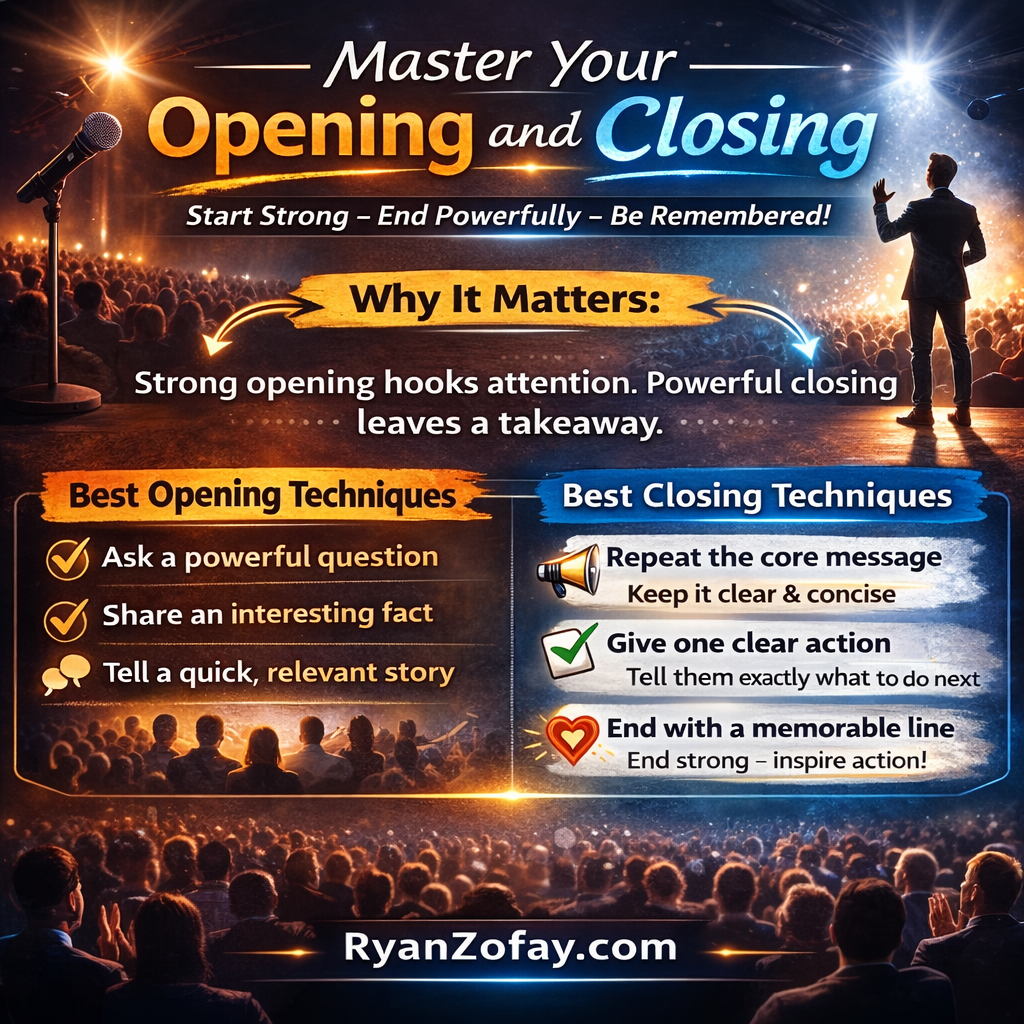
A strong closing does one thing: it gives the audience a clear takeaway and a clear next step.
3. Transform Nervousness Into Excitement
Here’s a secret, even after years of speaking, I still get nervous. The difference is that I’ve learned to reframe those butterflies. Instead of telling myself, “I’m nervous,” I say “I’m excited.” This simple shift changes everything.
The body sensations of nervousness and excitement are similar (elevated heart rate, heightened alertness). What changes performance is the label you put on it.
| Instead of thinking | Think this |
|---|---|
| “I’m nervous.” | “I’m excited.” |
| “I’m going to mess up.” | “I’m prepared, and I can recover.” |
| “They’re judging me.” | “They want something valuable from me.” |
| “I don’t belong here.” | “I was invited for a reason.” |
Try this before you speak: Say out loud, “This is energy. This is excitement. My job is to serve.”
That cue often prevents the mental spiral. The physiological response to nervousness and excitement is almost identical—increased heart rate, heightened awareness, elevated energy. The only difference is how we interpret these sensations. Be sure to let me know what your personal impromptu public speaking tipsare. Which of my best public speaking tips resonates with you?

4. Know Your Audience Inside and Out
Before every speaking engagement, I spend time researching my audience. What are their pain points? What keeps them up at night? What solutions are they seeking? When you truly understand your audience, you can tailor your message to resonate with them on a deeper level.
For business audiences, I focus on growth, efficiency, and practical strategies they can implement immediately. For motivational talks, I emphasize personal transformation and overcoming obstacles. The core message might be similar, but the delivery and focus change based on who’s listening.
Ask these 3 questions before you speak:
- What problem does this audience need solved?
- What level are they at (beginner, intermediate, advanced)?
- What would success look like for them after listening?
Research checklist:
- Industry and company background
- Current challenges they’re facing
- Their level of expertise on your topic
- What they hope to gain from your presentation
- Previous speakers they’ve had.

Remember, confidence increases when you know exactly who you’re speaking to and what they need. When you speak to the audience’s actual pain points, you don’t need to “perform.” You just need to communicate.
5. Use the Power of Strategic Pauses
One of the most underutilized tools in public speaking is the strategic pause. When I first started speaking, I was afraid of silence, so I filled every moment with words. This actually weakened my message and overwhelmed my audience.
Now I use pauses intentionally:
- After making an important point (let it sink in).
- Before revealing something significant (build anticipation).
- When transitioning between topics (give the audience time to process).
- During Q&A sessions (show you’re thinking about their question).
Remember, pauses are not empty space. They are authority.
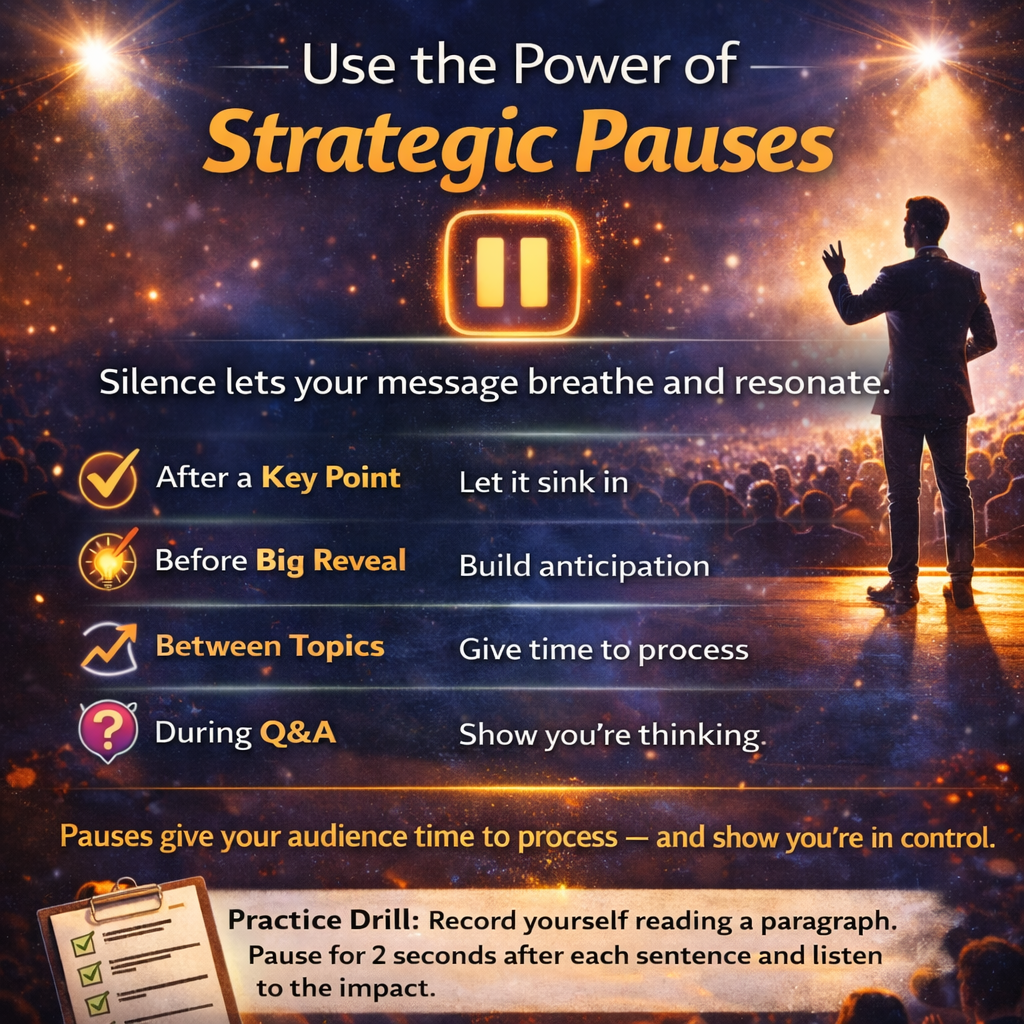
A well-placed pause can be more powerful than a dozen words. It gives your audience time to process. It gives you time to control pace, reduce filler words, and reset your nervous system. While these top 10 tips to overcome your fear of public speaking are helpful, practice makes perfect.
Practice drill: Record yourself delivering one paragraph and force yourself to pause for 2 seconds after every key sentence. Your delivery will immediately sound more confident.
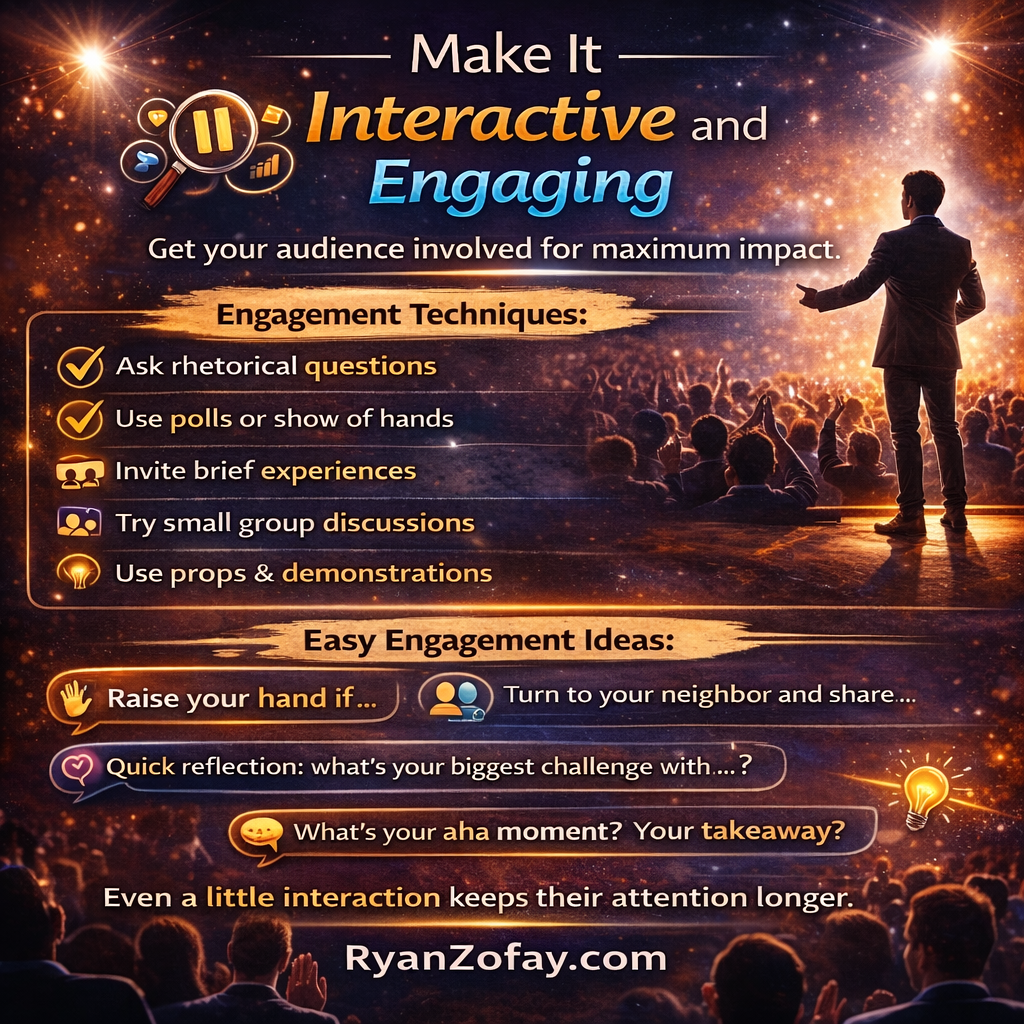
6. Make It Interactive and Engaging
Gone are the days when audiences wanted to sit passively and listen to a monologue. People want to be engaged, involved, and part of the conversation. I’ve learned to make my presentations interactive through:
Engagement techniques:
- Ask rhetorical questions throughout your talk
- Use polls or a show of hands
- Invite audience members to share brief experiences
- Include small group discussions
- Use props or visual demonstrations
Easy engagement ideas (even for shy speakers):
- “Raise your hand if…”
- “Turn to the person next to you and share…”
- “Quick 10-second reflection: what’s your biggest challenge with ___?”
- “What’s your aha moment? What’s your takeaway”
Remember, you can engage people without forcing participation. Use light interaction: a show of hands, a quick reflection prompt, or a simple question that creates mental participation.
Even one moment of interaction increases attention for the next several minutes.
Here are my clients’ favorite tips for public speaking. When I talk about entrepreneurship, I often ask the audience to consider their biggest business challenge. Then, I ask them to share it with the person next to them. This immediately gets them invested in the content.
7. Master Your Body Language and Vocal Variety
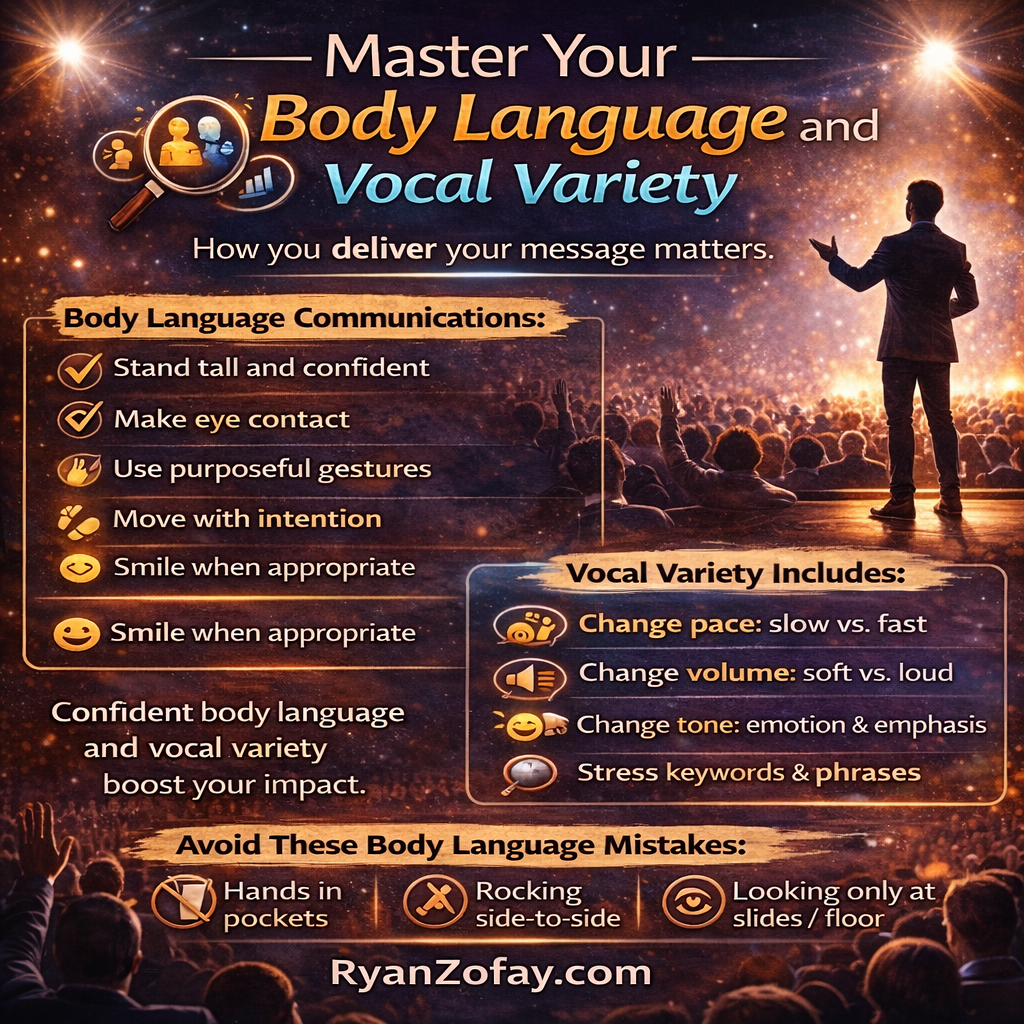
Your message isn’t just in your words. It’s in how you deliver them. I have worked hard to create confident body language and vocal variety. These help support my message instead of distracting from it.
- Stand tall with your shoulders back
- Make eye contact with different sections of the audience
- Use purposeful gestures that emphasize your points
- Move with intention, not nervous pacing
- Smile genuinely when appropriate
Vocal variety includes:
- Changing your pace (slow down for emphasis, speed up for excitement)
- Varying your volume (whisper for intimacy, project for energy)
- Using different tones to convey emotion
- Emphasizing key words and phrases
Avoid these 3 body language mistakes
- Hands in pockets the whole time
- Rocking side-to-side
- Looking only at slides / floor
Remember, your message isn’t only your words. It’s your presence. Stand grounded. Move intentionally. Make eye contact with one person long enough to finish a complete thought.
Let your voice match your meaning:
- slow down for key points,
- speed up for energy,
- and change tone to prevent monotone delivery.
If you want one quick fix: slow your pace by 10–15%. Most speakers talk too fast when nervous.
8. Prepare for the Unexpected with Confidence
Murphy’s Law applies to public speaking. If something can go wrong, it probably will at some point. I’ve had microphones fail, presentation slides crash, and even had a fire alarm go off mid-speech. The key is being prepared and staying calm.
Preparation strategies:
- Always have backup plans for technology
- Practice your speech without slides
- Prepare answers for potentially difficult questions
- Have a few go-to stories or examples you can use
- Learn basic troubleshooting for common tech issues
My 3 backups rule:
- a version you can deliver with slides,
- a version without slides,
- and a version you can deliver in half the time.
Remember, be ready for when tech fails, slides break, questions get weird, time gets cut, distractions happen.
The audience is usually more forgiving than you think. They want you to succeed, and how you handle unexpected situations often becomes a memorable part of your presentation.
When you’re prepared, you can stay calm.
Audiences remember and respond to calm especially when it’s under pressure.

9. Use Stories and Examples That Stick
Facts tell, but stories sell. Throughout my speaking career, I’ve learned that people remember stories long after they forget statistics. When I discuss overcoming challenges in business, I don’t just give advice. I share real stories about times when everything felt impossible.
Elements of a compelling story:
- A relatable character (often yourself)
- A clear challenge or conflict
- The journey toward resolution
- A specific lesson or takeaway
- An emotional connection point
Simple story framework that works every time:
- The struggle
- The turning point
- The lesson
Storytelling helps because it supports memory and recall. Research in economics and psychology shows that how we organize information affects what people remember later. This includes story structure and meaningful cues. Stories create context that makes recall easier than disconnected points. That’s why a short story with one lesson often works better than a list of tips. Tips can feel empty without an emotional or real-life anchor.
I have a collection of stories that show different ideas. I always add new ones from my recent experiences. Your stories should be authentic, relevant, and purposeful.
Remember, people remember meaning, not information. Narratives create structure, emotion, and context—making recall easier than disconnected facts. That’s why stories tend to “stick” long after a list of tips fades.
Use a simple story framework: Struggle → Turning point → Lesson → Application to the audience.
When you attach your point to a story, you give the audience a memory hook.

10. Practice Like Your Success Depends on It (Because It Does)
There’s no substitute for practice, but there’s smart practice and ineffective practice. Early in my career, I would practice by reading my notes over and over. That didn’t work. Now I practice the way I’ll actually deliver the speech.
Effective practice methods:
- Practice out loud, standing up
- Record yourself and review the playback
- Practice in front of friends or family
- Rehearse your opening and closing until they’re automatic
- Time your entire presentation
- Practice handling Q&A sessions
Best practice plan for beginners:
- Day 1: Outline + opening
- Day 2: Run-through out loud
- Day 3: Record and fix pacing
- Day 4: Practice Q&A
- Day 5: Final run-through
Avoid common public speaking mistakes:
- Talking too fast.
- Memorizing word-for-word.
- Weak opening.
- No clear takeaway.
- Reading slides.
I run through my talk multiple times. Especially the opening, transitions, and closing. The goal isn’t memorizing each word. It’s becoming so familiar with the structure that you can stay present with the audience.
Remember, most people practice the wrong way. Smart practice means rehearsing the way you will deliver out loud, standing, with timing, with pauses, and with a strong opening and closing.
If you’re newer, use a simple rhythm. Day 1 outline + opening, Day 2 full run out loud, Day 3 record and adjust pacing, Day 4 rehearse Q&A. Day 5 final run and rest.
You don’t need perfection. You need familiarity and control.

How to Become a Good Public Speaker: A Step-by-Step Guide
Along with learning the best public speaking tips, are you wondering how to develop your public speaking skills? Let me walk you through the exact process I use to prepare for any speaking engagement:
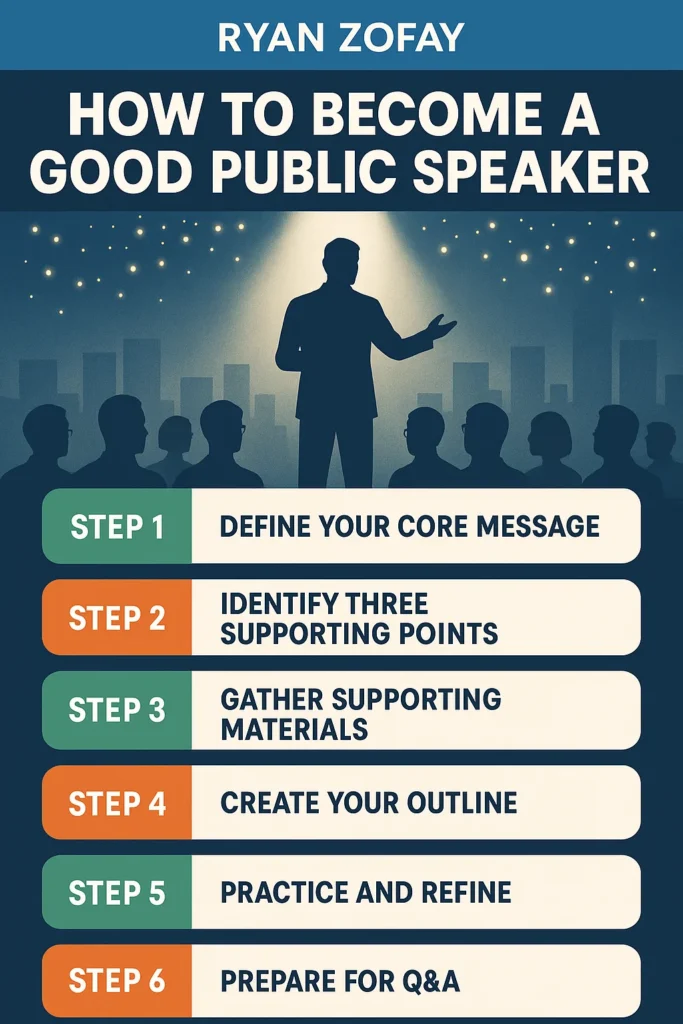
Remember, if you only follow one system, use this: Message → 3 points → proof → action
Step 1: Define Your Core Message
Start with one clear message you want your audience to remember. If they forget everything else but remember this one thing, what should it be? Write it down in one sentence.
Remember, write a single sentence: “After this talk, I want them to believe/feel/do ______.”
Step 2: Identify Three Supporting Points
Choose three main points that support your core message. Why three? It’s the magic number for retention. People can easily remember three things, but struggle with more.
Remember, three is a sweet spot for retention. If you have more points, you probably need a clearer message.
Step 3: Gather Supporting Materials
For each of your three points, collect:
- A relevant story or example
- Supporting data or research
- A practical tip or action step
Takeaway: For each point, include one story, one proof element (data or example), and one practical application.
Step 4: Create Your Outline
Structure your presentation with below. Open with a hook. Establish the problem. Deliver your three points. Close with action.
Simple outline template
- Hook
- Problem
- Solution (your 3 points)
- Example/story
- Action step
- Close
Devote proper time frames:
- Opening hook (2-3 minutes)
- Point 1 with supporting materials (5-7 minutes)
- Point 2 with supporting materials (5-7 minutes)
- Point 3 with supporting materials (5-7 minutes)
- Closing with call to action (2-3 minutes)
Step 5: Practice and Refine
Go through multiple practice sessions, timing each section and refining based on what feels natural and flows well.
Tip: Practice out loud, then record yourself once. Fix pacing first, clarity second, gestures third.
Step 6: Prepare for Q&A
Anticipate 10-15 questions your audience might ask and prepare thoughtful answers. This preparation gives you confidence and helps you stay in control during the Q&A session.
Remember, write 10 questions you might get. Answer them in short, direct language. Because Q&A confidence is built before you’re on stage.
The Science Behind Public Speaking (And Why These Tips Work)
Public speaking isn’t just a “confidence issue.” It’s a combination of psychology, physiology, memory, and human behavior. The good news is that modern research supports what great speakers learn over time. People don’t remember perfection. They remember clarity, connection, and emotional meaning.
Moreover, people can feel strong anxiety when speaking because the brain can see being watched and judged as a threat. Speaking anxiety is supported by the fact that first impressions form extremely fast. Research shows people can make judgments from very brief exposure. Which is one reason your first moments carry disproportionate weight.
Stories improve memory because they give information a clear structure. This helps the brain store and recall details better than separate facts. Great speaking isn’t magic. It aligns with how humans pay attention, form impressions, and remember meaning.
Public Speaking Studies + Real-World Speaking Insights
Here’s the science behind why public speaking feels so intense, why stories stick, and why first impressions matter so much.
| Science Behind Public Speaking (Study / Findings / Stats) | Insights + DIY Exercises + Related Guides |
|---|---|
| NIMH – Social Anxiety Disorder (fear of judgment + evaluation). Finding: Public speaking triggers fear of negative evaluation, a core driver of social anxiety symptoms. Stat: Confirms the psychological mechanism behind the “fight-or-flight” response in speaking situations. URL: https://www.nimh.nih.gov/health/publications/social-anxiety-disorder-more-than-just-shyness | Insight: If your heart races before you speak, it’s not weakness. It’s your nervous system reading the moment as a social threat. Your job is to train your body to feel safe while speaking. DIY Exercise (2 minutes): Before speaking, do 4 slow breaths: inhale 4 seconds → exhale 6 seconds. Then rehearse your opening once out loud. Related guide: https://ryanzofay.com/communication-coach/ |
| National Social Anxiety Center – Public Speaking Anxiety. Finding: Public speaking anxiety is common and often linked to fear of judgment. Stat: Some estimates suggest ~40% of people experience public speaking anxiety (depending on definition/measurement). URL: https://nationalsocialanxietycenter.com/social-anxiety/public-speaking-anxiety/ | Insight: You don’t need to “remove” fear — you need to perform with fear until your brain stops labeling speaking as danger. Confidence is earned through reps. DIY Exercise: Speak up once early in your next meeting (even a simple sentence). This trains leadership presence faster than waiting until the end. Related guide: https://ryanzofay.com/mastering-think-before-you-speak/ |
| First Impressions – Princeton research (Willis & Todorov). Finding: People form judgments extremely quickly. Stat: Impressions formed in as little as 100 milliseconds. URL: https://collaborate.princeton.edu/en/publications/first-impressions-making-up-your-mind-after-a-100-ms-exposure-to- | Insight: This is why your first 30 seconds matter more than your “best point.” Your presence sets the frame: confident, uncertain, prepared, or scattered. DIY Exercise: Practice your first two sentences 10 times. Keep your pace slow. Pause between sentences. Hold steady eye contact. Related guide: https://ryanzofay.com/the-art-of-public-speaking-classes-leadership/ |
| Story + Memory / Recall – Narrative structure improves retention. Finding: How information is structured impacts what people remember. Narrative structure improves retrieval compared to disconnected facts. Stat: Strong support that structured meaning improves recall. URL: https://academic.oup.com/qje/article/139/4/2181/7691253 | Insight: A story is a “memory delivery system.” If you want your audience to remember your point, attach it to a struggle, turning point, and lesson. DIY Exercise: Take one tip from your talk and build a 3-part story: Struggle → Turning Point → Lesson. Related guide: https://ryanzofay.com/makes-sense-so-to-speak/ |
| Arousal / Performance: the body treats public speaking like threat. Finding: Public speaking commonly triggers physiological arousal (adrenaline, elevated heart rate) similar to other performance-evaluation situations. Stat: Physiological arousal is normal; the difference is interpretation (nervous vs excited). URL: https://www.nimh.nih.gov/health/publications/social-anxiety-disorder-more-than-just-shyness | Insight: Your body can’t tell the difference between “danger” and “judgment.” Your job is to re-label the sensation as fuel. DIY Exercise: Before speaking, say out loud: “This is excitement. This is energy.” Then smile and begin. Related guide: https://ryanzofay.com/skillful-communication-a-zen-approach-tips-examples/ |
What the Science Confirms
Public speaking feels hard for real reasons:
- Your brain treats judgment like threat (social evaluation triggers anxiety).
- First impressions happen instantly, so openings matter.
- Stories improve recall, because meaning + structure makes memory easier.
- Confidence comes from repetition, not personality.
When you combine science with real-world speaking practice, public speaking becomes a skill you can build. Over time, it can become a strength you lead with.
Bonus Section: Advanced Strategies from My Experience
After years of speaking and coaching others, here are some communications tips and tricks. Plus, advanced presentation tips and strategies to take you to the next level of performance results:
Use vulnerability strategically
Vulnerability creates trust when it serves the audience. Not when it turns into a therapy session. Share the struggle only if you can connect it to a clear lesson and application.
Some of my most impactful presentations have included moments of vulnerability. Sharing my struggles with business failures, personal challenges, and moments of doubt creates a deep connection with audiences. Vulnerability isn’t weakness. It’s a strength that allows others to relate to your humanity.
Use slides as support, not a script
Slides should amplify your message. If your slides contain your speech, you’ll read and attention will drop.
Technology should enhance your message, not replace it. I use slides sparingly, focusing on powerful images rather than text-heavy presentations. When I use technology, it has a clear purpose. It might show an interesting statistic or a related video clip.
Building your “speaker toolkit”
Over the years, I’ve developed a toolkit of resources that support my speaking:
- A collection of go-to stories for different situations
- A database of relevant statistics and research
- A set of interactive exercises for different audience sizes
- Backup plans for common technical failures
- A list of powerful quotes that align with my message.
Tip: Over time, collect a small library of go-to stories, proof points, and audience exercises. The goal is to reduce preparation time while increasing impact.
The Follow-Up Factor
Your presentation doesn’t end when you leave the stage. The follow-up is where real relationships are built and business opportunities are created. I always have a plan for staying connected with audience members who want to continue the conversation.
Takeaway: Your talk isn’t over when you leave the stage. Have a clear follow-up. Provide a QR code resource, a link, an invitation, or a next step.
Tips for Different Speaking Situations
Here’s a quick breakdown of public speaking tips for different situations. You will always know what to focus on. This works for meetings, Zoom calls, or speaking to a crowd.
| Situation | My Insights on What to Do |
|---|---|
| Speaking in Meetings: Speak early with one clear point tied to outcomes. Speaking early establishes presence. | Prepare 1–2 key points in advance. Speak early to establish presence. Keep comments concise and outcome-focused. Tie contributions to business impact. Insight: “If you don’t claim your voice early, the room decides your value for you. Speak with clarity and conviction.” |
| Giving a Business Presentation: Lead with the objective, deliver 3 pillars, and close with decisions and next steps. | Structure content with a clear objective, 3 main points, and a strong close. Use stories and data. Maintain steady pacing and controlled body language. End with a decisive call to action. Insight: “People don’t buy information. They buy certainty. Deliver your message with ownership.” |
| Speaking on Zoom: Look at the camera for key lines, increase vocal energy slightly, and pause longer than you think you need. | Look directly at the camera. Improve lighting and audio quality. Use intentional pauses. Reduce slide clutter. Increase vocal energy slightly to compensate for virtual fatigue. Insight: “On Zoom, your energy must travel through a screen. If you feel slightly exaggerated, you’re probably just right.” |
| Giving a Toast: Make it 3 minutes or less. Use a single theme. End the toast warm and decisive. | Keep it under 3 minutes. Focus on one theme or story. Speak from the heart, not notes. Balance humor with sincerity. End with a clear, celebratory close. Insight: “A great toast isn’t about being clever — it’s about being genuine and present.” |
| Speaking at a Conference: Open strong, move intentionally, and build in a moment of audience participation. | Open with a strong hook. Establish authority quickly. Use stage movement intentionally. Engage the audience with questions or brief interaction. Finish with a memorable takeaway. Insight: “On a big stage, certainty and presence matter more than perfection. Own the stage.” |
Resources to Take Your Speaking Further
If you want to improve your public speaking skills, here are some helpful tips and resources I recommend:
Books that changed my perspective:
- “Talk Like TED” by Carmine Gallo
- “The Presentation Secrets of Steve Jobs” by Carmine Gallo
- “Speak With Impact” by Allison Shapira
Organizations to consider:
- Toastmasters International (great for beginners)
- National Speakers Association (for professional development)
- Local business groups and networking organizations
Online resources:
- TED Talks for inspiration and technique analysis
- YouTube channels focused on presentation skills
- Podcast interviews with successful speakers
For more specific guidance and resources, visit additional content with tips on public speaking. Join me as I share additional powerful tips for public speaking. Find guides about public speaking, business growth, and personal development.
- Guide to Public Speaking Workshops Near Me
- Ryan Zofay’s Public Speaking & Leadership
- Seeking Public Speaking Classes Near Me?
Frequently Asked Questions
What are the best public speaking tips for beginners?
Use a simple structure (opening, three points, closing), practice out loud, slow down, and focus on one message. Don’t memorize word-for-word—memorize your opening and closing so you always know how to start and finish.
How do I stop shaking when I speak in public?
Shaking is usually adrenaline. Slow breathing, ground your stance, relax shoulders/jaw, and slow your pace. The biggest lever is repetition—consistent reps teach your body that speaking is safe.
How do I speak confidently without memorizing?
Use an outline, not a script. Know the order of your points and rehearse transitions. Memorize only the first 30 seconds and the closing so you can recover even if you blank.
How do I overcome severe public speaking anxiety?
I understand this fear because I lived it. Start small with easy topics. Speak up in meetings, offer to give a toast at family events, or join a Toastmasters club. Gradually expose yourself to larger audiences as your confidence builds. The fear never completely goes away. You’ll just get better at managing it and reframing it as excitement.
What should I do if I forget what I’m going to say mid-presentation?
This has happened to me, and here’s what works: pause, take a breath, and remember your outline. If you’ve practiced your three main points, you can always navigate back to your structure. It’s good to have transition phrases ready. You can say, “Let me share another example of this…” or “This reminds me of…” These phrases give you time to gather your thoughts.
How long should I spend preparing for a presentation?
My rule is to prepare for one hour for every minute of presentation time. This is important, especially for beginners. For a 20-minute presentation, that’s 20 hours of preparation, including research, outline creation, practice sessions, and Q&A prep. As you become more experienced, this ratio can decrease, but thorough preparation is always worth the investment.
Should I use slides in my presentation?
Slides can be helpful, but they shouldn’t be a crutch. If you use them, follow the rule of minimal text and maximum impact. One powerful image or one key statistic per slide works better than paragraphs of text. Always be prepared to give your presentation without slides in case of technical difficulties.
How do I handle hostile or difficult audience members?
Stay calm and professional. Acknowledge their concern without getting defensive: “I understand your perspective, and that’s a valid point to consider.” If someone is disrupting the presentation, you can address it directly but kindly. You might say, “I appreciate your interest, and I’d be happy to talk more after the presentation.” Remember, the majority of your audience wants you to succeed and will support you in maintaining order.
How do I calm public speaking anxiety quickly?
Use box breathing (4-4-4-4), ground your body physically, and memorize your first 30 seconds. Once you begin speaking, anxiety drops rapidly.
What makes a speech memorable?
Clear structure, emotional storytelling, purposeful pauses, and one strong takeaway message.
Your Speaking Journey Starts Now
I want you to know that every expert speaker was once a beginner. Every confident speaker was once terrified of being on stage. The difference between those who succeed and those who don’t is not talent. It is the willingness to push through discomfort and keep getting better.
Your voice matters. Your message matters. The world needs to hear your voice. Share your business insights, personal experiences, or new ideas. Don’t let fear rob you or your audience of that connection.
Remember, public speaking is not just about the words you say. It is about the lives you touch, the minds you change, and the impact you make. As entrepreneurs and leaders, we must share our knowledge. We should inspire others to improve their lives and businesses.
Want help becoming a confident speaker faster? If you want deeper coaching, training, or leadership speaking, explore my events and coaching options.
Start with one small step today. You might volunteer to give a presentation at work. You could join a local speaking club. Or you can speak up more confidently in meetings. Give a two-minute talk to a friend, or record a one-minute video and review. Whatever that first step is for you, take it. Your future self will thank you.
Confidence compounds fast when you train consistently. The stage is waiting for you. Are you ready to step onto it?
Resources
Recommended Resources (Start Here)
Public speaking is more than giving presentations. It’s leadership in action.
The person who communicates clearly often becomes the person others follow. Whether you’re an entrepreneur, executive, coach, or team leader, your speaking ability directly impacts your credibility, influence, and results.
Over the years, I’ve learned that confident public speaking isn’t about being flawless. It’s about being structured, prepared, and authentic. You’ll find these resources helpful:
- The Art of Public Speaking Classes & Leadership Mastery
Comprehensive expert strategies for mastering communication, confidence, and leadership on stage. - Master “Think Before You Speak”
Strategies for thoughtful, audience-centered communication. - 101 Best Persuasive Speaking Topics
Variety of persuasive topics and approaches for speeches that resonate and motivate.ryanzofay - Skillful Communication: a Zen Approach
Top 10 tips to boost clarity, listening, and mindfulness in communication.
Want a personalized plan? Book a call.
Sources
Citations and sources for public speaking tips and tricks
Ryan Zofay – Entrepreneur & Sp… – Success Story with Scott D. Clary – Apple Podcasts
Ryan Zofay | Gladiator Summit Speaker
Ryan Zofay | Guest: The Think Unbroken Podcast | CPTSD and Trauma Mental Health Podcast
Ultimate Speaker Leader Program
These public speaking tips links offer a comprehensive set of resources. From foundational techniques to advanced coaching. Our best public speaking tips guide personal growth, boost confidence, and empower speakers to make a real difference. Each link is a gateway to practical tools and transformational strategies for public speaking mastery.
- https://ryanzofay.com/persuasive-speaking-topics/
- https://ryanzofay.com/makes-sense-so-to-speak/
- https://ryanzofay.com/mastering-think-before-you-speak/
- https://ryanzofay.com/communication-coach/
- https://ryanzofay.com/what-should-i-do-with-my-life/
- https://ryanzofay.com/circle-of-influence-circle-of-concern/
- https://ryanzofay.com/why-hire-as-a-speaker/

