
The Top Business Growth Strategies for Winning
Uncover the top‑performing business growth strategies that actually scale by design, not by accident. Use my free Growth & Transformation Blueprint. It helps you set up strategy, systems, sales, operations, and automation. This way, your business growth strategy will be predictable and sustainable. In this guide, I will show you the complete business growth strategy framework I use with founders and teams. This framework helps create effective strategies for business growth. It focuses on several areas, including:
- Planning
- Sales
- Lead generation
- Operations
- Process improvement
- Change management
- Digital transformation
- AI
I know firsthand what it takes to build something from the ground up. I didn’t start with investors or perfect systems—I started with pain, purpose, and relentless execution. After I beat my addiction and changed my life, I helped found the We Level Up addiction treatment centers. Growing one idea into a nine‑figure organization. That journey showed me that a good growth strategy for a business is not luck. It is a repeatable plan that includes structure, discipline, and teamwork. In this blueprint, I share my business development growth strategy. I use this strategy as a business growth consultant. It helps entrepreneurs simplify their growth, avoid chaos, and build lasting legacies.
Jump To
Table of Contents
My Business Growth Strategies & Transformation Blueprint (Start → Scale → Optimize)
You don’t need “more tactics.” You need a business growth strategy that ensures steady results. This way, your revenue won’t rely on luck. This is the blueprint I use to build businesses and coach my clients that start fast, scale clean, and optimize forever.
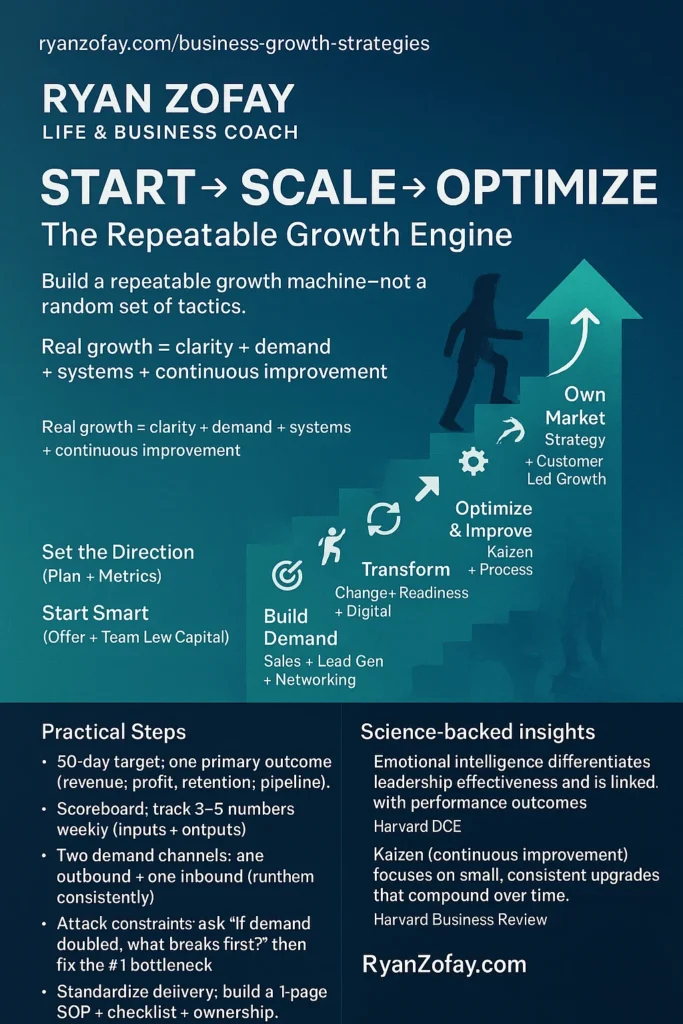
When I was rebuilding my life and my businesses, I saw that many leaders focus on tactics. Tactics are easy to measure now, but they are hard to grow in the future. I learned the hard way that growth shows up only when you stop chasing noise and build a repeatable machine. That’s the heart of this blueprint. If you’ve been stuck in any of these loops…
- Sales spike, then disappear.
- Operations break every time you grow.
- The team “tries hard” but misses targets.
- You’re the bottleneck—and you know it.
- Marketing is busy, but not measurable.
We’ll delve into the exact business growth strategy plan I use to help companies and coach clients. It is for those who want to start quickly, grow smoothly, and plan for the long term. As I rebuilt my life and my businesses, I saw leaders chasing short‑term tricks instead of durable business strategies for growth. Tactics are easy to copy but hard to scale; systems, on the other hand, give you a controllable engine. This Blueprint is built to move you from scattered efforts to a predictable machine.
…then you’re in the right place.
What “Real Growth” Actually Means
Most people say they want growth. What they really want is:
- Consistency
- Control
- Capacity
- Confidence
A business that grows but feels like chaos isn’t success—it’s a trap. When I talk about business growth strategies, I’m not talking about chasing a new funnel every week. I’m talking about installing a scalable business growth strategy framework that turns your company into a repeatable system:
Strategy → Planning → Sales → Operations → Improvement → Transformation.
That’s the game. As a coach and investor, I always tell teams that real growth begins with alignment. Where everyone is rowing in the same direction, they are working together. I’ve seen million-dollar months fall apart because there was no clarity in metrics, ownership, or rhythm. When you master those, growth stops being emotional—it becomes predictable.
The Business Growth Strategy Framework (The Blueprint)
Here it is—simple, brutal, effective:
- Set the Direction (plan + metrics)
- Start Smart (offer + basic structure)
- Build Demand (sales + lead gen + networking)
- Scale Operations (systems + constraints)
- Optimize & Improve (Kaizen + process improvement)
- Transform (change management + readiness + digital)
- Own the Market (business-level strategy + customer-led growth)
This is the business growth strategy framework that makes growth repeatable—not emotional. Now let’s break it down.

Step 1: Set the Direction (Plan + Metrics)
If your team can’t answer these in 10 seconds, you’re drifting:
- What are we trying to win this quarter?
- What’s the scoreboard?
- Who owns which outcomes?
- What gets measured weekly?
- What gets cut if it doesn’t move the needle?
This is where your business growth strategy plan starts—because without a plan, you don’t have a strategy. You have wishes.
Coach’s corner insight on implementation: As a coach, I start every growth sprint with a “clarity cascade.” If no one can explain our goal in 10 seconds, the plan is already off track. Use this as your litmus test before you add a single new tool or hire. So, if someone can’t explain our target in a single sentence, we pause and fix that first. Don’t add tools or headcount until the goal and metrics are crystal‑clear.
Install these non-negotiables
- A 90-day Growth Plan (targets, initiatives, owners, deadlines)
- Weekly execution rhythm (scoreboard + priorities + blockers)
- Inputs and outputs (lead measures + lag measures)
- One-page clarity: what matters, who owns it, what happens next
If you want a shortcut, begin with a simple planning template. Add complexity only after you consistently meet your targets.
Use these resources to architect your plan:
- Strategic Planning Templates
- Growth & Transformation Plan Template
- OKR vs KPI Examples
- Goal Setting Worksheets
- Time Blocking Templates
Want my eyes on your plan? Jump to Book a Call, and I’ll tell you exactly what’s missing.
Step 2: Start Smart (Offer + Team + Low Capital)
This is where the most effective small business growth strategies live. When I launched my first recovery center, I didn’t have a big team or a sophisticated CRM. I had one clear offer that solved a big problem. Within time, this focus helped us grow nationally. Focus beats flash every time, especially when you’re building a small business growth strategy from scratch. Early‑stage growth is about:
- A crystal‑clear core offer
- Fast feedback cycles with real customers
- Tight cash discipline
- Simple tracking
- Basic roles so everything doesn’t collapse onto one person
The most common early-stage mistake
The most common early‑stage mistake is trying to scale before you’ve earned it. If your offer isn’t tight, scaling amplifies pain. This stage explains a simple growth plan for a business that is still figuring out its product-market fit. First, focus on gaining traction. You can add more complexity later.
Build your foundation fast
- Define your ICP (ideal customer) in one paragraph
- Create one primary offer (not eight)
- Set pricing with margin, not vibes
- Assign roles (even if one person holds multiple)
This is the growth strategy of a business when you’re building from scratch: traction first, complexity later.
Helpful guides for this phase:
Step 3: Build Demand (Sales + Lead Gen + Networking)
No demand equals no business, no matter how great your systems are. This is where your marketing strategies for business growth connect directly to revenue.
Demand has 3 lanes:
- Outbound (cold email, cold DM, calling, partnerships)
- Inbound (content, SEO, referrals, community)
- Event-driven (networking events + buying triggers)
Run it like a machine
- Create lead sources you can measure
- Put follow-up on rails
- Track pipeline weekly
- Train the sales conversation (don’t “wing it”)
I’ve watched many founders outsource their growth before they understand their own numbers. Before you bring in a partner, run your own pipeline for 90 days. You’ll learn buyer behavior, conversion points, and your real pricing power. The right agency combining digital strategy and measurable business growth will amplify your clarity, not your confusion.
A real agency combining digital strategy and measurable business growth will tell you:
- CAC targets
- conversion rates
- payback window
- pipeline math
- what they’ll do if performance dips
If they can’t… they’re not a growth partner. They’re a content factory.
Integrated digital marketing strategy for business growth
This is where it comes together:
- SEO brings intent
- Paid media accelerates winning offers
- Email nurtures and pre‑frames
- sales closes
- CRM tracks
- retention compounds
If you want demand + follow-up automated, see LegacyBuilder AI.
Helpful guides to get going:
- Business Networking Events (List)
- Event-Based Buying Triggers (B2B)
- Lead Generation Guide (James Dooley)
- Real Estate Lead Generation
- Sales Training & Courses
Step 4: Scale Operations (Systems + Constraints)
Scaling without systems is like driving fast with worn-out tires. You may go quickly for a bit, but you are one mistake away from a crash. This is where many business growth strategies fall apart, because leaders push sales without strengthening delivery, processes, and capacity. As you grow, weak operations lead to missed handoffs. They cause unclear ownership and inconsistent delivery. Quality slips, customer churn, and team burnout can also happen.
When we scaled the We Level Up network, I discovered something important. Operational excellence is essential for serious business growth. Chaos kills culture, profit, and momentum. The turning point came when we installed real SOPs, clear roles, dashboards, and a customer‑success engine. Growth stopped feeling like constant firefighting and started to feel like a controlled, repeatable system. That’s the difference between “we grew” and “we scaled.”
When you grow, these pain points show up fast:
- missed handoffs
- unclear ownership
- inconsistent delivery
- quality slips
- customers churn
- team burns out
I’ll share another personal lesson. Scaling the We Level Up network taught me that operations determine happiness. Chaos crushes culture. Growth isn’t about doing more; it’s about removing friction.
Fix scaling by attacking constraints
To strengthen this part of your growth strategy of a business, start by attacking constraints:
- Ask: Where do we lose time, quality, or money?
- Identify what breaks first when volume increases.
- Design processes that are simple enough to follow, but strong enough to scale.
Then build:
- SOPs for every repeatable delivery process
- Clear role definitions and handoffs across functions
- Dashboards for throughput, capacity, and quality
- A customer‑success system so retention becomes one of your core strategies for business growth
This is the difference between “we grew” and “we scaled.”
More helpful guides to get you started:
Step 5: Optimize & Improve (Kaizen + Process)
Optimization is where you stop grinding for the same result and start compounding wins. This is the stage where your business growth strategies change from forceful to precise. Every improvement in conversion rate, cycle time, or customer retention boosts profit without causing more chaos. Continuous improvement (Kaizen), post‑mortems, and scorecards turn your company into a learning machine instead of a firefighting crew.
This is the world of:
- process improvement
- continuous improvement (Kaizen)
- post-mortems
- scorecards
- operational excellence
Kaizen, but aggressive
Kaizen is “small improvements daily.” That sounds soft until you realize it compounds into dominance. Think of this phase as aggressive Kaizen. You refine the growth strategy of a business by relentlessly asking, “What’s the constraint now?” and then tightening it. Focus on improving:
What you improve here:
- Conversion rates across your funnel
- Sales cycle length and delivery cycle time
- Cost per acquisition and cost to serve
- Churn and customer satisfaction
- Fulfillment speed
- Team productivity and error rates
If your growth plateaus, it’s usually because you stopped:
- improving
- measuring
- stopped fixing root causes
My thoughts on mindset and measurement: Many leaders resist optimization. It may not seem exciting, but that’s where profit is found. I treat every failed process like a teacher. If you can measure something, you can make it better. Minor daily improvements add up to a significant advantage.
If growth plateaus, it’s usually because you stopped measuring, stopped improving, or stopped fixing root causes. Every broken process is feedback. When you treat data as your teacher, you build a more innovative framework for business growth strategy that supports scale rather than fighting it.
Use these guides to engineer your optimization engine:
- Business Process Improvement
- Kaizen / Continuous Improvement: Evolution Not Revolution
- Engineering Change Management Best Practices
Step 6: Transform (Change + Readiness + Digital)
Optimization is polishing the engine; transformation is swapping the engine and upgrading the entire vehicle. You experience real change when the market shifts. This happens when your model reaches its limits. It can also occur when your organization chart no longer matches reality. Lastly, it happens when your technology cannot keep up. This is where business growth and expansion strategies demand a step‑change, not another tweak.
Before I built successful companies, I had to change myself. I faced what wasn’t working and replaced denial with discipline. Businesses transform the same way. Most transformations fail because the organization is not ready. Common issues include unclear goals, misaligned leadership, and no clear ownership. Weak communication and a lack of an adoption plan also contribute to failure. A robust business development growth strategy includes readiness as a prerequisite, not an afterthought.
Assess your readiness by reviewing:
- Leadership alignment
- Operational maturity
- Tech gaps
- Talent gaps
- Change capacity
This is how you avoid expensive, exhausting “change theater” and create real, measurable transformation. Blend organizational change with digital upgrades, AI, and automation to build a resilient, future‑ready company.
You transform when:
- the market shifts
- your model hits a ceiling
- your org outgrows your structure
- your tech stack can’t keep up
- you need a step-change, not a tweak
Transformation requires readiness
Most “transformations” fail because the business wasn’t ready:
- unclear goals
- weak leadership alignment
- no change ownership
- poor communication
- no adoption plan
If you want this done right, measure readiness first:
- leadership alignment
- operational maturity
- tech gaps
- talent gaps
- change capacity
This is how you avoid expensive, exhausting “change theater.”
Use these tools to guide your transformation:
- Business Transformation Strategies + Pitfalls Checklist
- Sanctified Soul Business Transformation (Values-Driven Change)
- Readiness for Business Transformation Assessment
- AI for Business Growth + LegacyBuilder AI coach
Step 7: Own the Market (Strategy + Customer-Led Growth)
Owning the market means your business growth strategies change from “getting more clients” to creating a top brand. This brand will have loyal fans, not just customers. At this level, your business growth strategy is based on clear positioning, differentiation, and expansion. This way, competitors react to you instead of the other way around. Your job changes from chasing demand to creating growth strategies for your business. These strategies build trust, increase lifetime value, and open new markets without losing your core focus.
At this stage, you stop playing defense. You don’t just own market share, you own mindshare. When customers lead your growth, and your systems create consistency, that’s when legacy begins. I’ve built mine this way, and you can too. Now you can get to dominance. This is where business strategies for growth become a competitive strategy:
- position
- differentiation
- category creation (sometimes)
- customer-led growth loops
- expansion paths
Customer-led growth (CLG)
If your customers are not shaping your growth, you are guessing. Customer‑Led Growth turns your client base into a live feedback lab and demand engine. Instead of just using internal ideas, you look at real-world usage, results, and retention data. This helps you plan your next steps and improve your business growth strategy.
CLG looks like:
- Intentional feedback loops with decision‑makers and power users
- Service or product improvements tied directly to retention and ROI
- Expansion offers based on usage patterns, milestones, or achieved outcomes
- Community, case studies, and referral engines that lower your acquisition costs
This approach turns your best clients into co‑designers of your business growth and expansion strategies. It also protects your margins, because you’re competing on value, transformation, and experience—not price alone.
Use these resources to sharpen your market‑winning strategy:
- Business-Level Strategy (“WIN” Drawing) – A visual, practical way to design a top‑level business growth strategy plan that clarifies how you win and where you focus.
- Customer-Led Growth Guide – A step‑by‑step playbook for building CLG loops into your sales, delivery, and retention systems so your customers actively drive your business strategies for growth.
At this stage, your systems, team, and offers are all working together. You’re no longer asking, “How do we get more leads?” You’re asking, “How do we deepen impact, expand value, and let our customers pull us into the next level of scale?” That’s when legacy starts to build itself.
The Science behaind Successful Business Growth Strategies
If you want growth that’s predictable (not lucky), pair hard metrics with human performance levers. The research is clear. Teams win when people feel safe to execute, and businesses win when they measure what matters—consistently.
Evidene-based Stats
- 🧠 Hiring signal: 71% of employers value EQ more than technical skill. (Harvard Business School Online)
- 🛡️ Team performance: Psychological safety is a core driver of team effectiveness (Project Aristotle). (Rework)
- 📈 Growth edge: “Champions” using customer analytics are almost 3× more likely to generate above-average growth (43% vs 15%). (McKinsey & Company)
- 💰 ROI edge: Intensive customer analytics users are 2.6× more likely to have significantly higher ROI (45% vs 18%). (McKinsey & Company)
Science-backed findings + insights
| Hot Study (new window) + finding/stat | My insights, tips & advice |
|---|---|
| 🔥 Hot Study. Finding: “71% of employers value emotional intelligence more than technical skills when evaluating candidates.” (Harvard Business School Online) | If you want better hiring + promotion decisions, test for EQ in the process: have candidates role-play a hard feedback convo, a conflict resolution, and a “bad news to a client” scenario. Don’t guess—watch. |
| 🔥 Hot Study. Finding: Google’s team research (Project Aristotle context) focuses on what makes teams effective—not just who is on them. Psychological safety is a widely cited condition tied to stronger team functioning. (Rework) | Psychological safety isn’t “be nice.” It’s speed + honesty. Set the weekly rule: no surprises. If something is slipping, it gets said early—then you fix it together. |
| 🔥 Hot Study. Finding: Analytics “champions” are almost 3× more likely to generate above-average turnover growth (43% vs 15%). (McKinsey & Company) | This is why I push a weekly scoreboard: growth isn’t a vibe, it’s a system. Pick 3–5 numbers (inputs + outputs), assign owners, and make one decision every week based on the data. |
| 🔥 Hot Study. Finding: Companies making intensive use of customer analytics are 2.6× more likely to have significantly higher ROI (45% vs 18%). (McKinsey & Company) | Don’t build dashboards—build feedback loops. Every metric needs: owner → weekly review → next action → next check. If a number doesn’t change behavior, it’s noise. |
Practical steps (action bullets)
- 90-day target: pick one primary outcome (revenue, profit, retention, pipeline).
- Scoreboard: track 3–5 numbers weekly (inputs + outputs).
- Two demand channels: one outbound + one inbound—run consistently.
- Attack constraints: “If demand doubled, what breaks first?” Fix the #1 bottleneck.
- Standardize delivery: 1-page SOP + checklist + ownership.
Your unfair advantage is combining human performance (EQ + psychological safety) with business instrumentation (analytics + weekly scoreboards). That’s how you get execution that compounds instead of resets.
The Quick-Start Business Growth Strategy Plan (7 Days)
When a founder comes to me overwhelmed, this is often where we start. In seven focused days, you can install the foundations of a real business growth strategy—something you can build on, not just “try out.” Use this as a sprint to prove to yourself and your team that execution beats ideas every time.
Want to move fast? Do this:
Day 1
Day 1: Pick one growth target
Revenue, profit, leads, pipeline, retention—choose ONE primary focus.
Lesson:
Confused goals create confused action. Every strong business growth strategy begins by picking one main goal. This helps the whole team understand what “winning” means this quarter.
Your activity:
- Open a blank page and write:
- “This 90 days, our #1 growth target is: ________.”
- Choose one from:
- Revenue
- Profit
- Leads generated
- Sales pipeline value
- Customer retention or renewals
- Under that sentence, add:
- “Why this matters now:” (write 3–5 bullet points)
- “What becomes possible when we hit it:” (another 3–5 bullets)
Example:
If you’re a small agency bleeding clients, your growth target isn’t “more sales”—it’s retention. That becomes the center of your small business growth strategy for the next 90 days. Every decision gets filtered through, “Does this help us keep and grow the clients we already have?”
Pro tip:
Share this target with your team in writing. If you’re solo, send it to one person you respect. Accountability multiplies commitment.
Day 2
Day 2: Set the scoreboard
Define 3–5 numbers you’ll review weekly.
Lesson:
What you measure, you can improve. Without a simple scoreboard, your business growth strategy plan is just a wish list.
Your activity:
- Choose 3–5 numbers that define success for your one target.
- If your target is revenue: monthly recurring revenue, average deal size, win rate.
- If it’s leads: number of qualified leads per week, cost per lead.
- If it’s retention: churn rate, NPS, expansion revenue.
- Decide when you’ll review them (for this sprint, once a week at minimum).
- Put them in a one‑page dashboard—Google Sheet, Notion, whiteboard, doesn’t matter. Simple beats pretty.
Example:
When I was scaling We Level Up, we had a simple daily scoreboard for admissions, show‑ups, and bed utilization. That focus on a few critical numbers did more for growth than any complex report ever could.
Pro tip:
Color‑code each metric: green (on track), yellow (at risk), red (off track). You should be able to see your business health in 10 seconds.
Day 3
Day 3: Choose 2 demand channels
One outbound, one inbound (or event-based). Measure both.
Lesson:
You don’t need 20 marketing tactics. You need a couple of reliable, measurable demand engines that fit your business growth strategy framework.
Your activity:
- Choose one outbound channel (examples):
- Targeted cold email
- Warm outbound to current network
- Strategic partnerships / referrals
- Choose one inbound or event-based channel (examples):
- Content + SEO (articles, YouTube, podcast guesting)
- Webinars or live workshops
- Industry networking events or virtual summits
- Define the minimum weekly activity for each channel:
- Outbound: X emails / DMs sent, X follow‑up touches.
- Inbound/event: X pieces of content, X events or appearances.
- Add both channels to your scoreboard with simple metrics:
- of touches
- of responses / leads
- of booked calls
Example:
A small consulting firm might choose:
- Outbound: 30 targeted LinkedIn messages per week to decision‑makers.
- Inbound: one authority article per week answering a key client problem and pushing to a discovery call.
Pro tip:
Commit to 90 days with these two channels before you judge them. Most founders pivot too soon and never get enough data to improve.
Day 4
Day 4: Fix your #1 bottleneck
Whatever slows delivery or closes—solve that first.
Lesson:
Every business has a single constraint that’s quietly capping growth. Your job as a leader is to find it and fix it before you add more volume.
Your activity:
- Ask yourself and your team:
- “If we doubled demand next month, what would break first?”
- “Where do we lose the most time, money, or quality right now?”
- List the top three bottlenecks. Circle the one that hurts the target you picked on Day 1 the most.
- Design a simple 7–14 day fix for that one constraint. Examples:
- Leads falling through the cracks → create a basic CRM pipeline with follow‑up tasks.
- Proposals taking too long → build a template with standard sections.
- Clients confused about next steps → add a one‑page onboarding checklist.
Day 5
Day 5: Install follow-up automation
If leads aren’t being followed up consistently, you’re leaking money.
Lesson:
If you don’t follow up, you are lighting money on fire. A serious business growth strategy always treats follow‑up as an asset, not an afterthought.
Your activity:
- Map your core follow‑up moments:
- After opt‑in
- After a call is booked
- After a sales call (won or lost)
- After onboarding
- Choose a simple tool you’ll use (CRM, email platform, or pipeline tool—whatever you’ll actually open).
- Build one basic follow‑up sequence for your highest‑value moment. For example:
- New lead: Day 0 (thank‑you + next step), Day 2 (value email), Day 5 (case study), Day 7 (soft CTA), Day 10 (strong CTA).
- Add “follow‑up completed” as a metric on your scoreboard.
Example:
When we improved our follow-up at We Level Up, we kept our ad spending the same. Admissions went up because more people felt guided and supported, not forgotten.
Pro tip:
Speak to one person in your automation. Make it sound like you wrote that message just for them, not for a list.
Day 6
Day 6: Standardize the delivery process
SOPs, checklists, and ownership.
Lesson:
Great marketing without consistent delivery is a trap. To scale, your business growth strategy has to protect the client experience as volume increases.
Your activity:
- Choose your core offer—the thing you sell most.
- Write out the delivery journey in plain language:
- Step 1:
- Step 2:
- Step 3: … through the final result.
- Turn that into:
- A one‑page SOP (what happens, in what order).
- A checklist for whoever delivers it.
- Clear ownership: who is responsible at each step.
- Ask, “Where do we consistently drop the ball?”
- Add one safeguard for each weak point (e.g., confirmation emails, internal QA checks, client touchpoints).
Example: For a coaching program, you can follow these steps:
- Send a welcome email.
- Hold a kickoff session.
- Have weekly coaching calls.
- Conduct a monthly review.
Plan for graduation and upsell. Each step has a template and an owner, so nothing depends on memory or mood.
Pro tip:
Record one complete delivery flow using screen share or video. Save it so new team members can see how we do things here without you having to teach it every time.
Day 7
Day 7: Weekly rhythm meeting
Scoreboard → priorities → owners → blockers → next week.
Lesson:
Consistency beats intensity. A simple weekly rhythm is the glue that keeps your business growth strategy alive after the excitement wears off.
Your activity:
Run a 30–45 minute meeting with this agenda every week:
- Scoreboard (10 minutes)
- Review your 3–5 key numbers.
- Green / yellow / red. No stories yet—just facts.
- Wins + Learnings (5 minutes)
- Rapid‑fire: what worked, what didn’t, what we learned.
- Priorities (10–15 minutes)
- Confirm the 1–3 most important priorities for the next 7 days, tied directly to your main growth target.
- Owners + Blockers (10 minutes)
- Assign owners to each priority.
- Ask, “What might stop you from getting this done?” and clear as many blockers as you can in the room.
- Close (5 minutes)
- Reaffirm the target and next steps.
- End with one commitment each person will keep this week.
Example:
When I step into a business as a coach, one of the first things I install is a real weekly rhythm. The companies that honor it grow. The ones that treat it as optional slide back into chaos and emotion‑based decisions.
Pro tip:
Use the same agenda every week. Predictability builds trust and momentum. The power isn’t in having the perfect meeting—it’s in having it every week.

Final Word on This 7‑Day Sprint
If you take this seriously for one week, you’ll have more clarity and control than most leaders get in a full quarter. You will understand your target. You will know your scoreboard. You will identify your demand channels. You will recognize your bottleneck. You will manage your follow-up. You will learn your delivery process. You will establish your operating rhythm. That’s the base of any real business growth plan. Once it’s set, everything else you add has a strong place to go.
That’s it. No fluff. Execution wins.
FAQs
What’s the difference between a business growth strategy and a business transformation?
Growth strategy focuses on expanding what already works (demand + delivery). Transformation is when the model, structure, or systems must fundamentally change to reach the next level.
What are the best business growth strategies for small businesses?
The best business growth strategies for small businesses are simple. Focus on one firm offer and one clear ideal customer profile (ICP). Use 1-2 measurable lead channels. Follow up consistently and set up basic operations systems. This way, quality will not suffer.
When should I hire business growth strategy consultants?
Bring in business growth strategy consultants when you have demand but lack systems. If you are stuck in a plateau, you need a precise diagnosis and an implementation plan. If you want help executing, that’s where business growth strategy consulting should be performance-driven, not advice-only.
What about business growth and expansion strategies?
Expansion is the second stage. After your main offer is stable, you can grow. You can do this by adding upsells, reaching new segments, entering new locations, or introducing new products. Make sure not to disrupt operations.
Can automation help startups grow faster?
Yes, business growth automation strategies can help startups. These strategies include follow-up, CRM, pipeline management, onboarding, and reporting. They help reduce the “founder bottleneck.” They turn chaos into a process that can be repeated.
If you take one thing from this: predictability beats intensity. Growth isn’t about hustle—it’s about harmony between strategy, systems, and people. I built my life, recovery, and business on that truth. Use this blueprint to cut noise, reclaim clarity, and create something that scales and sustains you. Growth follows purpose—and purpose follows discipline.
Next Steps
Book a Call. If you want me to diagnose your business fast—what’s working, what’s broken, and what will move the needle next—book a call. On the call we’ll:
- identify your #1 constraint
- build your next 90-day growth plan
- map the demand engine + ops stabilization
- decide whether coaching or implementation makes sense
→ Book a Call (Growth Strategy Session)
LegacyBuilder AI
If your problem is consistency with follow-up, pipeline, content, conversion, or workflow, use automation that works.
LegacyBuilder AI helps you:
- capture and qualify leads
- automate follow-up sequences
- systemize workflows and reporting
- tighten your marketing + sales loop
Coaching
If you want velocity, accountability, and a blueprint you’ll actually execute, coaching is the move.
Coaching is for you if:
- you’re growth-ready but stuck in execution
- you want weekly pressure + clarity
- you want systems installed, not theory
