
Wondering What Are Values? And How They Can Shape your Life?
Join me as I reflect on what are values. And why do they matter? We’ll identify what are core values, what are personal values, and leadership values. With 300+ examples and actionable tips, exercises and activities.
I didn’t always live by my values. In fact, for a long time, I didn’t even know what my values were. I grew up chasing approval, money, validation, and adrenaline. Addiction, childhood trauma, broken relationships, and self-sabotage were all symptoms of a core problem. I had no alignment with what are my core values needed to be.
Everything changed when I finally learned what core values I should live by daily. This guide is both my story and a practical guide to help you answer the questions:
- What are my values?
- What are personal values?
- What are the core values of a person—and how do I live mine?
My life story sheds light on what are values and how they transformed my life.
How Figuring out What Are My Values Transformed My life?
I was pronounced dead at the scene of a car accident on October 6, 2001. I was a teen with addiction-related felonies, a seventh-grade education, and a heart full of pain. I had lost my sister, watched my mother suffer, and numbed myself with alcohol and drugs until I literally crashed. But God had a different plan. I woke up from a coma three days later. On October 9, 2001, I started my journey to sobriety. This journey helped me found a successful business worth nine figures. It also allowed me to help thousands of others heal.
How I Went from a Homeless Addict to Leading Business and People?
People ask me how I went from a homeless addict to leading We Level Up rehab centers with over 600 employees. They ask how I survived the lawsuits, the failures, and the shame. The answer isn’t luck. It isn’t just hard work. It’s that I finally started asking, “What is my purpose? and What are values I should live by?”
My Story: How I Discovered My Values the Hard Way
For years, my “values” were:
- Escape
- Control
- Validation
Those aren’t real values—they’re survival mechanisms. Juvinile detention as a teenager, forced me to confront what are values of a person. When everything external is stripped away my core values were finally exposed. I had to ask:
- Who am I without drinking and using drugs?
- Who am I without status?
- What do I stand for?
That’s when I began rebuilding my life around core values in a person, not impulses.
What Are My Core Values? (Mine, Personally)
People often ask me, what are my core values?
Here are mine—and how I live them:
| My Core Value | How I Practice It |
|---|---|
| Radical Responsibility | I own outcomes—no excuses |
| Faith | I trust God’s process over my fear |
| Service | I help others transform their lives |
| Discipline | I do what I say I’ll do |
| Growth | I pursue discomfort daily |
Living these saved my life. My full transformation philosophy is grounded in the work:
- The Best Mourning Routine for Success.
- Emotional Intelligence 2.0 Travis Bradberry Guide.
- Growth Mindset Coaching.
If you feel lost, overwhelmed, or stuck in a life that doesn’t feel like yours, you are likely out of alignment with your truth. Today, I’m going to help you uncover what are values, and define what are core values. I’ll share the secret tools I used to rebuild my identity from the ground up.
Jump To
Table of Contents
What Are the Meaning of Values?
When I was in the thick of my addiction, my “values” were survival, silence, self-doubt sprinkled with numbness. I didn’t choose them consciously. They were reactions to my childhood trauma.
So, what are values in the truest sense? Values are the fundamental beliefs that guide your behavior and dictate your choices. They are the lens through which you view the world. They are the “why” behind everything you do.
When we ask what are values in life, we are really asking, “What matters most to me?”
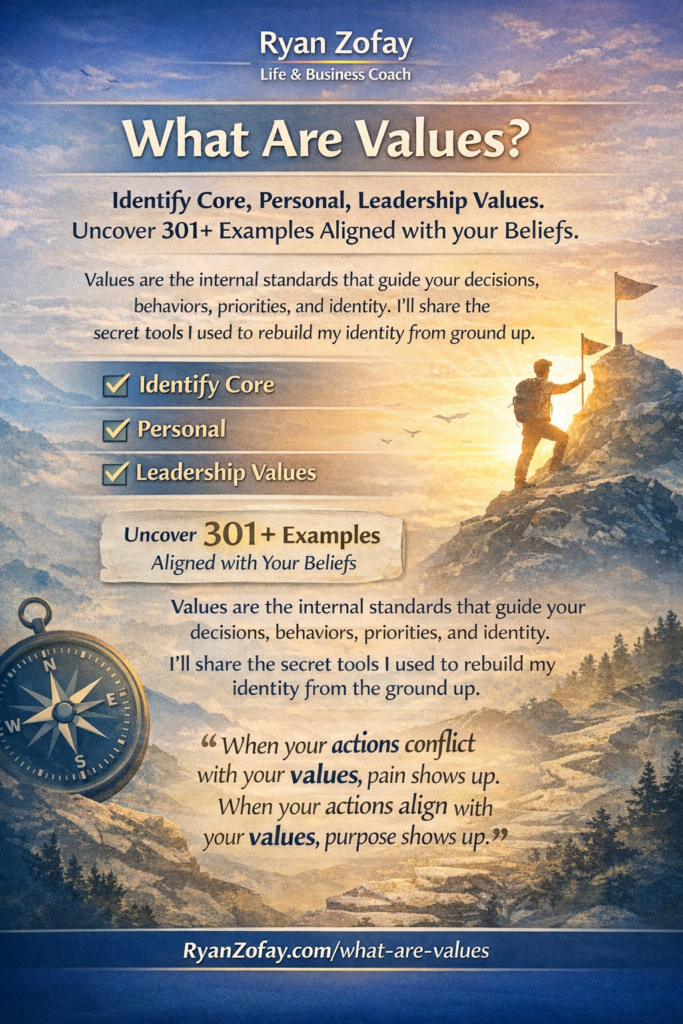
Think of your life as a ship. Your goals are the destination, but your values are the rudder. Without them, you are just drifting, pushed around by the currents of other people’s opinions or your own past traumas.
Values are the internal standards that guide your decisions, behaviors, priorities, and identity. They determine:
- What you say yes or no to
- How you define success
- Who you become under pressure
In simple terms, what are values in life? They are your non-negotiables.
When your actions conflict with your values, pain shows up.
When your actions align with your values, purpose shows up.
What Are Morals and Values?
It’s easy to get confused between ethics, morals, and values. What are moral values versus personal values?
- Morals are often societal or religious standards of right and wrong (e.g., “Thou shall not steal”).
- Values are personal or organizational principles that determine importance (e.g., “I value transparency”).
You can have a value of “loyalty” that leads you to do something immoral (like lying for a friend). That’s why getting clear on what are morals and values in your specific life is critical for finding your life purpose.
What Are Core Values? (The DNA of Your Identity)
In my coaching, I often see high-level executives who are successful on paper but miserable in their hearts. They have the money, but they lack the meaning. This happens when you violate your core.
What are core values? They are your non-negotiables. They are the handful of principles that, if taken away, you would cease to be you.

When I started my business, I had to define what are the core values of Ryan Zofay. I realized my top ones were:
- Vulnerability: Because hiding my pain nearly killed me.
- Growth: Because if I’m not growing, I’m dying.
- Service: Because helping others is the only way I stay sober.
If you are asking, “What are my core values?” look at your calendar and your bank account. Where you spend your time and money shows what you really value at the moment. This is true even if those values, like comfort or approval, are not what you want them to be.
Moreover, core values are the 3–7 principles that sit at the center of who you are. They are:
- Stable (they don’t change with moods)
- Action-oriented
- Identity-based
What are the core values of a person? They are the values you would still live by even if it cost you money, comfort, or approval.
What Are Critical Values?
In crisis, we discover what are critical values. These are the values that rise to the top when the pressure is on. When the FTC sued me and I lost almost everything, my critical value became Resilience. I had to overcome deep-rooted beliefs that told me I was a failure. I had to pivot.
What Are Personal Values? (And Why You Need Them)
What are personal values if not the blueprint for your happiness? If you value “Freedom” but work a 90-hour week in a micromanaged corporate job, you will burn out. If you value “Connection” but spend all your time scrolling social media instead of talking to your spouse, you will feel lonely.
What Are Personal Values Examples?
Here is a list to get you thinking. What are examples of personal values that resonate with you?
- Authenticity: Being real, even when it’s scary.
- Courage: Overcoming fear to take action.
- Health: Prioritizing your physical and mental vessel.
- Wisdom: Seeking knowledge and understanding.
To truly understand what are values of a person, watch how they treat people who can do nothing for them. That is the ultimate test.
The 301+ List: Categorizing Your Values
To help you answer “what are my values,” I’ve broken them down into categories. You cannot value everything, or you value nothing. Use these lists to curate your life.
1. What Are Financial Values?
Money is just energy. What are financial values? They are the principles that dictate how you earn, save, and spend.
| Financial Value | Meaning |
|---|---|
| Security | Prioritizing savings and low-risk investments. |
| Generosity | Using wealth to impact others (like our HOPE scholarship). |
| Freedom | Money as a tool to buy back your time. |
| Legacy | Building generational wealth for your children. |
| Frugality | Finding joy in simplicity and efficiency. |
2. What Are Family Values?
What are family values? These are the glue that holds your home together. Growing up, my family environment was chaotic. Today, I build my “family”—both biological and chosen—on trust.
- Loyalty
- Communication
- Tradition
- Unconditional Love
- Respect
3. What Are Cultural and Traditional Values?
We are shaped by where we come from. What are cultural values? They are the collective principles of a group.
- Collectivism: Putting the group before the individual.
- Honor: Protecting the reputation of the family/community.
What are western values generally? They often focus on:
- Individualism
- Democracy
- Innovation
- Free Speech
What are American values specifically? Often, we look at dreaming the “American Dream,” as the belief that through grit and determination, anyone can rise.
- Liberty
- Equality
- Self-Reliance
- Competition
If you are spiritual, you might ask, what are Christian values? These often overlap with moral values:
- Charity (Love)
- Forgiveness
- Humility
- Grace
4. What Are Company Values? (Leadership)
In my business coaching, I tell founders: culture eats strategy for breakfast. What are company values? They are the rules of the game for your employees.
At We Level Up, we don’t just put words on a wall. We live them.
- Integrity: Do the right thing, always.
- Excellence: Good enough is not enough.
- Compassion: We are in the business of saving lives.
What are effort values? These are crucial for high-performance teams. They value the try, the hustle, and the persistence over just natural talent.
5. What Are Critical Values for Leadership?
What are the critical values that make a leader?
- Vision: Seeing what others cannot.
- Accountability: Taking the blame, sharing the credit.
- Empathy: Understanding the emotional landscape of your team.
If you want to dive deeper into this, check out my thoughts on transformative leadership.

Claim Your Call
Claim your free next level strategy call. Select your date and time. Get guidance and insights. Find answers to your questions. Gain focus, and belief in yourself with No excuses holding you back.

Join the 1%
Seize opportunity. Make the Most of Your Life! Live Without Limitations. Overpower Challenges. Grasp Opportunities to make the Most of Each Moment. Propel & Surpass Others.
What Are More Examples of Values? (The Master List)
Here are examples to help you select your top 5.
The Drivers (Achievement)
- Ambition
- Discipline
- Excellence
- Perseverance
- Success
- Impact
The Connectors (Relational)
- Empathy
- Kindness
- Collaboration
- Trust
- Vulnerability
The Stabilizers (Foundational)
- Balance
- Health
- Security
- Order
- Peace
The Explorers (Growth)
- Curiosity
- Adventure
- Innovation
- Learning
- Freedom
What are effort values?
- Hard work
- Persistence
- Perseverance
- Self-discipline
- Dedication
- Responsibility
- Motivation
- Commitment
- Resilience
- Doing one’s best
What Are Examples of Core Values?
Here are examples of core values I see most often in high performers:
- Integrity
- Responsibility
- Courage
- Faith
- Service
- Family
- Excellence
These are also what are some core values shared across cultures.
What are cultural values examples?
- Family orientation
- Individualism
- Collectivism
- Respect for elders
- Work ethic
- Education
- Religion or spirituality
- Hospitality
- Honesty
- Tradition
- Gender roles
- Time orientation
- Respect for authority
- Community involvement
- Self-reliance
What are moral values?
Moral values are principles that help people understand right and wrong. They influence how we behave and make decisions.
Examples of moral values include:
- Honesty
- Integrity
- Respect
- Responsibility
- Fairness
- Kindness
- Compassion
- Empathy
- Justice
- Loyalty
- Trustworthiness
- Forgiveness
- Courage
- Humility
What are the critical values?
Critical values are principles that emphasize thinking carefully, evaluating information, and making reasoned judgments. They focus on how people analyze ideas, decisions, and situations rather than accepting things at face value.
Examples of critical values include:
- Critical thinking
- Open-mindedness
- Objectivity
- Logical reasoning
- Skepticism
- Evidence-based thinking
- Curiosity
- Problem-solving
- Fair-mindedness
- Intellectual honesty
What are traditional values?
Traditional values are beliefs and principles. They focus on customs, long-standing practices, and cultural or social norms. These are passed down through generations.
Examples of traditional values include:
- Respect for elders
- Family loyalty
- Marriage and family stability
- Religious faith
- Obedience to authority
- Cultural customs and rituals
- Gender roles
- Modesty
- Duty and responsibility
- Preservation of heritage
What are the army values?
The Army Values are the core principles that guide members of the U.S. Army. They are commonly remembered by the acronym LDRSHIP.
The Army Values are:
- Loyalty
- Duty
- Respect
- Selfless Service
- Honor
- Integrity
- Personal Courage
These values define expected behavior and ethical standards for soldiers in both military and civilian life.
What are brand values?
Brand values are the main principles and beliefs that guide how a company acts, talks, and shows itself to customers and the public.
Examples of brand values include:
- Trust
- Transparency
- Quality
- Innovation
- Customer focus
- Integrity
- Sustainability
- Reliability
- Authenticity
- Social responsibility
- Inclusion and diversity
- Accountability
What are ethical values?
Ethical values are principles that guide moral conduct, decision-making, and professional behavior, especially in situations involving fairness, responsibility, and accountability.
Examples of ethical values include:
- Honesty
- Integrity
- Fairness
- Accountability
- Respect
- Transparency
- Responsibility
- Trustworthiness
- Justice
- Professionalism
- Confidentiality
- Ethical leadership
What are the values of America?
The values of America commonly refer to core principles that shape U.S. society, culture, and civic life.
Examples of American values include:
- Freedom
- Democracy
- Equality
- Individualism
- Rule of law
- Justice
- Opportunity
- Personal responsibility
- Patriotism
- Free enterprise
- Diversity
- Civic duty
What are value judgments?
Value judgments are opinions or evaluations that are based on personal beliefs, values, or morals, rather than objective facts. They involve deciding whether something is good or bad, right or wrong, important or unimportant.
Examples of value judgments include:
- “Honesty is more important than success.”
- “Everyone should be treated equally.”
- “Hard work is better than natural talent.”
- “Freedom is the most important right.”
- “This behavior is unacceptable.”
What are work values?
Work values are beliefs about what is important in a job or workplace. They influence career choices, job satisfaction, and professional behavior.
Examples of work values include:
- Achievement
- Responsibility
- Teamwork
- Reliability
- Work–life balance
- Job security
- Professional growth
- Independence
- Fair pay
- Recognition
- Integrity
- Respect
What are conservative values?
Conservative values generally emphasize tradition, stability, personal responsibility, and limited government. They are often rooted in preserving established social, cultural, and economic institutions.
Examples of conservative values include:
- Respect for tradition
- Family values
- Personal responsibility
- Limited government
- Free-market capitalism
- Rule of law
- National security
- Religious or moral tradition
- Individual liberty
- Fiscal responsibility
What are Jesuit values?
Jesuit values are principles based on the teachings of the Society of Jesus (Jesuits). They focus on education, service, justice, and spiritual growth.
Core Jesuit values include:
- Cura personalis (care for the whole person)
- Service to others
- Social justice
- Magis (striving for excellence)
- Reflection and discernment
- Faith and spirituality
- Finding God in all things
- Leadership in service
What are social values?
Social values are shared beliefs about what is important, acceptable, and desirable in a society. They guide how people interact with others and function within communities.
Examples of social values include:
- Cooperation
- Respect
- Equality
- Fairness
- Responsibility
- Tolerance
- Trust
- Community involvement
- Social justice
- Rule-following
- Civic duty
What are values in culture?
Values in culture are common beliefs and principles. They guide behavior, traditions, and social norms in a group or society.
Examples of values in culture include:
- Family importance
- Respect
- Tradition
- Religion or spirituality
- Individualism or collectivism
- Hospitality
- Work ethic
- Education
- Social harmony
- Responsibility
- Loyalty
What are corporate values?
Corporate values are the main principles that guide how a company works. They influence decisions and how the company treats employees, customers, and stakeholders.
Examples of corporate values include:
- Integrity
- Accountability
- Transparency
- Customer focus
- Teamwork
- Innovation
- Respect
- Excellence
- Diversity and inclusion
- Sustainability
- Ethical conduct
What are expected values?
Expected values are standards or behaviors that people should show. This applies in places like school, work, family, and society. They reflect norms, rules, and shared expectations.
Examples of expected values include:
- Respect
- Responsibility
- Honesty
- Punctuality
- Accountability
- Cooperation
- Professionalism
- Fairness
- Reliability
- Courtesy
What are good values?
Good values are positive principles that guide ethical behavior, healthy relationships, and responsible decision-making.
Examples of good values include:
- Honesty
- Respect
- Kindness
- Integrity
- Responsibility
- Empathy
- Fairness
- Compassion
- Trustworthiness
- Loyalty
- Humility
- Perseverance
What are social values as they pertain to money?
Social values about money are shared beliefs in a society. They explain how money should be earned, spent, saved, and shared. These values influence attitudes toward wealth, spending, and financial responsibility.
Examples of social values related to money include:
- Hard work as a path to income
- Saving and financial responsibility
- Fair pay for work
- Generosity and charitable giving
- Economic equality or equity
- Avoiding excessive debt
- Responsible spending
- Providing for family
- Ethical earning
- Social responsibility of wealth
What are the four person centered core values?
The four person-centered core values (commonly used in person-centered care, especially in healthcare and social services) are:
- Dignity and respect
- Information sharing
- Participation
- Collaboration
These values focus on treating people as partners in their care. They honor their preferences and involve them in decisions that affect their lives.
What are company core values?
Company core values are the basic principles that guide how a business works. They influence decisions and how the company treats employees, customers, and partners. They define the company’s culture and expectations.
Examples of company core values include:
- Integrity
- Accountability
- Transparency
- Customer focus
- Teamwork
- Innovation
- Respect
- Excellence
- Ethical behavior
- Diversity and inclusion
What are daily values?
Daily values are the everyday principles or habits that guide how people act and make choices. They also shape how we interact with others regularly.
Examples of daily values include:
- Honesty
- Respect
- Responsibility
- Kindness
- Punctuality
- Patience
- Self-discipline
- Gratitude
- Cooperation
- Accountability
What are organizational values?
Organizational values are the common principles and beliefs that guide how an organization works. They influence decisions and behavior both inside and outside the organization.
Examples of organizational values include:
- Integrity
- Accountability
- Transparency
- Teamwork
- Respect
- Excellence
- Innovation
- Ethical conduct
- Customer or stakeholder focus
- Diversity and inclusion
Once you have your top 5, write them down. Put them on your mirror. These are now your filter for every decision. Download my Personal Development Plan Template to formalize this.
The Science of Core Values: The Foundation of Who You Are
Core values define what matters most and guide how you think, act, and lead.
They shape your decisions, boundaries, identity, and long-term success.
Science Findings and Stats
| Science Behind Core Values (Study + Findings + Stats + URL) | Insights, Tips, DIY Activities |
|---|---|
| Key Finding: Values-driven leadership strengthens trust, which directly improves performance and reduces stress/burnout outcomes. Stats: Employees at high-trust companies report 74% less stress, 106% more energy, 50% higher productivity, and 40% less burnout. Harvard Business Review / Trust & Leadership Research: https://hbr.org/2017/01/the-neuroscience-of-trust | My Insight: Trust starts with integrity — when your actions match your values, you build self-trust and confidence. ✅ DIY Exercise: Integrity Tracker – Pick 1 value (ex: discipline) – Track 1 daily action that proves it (workout, hard conversation, deep work) 🔗 Guide: Printable Tracker Template |
| Key Finding: When goals align with internal values (autonomy, competence, relatedness), motivation becomes more sustainable and self-driven. Stat: Values-aligned goals improve long-term persistence and follow-through (supported across SDT research). Self-Determination Theory (SDT) — Intrinsic Motivation & Values Alignment: https://selfdeterminationtheory.org/theory/ | My Tip: Stop chasing outcomes that look good externally — build goals that match your identity. ✅ DIY Exercise: Values → Goals Translation – Value: “Growth” – Goal: “Read 20 pages/day” – Standard: “No zero days” 🔗 Guide: Uncover How to make SMART goals. |
| Key Finding: Values clarity reduces avoidance behavior and improves psychological flexibility (better decision-making under stress). Stat: ACT is widely supported as evidence-based for improving mental health and behavior change through values-aligned action. Acceptance & Commitment Therapy (ACT) — Values-Based Living: https://contextualscience.org/act | My Insight: You don’t “feel” your way into discipline — you act your way into it. Values-based action creates confidence. ✅ DIY Exercise: The 5-Minute Values Move – Ask: “What would my best self do for 5 minutes?” – Do it immediately 🔗 Guide: https://ryanzofay.com/confidence-coach/ |
| Key Finding: People experience higher satisfaction and resilience when work aligns with personal meaning and values. Stat: Values alignment is strongly correlated with job satisfaction and psychological well-being across APA-supported workplace research. American Psychological Association (APA) — Work Meaning, Values, Satisfaction: https://www.apa.org/monitor/2023/07/meaning-work | Tip: Boundaries are value-protection systems — if you don’t defend your values, your calendar will destroy them. ✅ DIY Exercise: Boundary Builder Script – “That’s not a priority for me right now.” – “I’m protecting my focus this week.” 🔗 Guide: Motivational resilience quotes for Strength, Inspiration, Growth can help you level up. |
| Key Finding: Consistency between values and actions strengthens identity and behavior repetition (identity-based habit formation). Stat: Repeated aligned actions reinforce self-concept, improving long-term consistency and emotional regulation. Neuroscience of Habits + Identity Reinforcement: https://www.ncbi.nlm.nih.gov/pmc/articles/PMC4833422/ | My Insight: Your identity isn’t what you say — it’s what you repeatedly prove. ✅ DIY Exercise: Evidence List – Write 10 “proof points” you’re becoming disciplined/confident – Add 1 new proof daily 🔗 Guide: Select the Best Morning Routine for Success. Building these consistent habits enhances productivity, clarity and success. |
Core values don’t just “sound good” — they create measurable impact when lived daily:
- They reduce stress and burnout risk through trust and alignment
- They strengthen intrinsic motivation and follow-through via purpose-driven goals
- They improve emotional regulation and decision-making under pressure through values-based action
- They reinforce identity through consistent aligned behavior
Activity: Discover What Are Your Values
Exercise 1: Values Extraction
- Write 10 moments you felt proud.
- Identify the value present in each.
- Narrow down to 5 recurring themes.

Exercise 2: Pain Audit
Ask:
- When was I most frustrated?
- Which value was violated?
Pain often points directly to what are my values

Activity: What Are My Values Quiz?
You might be asking, “what are my values quiz?” or “how do I find them?” You don’t need a complex algorithm. You need quiet reflection.
Step 1: The Peak Experience
Think of a moment in your life when you felt the most alive, proud, and aligned. What was happening?
- Example: I felt most alive when I helped my first client stay sober.
- Value: Service / Impact.
Step 2: The Trigger Moment
Think of a time you were angry or frustrated. Usually, anger comes when a value is violated.
- Example: I get angry when people lie to me.
- Value: Honesty / Truth.
Step 3: The “Must-Haves”
Look at the list below. What are some core values you absolutely cannot live without? Pick 5.
What Are Core Values in a Person? (Living It)
Knowing what are examples of values is easy. Living them is hard.
What are core values in a person who is actually integrated? It means your “audio” matches your “video.” What you say you believe matches what you do.
If you say you value “Health” but you never exercise, that is not a value; it’s a wish.
If you say you value “Family” but you bring your work stress home every night, you are out of alignment.
To fix this, you need routine. You need a morning routine for success that reinforces your values before the world tries to steal your attention.
FAQs
What Are Effort Values?
Persistence, consistency, grit, work ethic.
What are critical values?
Values that become non-negotiable during pressure or crisis.
What are cultural values?
Shared norms passed through communities.
What Are Personal Values?
They are the principles you personally choose to live by—regardless of culture, family, or society.
What are moral values?
Ethics like honesty, fairness, and responsibility.
What are American values / Western values?
Freedom, individual responsibility, opportunity, equality.
What are family values?
Loyalty, commitment, protection, and love within family systems.
Conclusion: Your Values Are Your Legacy
We covered a lot today. We talked about what values are. We also discussed what core values mean. Finally, we shared examples of personal values in different areas of life.
But knowledge isn’t power. Action is power.
I was given a second chance at life not so I could hoard success, but so I could share the roadmap. Your values are that roadmap. When you clarify what are your values, you stop agonizing over decisions. You stop worrying about what others think. You start building a legacy that outlasts you.
Are you ready to level up?
If you want to explore more, and understand the core values that will lead to your success, I invite you to join me. Whether it’s through my personal development workshops or one-on-one coaching, let’s do the work together.
You deserve to live a life that makes you proud.

Additional Resources on RyanZofay.com
- About Ryan Zofay
- Online Life Coach Services
- Making SMART Goals
- Finding Your Passion
- The Art of Public Speaking
- Mindfulness Exercises
- Emotional Intelligence Test
- Leadership Training Programs
- Benefits of Journaling
- Self-Love Journal for Success
- How to Be the Best Version of Yourself
- Business Networking Events
- We Level Up Treatment Centers
