
What is my Purpose Guide and Quiz. Top 10 Questions Answering What is my Purpose in Life.
Feeling stuck asking “what is my purpose?” You aren’t alone. Use my purpose guide and quiz to uncover your passion, meaning, and direction today. Start by exploring what am I passionate about? Dive into what should I do with my life. Consider growth mindset coaching to add more meaning to your life.
In this guide, I will help you use the same framework that helped me find my purpose in life. We will look at practical steps you can take now. We will also discuss important questions to ask. Plus, there is a what is my purpose in life quiz to help you find your starting point. Clarity does not come from guessing. It comes from getting honest.
Finding what is my purposes in life – my life story
My Life Story
I used to hate the quiet hours of the night. Around 3 a.m., when everything slowed down, my mind got loud. I’d stare at the ceiling with a tight chest and a heavy, sinking feeling that wouldn’t let me rest. Back then, I wasn’t just stressed. I was facing the effects of addiction, broken relationships, and a life that seemed busy but felt aimless. And the question that kept coming, no matter how hard I tried to outrun it, was simple and brutal:
What is my purpose?
I asked it a dozen different ways—what is my purpose in life, what is my life purpose, what is the purpose of my life, what is my purpose on earth? Hoping one version of the question would finally produce an answer that made everything make sense. Some nights I’d even search for a what is my purpose meme just to break the tension and feel normal for five seconds. But the truth was, I wasn’t looking for a laugh. I was looking for relief. I needed to believe my life mattered.
My name is Ryan Zofay. I’m sharing this because I have felt the confusion, shame, emptiness, and fear. I wondered if there is no “why” at all. I’ve also lived what happens when you stop running long enough to rebuild your life with intention. This page isn’t theory for me. It’s personal.
My Background
When people search “what is my purpose in life”, they’re rarely asking out of curiosity. Many people feel something is wrong. They feel like they are just surviving, not really living. They check off tasks but still feel empty. They seem successful on paper but feel disconnected inside. I understand that, because purpose didn’t come to me through a clean, inspirational moment. It came through pain, accountability, and a decision to change.
In my experience, purpose isn’t something you magically discover—it’s something you develop. It’s shaped through self-awareness, values, service, and the willingness to turn your hardest seasons into something meaningful. I spent hundreds of hours in personal development seminars. I practiced emotional intelligence, which helped me grow as a servant leader. This journey led me to found the We Level Up Behavioral Health clinics.
Many people begin with tools like a what is my purpose in life quiz or a what is my purpose quiz. They want words for their feelings and a starting point. This helps them not feel pressured to have everything figured out right now. And for others, the question is spiritual at its core—what is God’s purpose for my life? Because they’re looking for meaning that goes beyond career goals or productivity.
This guide is built for all of that. It’s grounded in lived experience, practical reflection, and real-world steps that help you move from “I’m lost” to “I have direction.” I will share what I learned in recovery. I will talk about what I’ve seen in others who rebuilt their lives. I will also share the questions that helped me turn my lowest point into a mission.
If you’re asking what is my life purpose right now, you don’t need a perfect plan. You need a path—and a way to take the next right step. That’s what we’re going to build here.
We’ll examine the tools, questions, and insights that helped me answer “what is my purpose in life.” We’ll dive into the science behind purpose, practical steps you can take today, and a quiz to help you get started.
Jump To
Table of Contents
Why “What Is My Purpose?” Is the Most Important Question You’ll Ask
When we ask, “what is the purpose of my life,” we aren’t just looking for a job title. We are looking for an anchor.
Science backs this up. Research shows that having a clear sense of purpose is one of the strongest predictors of long-term health and happiness. A study published in Psychological Science found that purposeful individuals actually lived longer than their counterparts. This wasn’t just about being happy; it was about having a direction.
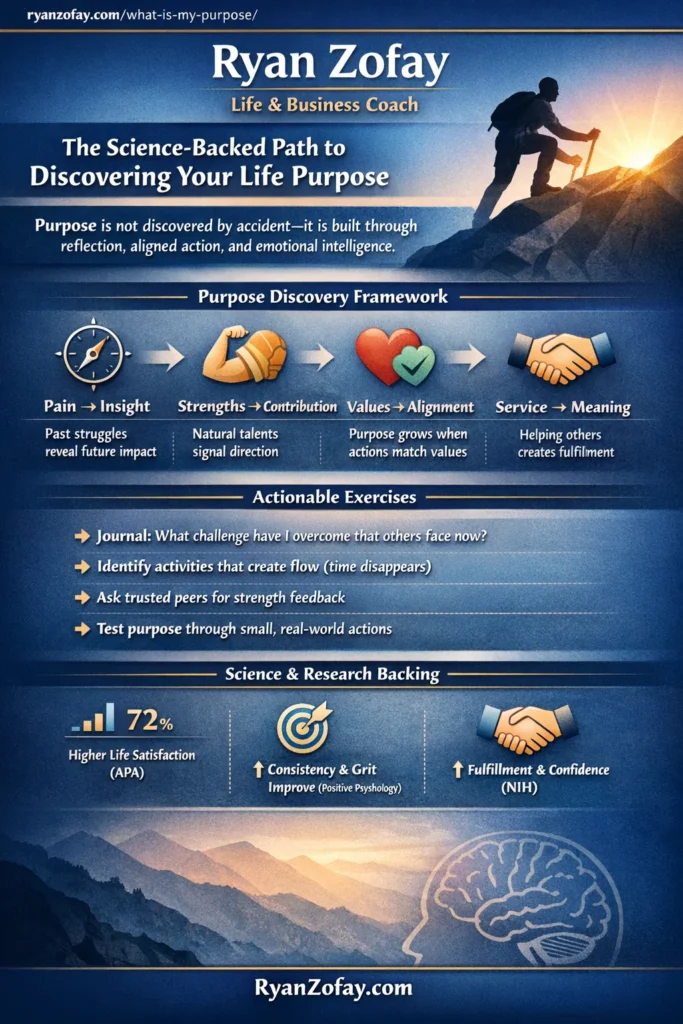
When I was struggling, I didn’t have that direction. I was adrift. Once I found my purpose in helping others, my life changed. I focused on helping people overcome addiction and trauma. I went from feeling like a victim of my circumstances to being the architect of my future.
Having a purpose gives you:
- Resilience: When life hits hard (and it will), purpose helps you bounce back.
- Clarity: It acts as a filter for decision-making. If something doesn’t align with your purpose, it’s easier to say no. Apply emotional intelligence 2.0 best practices to overcome self-doubt and build confidence.
- Motivation: It’s the fuel that gets you out of bed when you’d rather stay under the covers.
If you are asking “what is my soul purpose” or “what is my life’s purpose,” you are already on the right track. The desire to know is the first step toward the answer. Join my next level performance high achiever personal development workshops to refine your purpose and meaning.

Science + Coaching for Purpose, Resilience, Performance, & Leadership
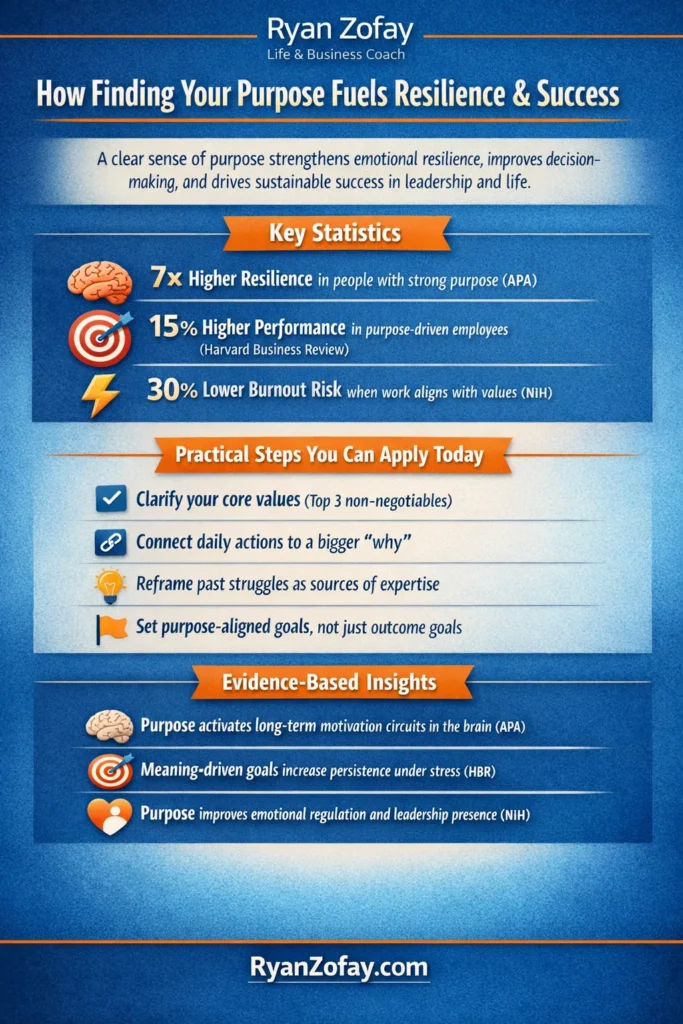
Purpose is not a motivational slogan; it is a measurable psychological resource. Research shows that having a strong sense of purpose helps with stress management. It also leads to better emotional recovery after tough times. Additionally, it improves long-term health. All these factors are important for good leadership. They help with staying calm under pressure, being persistent, and making decisions based on values.
Uncover your Purpose & Passion. Change your Life!
Find your Passion to Find Hope, Inspiration & Motivation.
Uncover a Greater Purpose. Feel Motivated, Connected & Supported. Improve Anxiety & Relationships with Coaching That Works.
Find Your Passion to Unlock Your PotentialMy framework on crafting your purpose turns these findings into practical coaching steps. These steps include values clarity, “mini-purpose” experiments, feedback loops, and service-driven meaning.
Evidence-based Insights Behind Purpose
| Science Behind Purpose (Study • Findings • Stats • URL) | Ryan Zofay’s Insights, Tips, DIY Activities + Guides (Ryanzofay.com) |
|---|---|
| Purpose in Life as a Predictor of Mortality Across Adulthood (Hill & Turiano, 2014, Psychological Science) \n Finding: Purpose predicts longevity across adulthood, even when controlling for other well-being factors. \n Stat: Purpose associated with living longer across a 14-year follow-up (hazard-model results reported in paper). \n Study: midus.wisc.edu PDF (MIDUS – Midlife in the United States) | Insight: If purpose can predict long-term health outcomes, it can absolutely predict long-term leadership performance. Because leaders under pressure need an internal “why,” not external motivation. DIY: “Purpose Anchor” (10 minutes) — Write one sentence: “I exist to ______ so that ______.” Post it where you plan your day. \n Guides: Purpose guide + questions. How to get motivated and stay that way. |
| Association Between Life Purpose and Mortality Among US Adults Older Than 50 (Alimujiang et al., 2019, JAMA Network Open) \n. Finding: Lower purpose is linked to higher all-cause mortality risk in older adults. \n. Stat: Hazard ratio 2.43 comparing lowest vs highest purpose group (all-cause mortality). \n Study: JAMA Network Open (JAMA Network) | Insight: Purpose is protective because it organizes behavior. When your “why” is clear, decisions get simpler and distractions lose power. DIY: Values-to-Decisions Filter — List your top 3 values. Before any commitment, ask: “Does this strengthen or drain my values?” Guides: What should I do with my life? |
| Purpose in Life Predicts Better Emotional Recovery from Negative Stimuli (2013, PLOS ONE) \n Finding: Purpose is linked to better emotional recovery (a resilience mechanism). \n Stat: Study supports purpose as a mechanism for emotion regulation after negative provocation. \n URL: PLOS ONE (PLOS) | Insight: Emotional regulation is leadership. Purpose helps you recover faster so you can respond—rather than react—under pressure. (PLOS) \n. DIY: 90-Second Reset + Reframe — When triggered: breathe slowly for 90 seconds, then write: “The lesson here is ______.” \n Guide: Growth mindset coaching |
| The Motivational Potential of Meaningful Work: Meaning → Strengths Use → Engagement → Performance (2018, PLOS ONE) \n. Finding: Meaningful work connects to performance through engagement and strengths use pathways. \n. Stat: Study models meaningful work’s relationship to performance via engagement/strengths use (multiple mediated links). \n. Study: PLOS ONE (PLOS) | Insight: “Purpose-driven performance” is built by aligning strengths to outcomes. If you do work that uses your strengths, motivation becomes renewable. (PLOS) \n. DIY: Strength-to-Service Map — Write 3 strengths → 3 ways they help others → 1 weekly action to apply them. \n. Guide: What am I passionate about? |
| Value Congruence and Workplace Burnout (Veage et al., 2014/2015; values-work alignment study) \n. Finding: Values congruence is linked to lower burnout and higher wellbeing (especially in caring professions). \n. Stat: Reported relationship: higher value congruence → lower burnout (directional finding; specific effect sizes vary by measure). \n. Study: ScienceDirect (ScienceDirect) | Insight: Burnout is often misdiagnosed as “too much work.” Many times it’s misaligned work—high effort with low meaning. (ScienceDirect) \n. DIY: Alignment Audit (15 minutes) — Rate your week’s tasks: +2 energizing / 0 neutral / -2 draining. Reduce one -2 task or redesign it to serve a value. \n. Guide: 5 steps to clarity |
| Sense of Purpose and Emotion Regulation Strategy Use (2025 mini-review, ScienceDirect) \n. Finding: Emerging evidence links stronger purpose with healthier emotion regulation strategies (e.g., cognitive reappraisal). \n. Stat: Review highlights consistent connections between purpose and reduced stress reactivity / better strategy use across studies. \n. Study: ScienceDirect (ScienceDirect) | Insight: Purpose doesn’t remove stress—it changes your relationship to stress. That’s why purpose-driven people persist longer and quit less often. (ScienceDirect) \n. DIY: Mini-Purpose Experiments (7 days) — Choose one “test purpose” (mentor, create, lead, serve). Do it daily for 20 minutes. Track energy and meaning. \n. Guides: Improvise adapt to overcome. How to recover from burnout playbook. Resilience quotes. |
The Science-based Takeaways
My life coaching approach helps you take action on your purpose. First, we define your values. Then, we run small “mini-purpose” experiments. After that, we seek feedback. Finally, we build meaning through service.
Purpose strengthens resilience by improving emotional recovery and stress regulation, which supports better leadership presence under pressure.
Meaningful work boosts performance by increasing strengths and engagement. Purpose becomes real when it is shown through consistent action.
Values alignment protects against burnout risk; when values conflict is chronic, exhaustion and disengagement rise.
Top 10 Questions to Answer “What Is My Purpose in Life?”
You can’t Google your way to your life’s purpose. You can scroll endlessly. Take my what is my purpose quiz. Laugh at a what is my purpose meme, rather than searching for what is my purpose in life at 2 a.m.—and still feel stuck. Real purpose work is internal.
The right questions act like keys. They unlock insight, clarity, and direction. You need the right prompts to unlock those answers. Here are the top 10 questions I ask my coaching clients to help them breakthrough.
1. What pain have you overcome that you now want to help others avoid?
Insight: Your life experience is not random. What you survived often becomes what you’re meant to serve through. Purpose is frequently born from pain that’s been transformed into wisdom.
Example: My struggle with addiction became the foundation for my work in recovery, leadership, and personal growth. What once nearly destroyed me now allows me to help others rebuild their lives.
Exercise: Write down the three hardest seasons of your life. Next to each one, answer: What did I learn that could help someone else?
Helpful resource: Explore how pain becomes purpose in my guide on how to be change.
This was the game-changer for me. My struggle with addiction became my platform for impact. Your deepest wounds often reveal your greatest power. If you’ve survived something difficult, your purpose might be guiding others through that same darkness.
2. What would you do if you knew you couldn’t fail?
Insight: Confusion is often fear in disguise. When people say “I don’t know my purpose,” what they usually mean is “I’m afraid of the risk.”
Example: Clients often say they want to start coaching, writing, building a nonprofit, or changing careers. But fear holds them back.
Exercise: Remove failure from the equation for five minutes. Write freely: If success was guaranteed, I would…
Fear often masquerades as confusion. We say “I don’t know what to do” when we really mean “I’m scared to do what I want.” Remove the possibility of failure for a moment. What dreams surface?
3. What activities make you lose track of time?
Insight: Psychologists call this a flow state—when skill, interest, and meaning intersect. Flow is a powerful indicator of alignment with your life’s purpose.
Example: You may lose hours teaching, creating content, problem-solving, mentoring, or building systems.
Exercise: Track your week. Note when time disappears and energy increases. Those moments are clues.
When you are in a flow state, you are fully immersed and energized. Is it writing? solving complex problems? gardening? coaching others? Follow the flow.
4. Who do you secretly admire, and why?
Insight: Admiration is directional. We admire people who are expressing traits or missions we haven’t yet owned in ourselves.
Example: If you admire speakers, maybe your purpose involves using your voice. If you admire healers, maybe service is core to your life’s work.
Exercise: List three people you admire. Write why for each. Look for patterns.
Jealousy and admiration are maps. If you admire someone who is a great speaker, it might be because you have a dormant desire to use your voice. If you admire a philanthropist, maybe your soul purpose involves giving back.
5. What makes you angry about the world?
Insight: Purpose isn’t always tied to passion—it’s often tied to injustice. Anger can be a compass.
Example: Some people are driven by outrage at addiction, mental health neglect, inequality, or abuse. That anger points to a mission.
Exercise: Finish this sentence honestly: “I can’t stand when…”
Purpose isn’t always about what you love; sometimes it’s about what you hate. Injustice, poverty, cruelty—what breaks your heart? Your purpose might be the solution to a problem that angers you.
6. What are your natural talents?
Insight: Your gifts often feel “normal” to you—which is why you undervalue them. But ease is evidence.
Example: You might naturally listen deeply, organize chaos, motivate others, or see patterns others miss.
Exercise: Ask three trusted people: What do you think I’m naturally good at?
Assessment: For deeper insight, take my free 16 personalities test.
What comes easily to you that others struggle with? Maybe you are a natural listener, or you can organize chaos into order. These are clues. For help identifying these, also check out my Free DISC Assessment.
7. If you had to teach something to others with zero preparation, what would it be?
Insight: This reveals both confidence and lived expertise—two pillars of purpose-driven work.
Example: Recovery tools, leadership under pressure, relationships, fitness, mindset, or communication.
Exercise: Answer quickly. Don’t overthink it. Speed reveals truth.
This reveals your innate expertise and passion. It’s the topic you can talk about for hours without getting bored.
8. What did you love doing as a child?
Insight: Before conditioning and expectations, you were already wired a certain way. Your younger self left clues.
Example: Building, performing, protecting others, teaching, exploring, creating.
Exercise: Ask: What energized me before I cared what people thought?
Before the world told you who to be, who were you? Did you build things? Did you perform? Did you protect others? Your childhood self often holds the key to your adult purpose.
9. How do you want to be remembered?
Insight: his question cuts through noise. Purpose becomes clear when you think in legacy terms.
Example: “Successful” fades fast. “He helped me change my life” doesn’t.
Exercise: Write your own eulogy in one paragraph. Be honest.
Imagine your eulogy. What do you want people to say about you? “He made a lot of money” or “He changed lives”? Living with the end in mind clarifies what matters now.
10. What are you willing to struggle for?
Insight: Every meaningful path includes pain. Purpose isn’t avoiding struggle—it’s choosing the right one.
Example: You may hate comfort-zone discomfort but willingly endure hardship for growth, service, or impact.
Exercise: Finish this sentence: “I’m willing to suffer for…”
Every path has challenges. Purpose isn’t about finding a path without pain. It’s about finding the pain you can handle because the result is worth it.
Takeway
If you are wondering about your life purpose or God’s purpose for you, keep this in mind:
- Clarity comes from getting involved.
- It does not come from being perfect.
These questions aren’t meant to overwhelm you—they’re meant to activate you. Use them. Journal them. Sit with them. Revisit them. And if you want structured support, guided exercises, and deeper self-discovery tools, explore my free guides and quizzes. Purpose doesn’t arrive fully formed. It’s built—one honest answer at a time.
Your Purpose Guide: 5 Steps to Clarity
If you are still asking “god what is my purpose” or feeling lost, follow this simple framework.
Step 1: Self-Reflection and Assessment
You need data on yourself. It’s hard to read the label when you are inside the jar. Use tools to get an objective view of your personality and drives.
- Action: Take my Free Enneagram Test Online to understand your core motivations and fears.
Step 2: Define Your Values
Your values are your north star. If you are living out of alignment with them, you will feel lost.
- Action: Write down your top 5 values. Is it Freedom? Integrity? Family? Service? Creativity?
Step 3: Experiment with “Mini-Purposes”
You don’t have to get it 100% right immediately. Treat your life like a lab. Try volunteering. Start that side project.
- Action: Commit to one new experience this month that aligns with a potential interest.
Step 4: Seek Feedback
Ask the people who know you best. Sometimes they see your light when you only see your flaws.
- Action: Ask three friends, “When do you see me at my happiest?” or “What do you think is my greatest strength?”
Step 5: Serve Others
I truly believe that service is the fast track to purpose. When you focus on others instead of yourself, the question “what is my purpose on earth” often answers itself.
- Action: Find one way to help someone else today, with no expectation of return.
What Is My Purpose Quiz
While no online quiz can tell you the full depth of your soul, this quick assessment can point you in the right direction. Be honest with your answers.
1. When do you feel most energized?
- A) When I’m solving a complex problem or puzzle.
- B) When I’m listening to a friend and helping them through a tough time.
- C) When I’m creating something new (art, writing, building).
- D) When I’m leading a team to achieve a goal.
2. What type of books or content do you consume most?
- A) Non-fiction, science, history, or “how-to” guides.
- B) Biographies, psychology, or self-help.
- C) Fiction, design blogs, or creative inspiration.
- D) Business, leadership, or strategy.
3. In a group project, what role do you naturally take?
- A) The Researcher: I gather the facts and ensure accuracy.
- B) The Peacemaker: I ensure everyone feels heard and included.
- C) The Creator: I come up with the big ideas and vision.
- D) The Driver: I set the deadlines and keep us moving forward.
4. What is your biggest fear?
- A) Being incompetent or ignorant.
- B) Being unloved or unwanted.
- C) Being ordinary or misunderstood.
- D) Being powerless or controlled.
5. If you could change one thing about the world, what would it be?
- A) Inefficiency and lack of truth.
- B) Suffering and loneliness.
- C) Ugliness and lack of expression.
- D) Injustice and weakness.
Quiz Results Interpretation
Mostly A’s: The Thinker/Solver
Your purpose likely involves Truth and Wisdom. You are here to analyze, understand, and solve the problems that confuse others. Look into fields where your analytical mind can shine—research, engineering, consulting, or teaching.
Mostly B’s: The Healer/Helper
Your purpose likely involves Love and Connection. You have a gift for empathy. “Lord what is my purpose?” For you, it’s often simply to love people back to life. Consider coaching, counseling, healthcare, or community building.
Mostly C’s: The Creator/Visionary
Your purpose likely involves Beauty and Innovation. You are here to bring the new into existence. Whether it’s art, business innovation, or storytelling, your soul craves expression. Don’t stifle that creative impulse.
Mostly D’s: The Leader/Challenger
Your purpose likely involves Power and Justice. You are a natural protector and leader. You are here to move mountains and champion causes. Look for roles where you can lead change—entrepreneurship, advocacy, or management.
Note: For a deeper dive into your personality type, check out my Free Enneagram Test Online and Free DISC Assessment.
The Science of Purpose: It’s Not Just a Feeling
We often think of purpose as this mystical, intangible concept. But researchers like Michael Steger have quantified it. The Meaning in Life Questionnaire breaks purpose down into two parts:
- Presence of Meaning: Do you feel your life has meaning right now?
- Search for Meaning: Are you actively looking for meaning?
For a long time, I was high on the “search” but low on the “presence.” I was desperate for answers but felt empty. The goal is to move from constantly searching to living in that presence.
According to Self-Determination Theory, human beings have three innate psychological needs:
- Autonomy: Feeling in control of your own behaviors and goals.
- Competence: Feeling effective in navigating your environment.
- Relatedness: Feeling a sense of belonging and attachment to others.
Your purpose usually lies at the intersection of these three. When you find something you enjoy, that you are skilled at, and that connects you with others, you may have discovered your purpose.
Overcoming the “I Don’t Know What to Do” Trap
I hear it all the time: “I don’t know what to do with my life.”
Here is the truth: Clarity comes from action, not thinking. You cannot think your way into a new way of living; you have to live your way into a new way of thinking.
When I was stuck, I had to take messy action. I had to try things that didn’t work. I had to fail. And with every step, the fog lifted a little bit more.
If you are paralyzed by the fear of picking the “wrong” purpose, remember that purpose evolves. My purpose at 20 is different from my purpose now. That’s okay.
If you are feeling stuck, read my guide on I Don’t Know What to Do With My Life. It breaks down practical strategies to get unstuck and start moving.
The Spiritual Dimension: “Lord, What Is My Purpose?”
For many of us, the search for purpose is deeply spiritual. We feel a tug that says we were made for more. We ask, “what is my purpose in life god” or “what is my soul purpose.”
In my own journey, connecting with a higher power was essential. It took the pressure off me to be the center of the universe. I realized I was part of a larger story.
No matter what you believe, asking “what is the purpose of my existence” brings a feeling of humility and wonder. It acknowledges that your life is a gift. The question then becomes: How will you use this gift to bless others?
Next Steps: Moving from Question to Action
You’ve read my “what is my purpose” guide. You’ve taken the quiz. Now what?
- Commit to Growth: Personal development isn’t a luxury; it’s a necessity for a purposeful life.
- Get a Coach: Sometimes we need someone to hold the mirror up for us. Check out my Online Life Coach resources.
- Find Your Tribe: Surround yourself with people who are also asking big questions. Join a Personal Development Workshop to meet like-minded achievers.
- Practice Gratitude: It’s hard to be anxious about your purpose when you are grateful for your present. Learn how to cultivate an Attitude of Gratitude.
Your purpose is waiting for you. It’s not out there in the distance; it’s right here, hidden under your fears, your doubts, and your daily routine. It’s time to uncover it.
You are stronger than you think. You are more capable than you know. And the world needs what only you can give.
Let’s level up.
Frequently Asked Questions (FAQ)
What if I have no idea what my purpose is?
It is completely normal to feel this way. Start by exploring what you are naturally good at and what you enjoy. Small steps, like trying a new hobby or volunteering, can provide clues. Action creates clarity.
Can my purpose change over time?
Absolutely. As you grow and change, so will your purpose. What fulfilled you in your 20s might be different in your 40s. Embrace the evolution of your life’s direction.
Is there a reliable “what is my purpose quiz”?
While quizzes can provide insight into your personality and inclinations, they are starting points, not final answers. Use them to spark self-reflection. I recommend combining them with deep introspection or coaching.
How does “what is my purpose in life” differ from a career?
Your career is how you might express your purpose, but it isn’t the purpose itself. Your purpose is the why behind what you do. You can live your purpose in any job, or even outside of work through family and community.
Why do I feel empty even though I’m successful?
Success without fulfillment often leads to emptiness. You might be achieving goals that align with society’s standards but not your own values. Reconnecting with your core values is key to filling that void.
What if my purpose feels small or ordinary?
There is no such thing as a “small” purpose. Raising a kind child, caring for an elderly parent, or making your local community better are profound purposes. Impact is not measured by fame.
How can I stop worrying about “what is my purpose on earth”?
Focus on service. When you focus on helping others, the anxiety about your own significance often fades. You find meaning in the act of giving, rather than just receiving or achieving.
How do I stay motivated when working toward my purpose?
Motivation often comes in waves, but staying connected to your “why” can help you push through moments of doubt. Remind yourself of the impact your actions have on others or the long-term rewards they will bring. Break your goals into smaller, manageable steps and celebrate each milestone, no matter how small. Surround yourself with supportive people who inspire you and share your vision. Above all, acknowledge that setbacks are a natural part of the process and an opportunity to learn and grow.
