
Imposter Syndrome Guide to Overcoming Self-Doubt & Building Real Confidence
Hi, I’m Ryan Zofay. I’m a personal development, life, and business coach. I help entrepreneurs, executives, and high performers identify imposter syndrome and beat it. I help build real confidence in leadership for success.
After rebuilding my life from addiction and self-doubt, I co-founded We Level Up, a nine-figure company with over 600 team members. Today I coach thousands online and in person through leadership and mindset transformation tips, strategies and programs.
Through self-improvement, growth mindset coaching, and years studying human behavior and neuro-linguistic strategies, I transformed my life. Creating a mission to help others do the same became my passion. Today, I coach leaders and professionals who want to beat fraud syndrome, overcome self limiting beliefs, while finding real purpose.
Uncover my life story and lessons for overcoming feeling undeserving in business, leadership, and life. Learn symptoms, examples, and practical steps to build confidence.
Jump To
Table of Contents
what is the Definition of imposter syndrome – Quick answer?
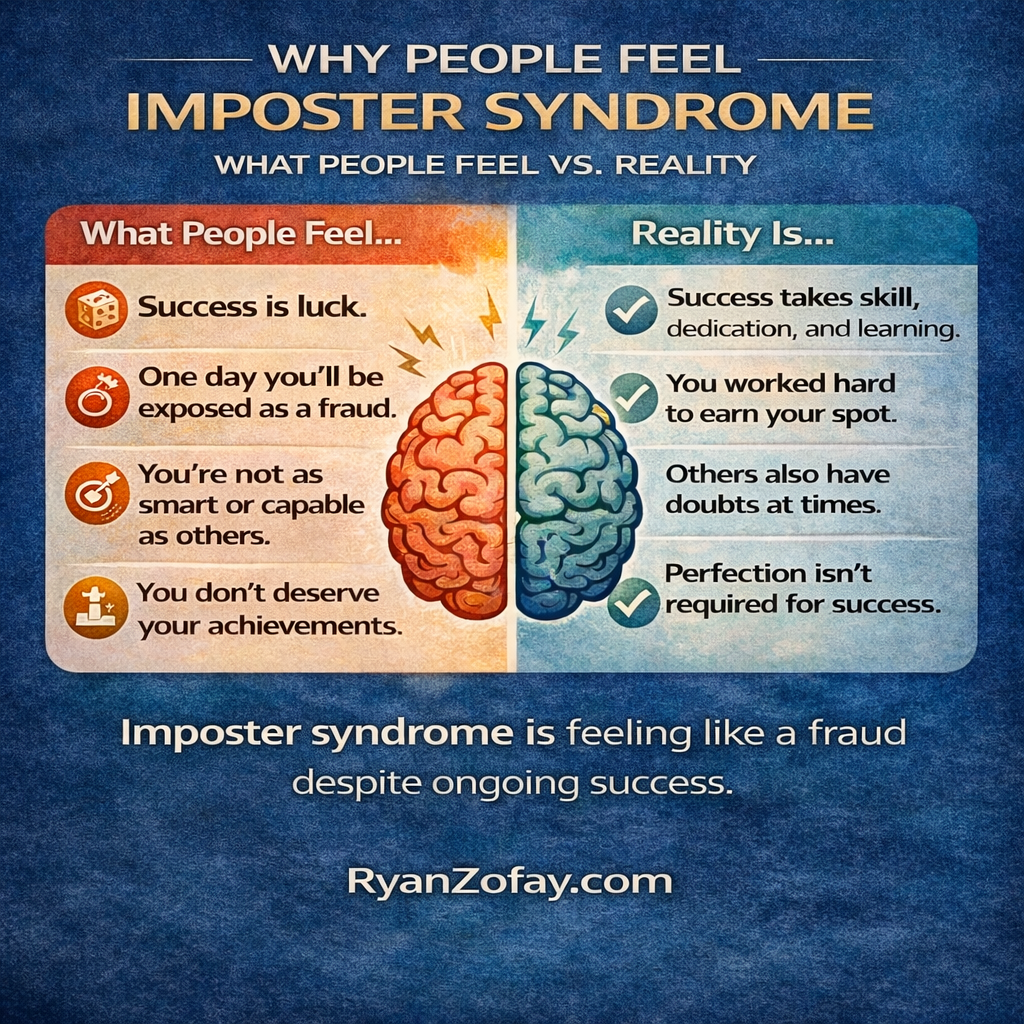
The Quick Answer to what is imposter syndrome? Imposter syndrome is the persistent belief that your success is undeserved. That you will eventually be exposed as a fraud. Even high-achieving professionals, entrepreneurs, and leaders experience it. Despite clear proof of skill, people with achievement insecurity credit success to luck, timing, or outside help. They do not credit their own abilities.
My personal feeling unworthy experience and comeback
My Story and How I Learned to Turn Self-Doubt Into Success
Feeling undeserving of success is something I know very well. I have felt it in my life, my business journey, and even during moments of success. For many years, I believed I was not good enough. I believed someone would eventually discover that I did not deserve the success I was building.
Today, as a confidence coach I help entrepreneurs, leaders, and high performers grow their confidence and purpose. But my journey was not easy. I had to face my own fears and break through deep self-doubt.
Many successful people quietly struggle with imposter/fraud syndrome. They achieve great things but still feel like they do not deserve them. I know that feeling because I lived it.
My Personal Story With Severe Self-Doubt
Before I became a coach, my life looked very different. I struggled with addiction, self-destructive choices, and deep self-doubts. I suffered through constant self-sabotaging behaviors resulting from a complete lack of belief in myself. Powerful self-limiting beliefs controlled my life. I spent years feeling lost and unsure about my future. I didn’t know my purpose nor what to do with my life.
When I began rebuilding myself, I started working on personal growth. I studied growth mindset, leadership, and human behavior. I also learned about neuro-linguistic programming and how thoughts shape actions.
Even as I helped people and built businesses, I still felt the effects of my lingering self-doubt despite utter success. I would ask myself questions like:
- Do I really deserve this success?
- What if people find out I am not good enough?
- What if everything falls apart?
But I learned something important. Those thoughts were not truth. They were old beliefs trying to control my future. As my life began to improve, something unexpected happened. When I changed my mindset, everything changed.
Today, helping people overcome self-doubt is one of the most powerful parts of my work.
In this guide I’ll explain what is imposter syndrome, and teach you how to overcome it in business, leadership, and life.
What Is Imposter Syndrome – The Complete Answer?
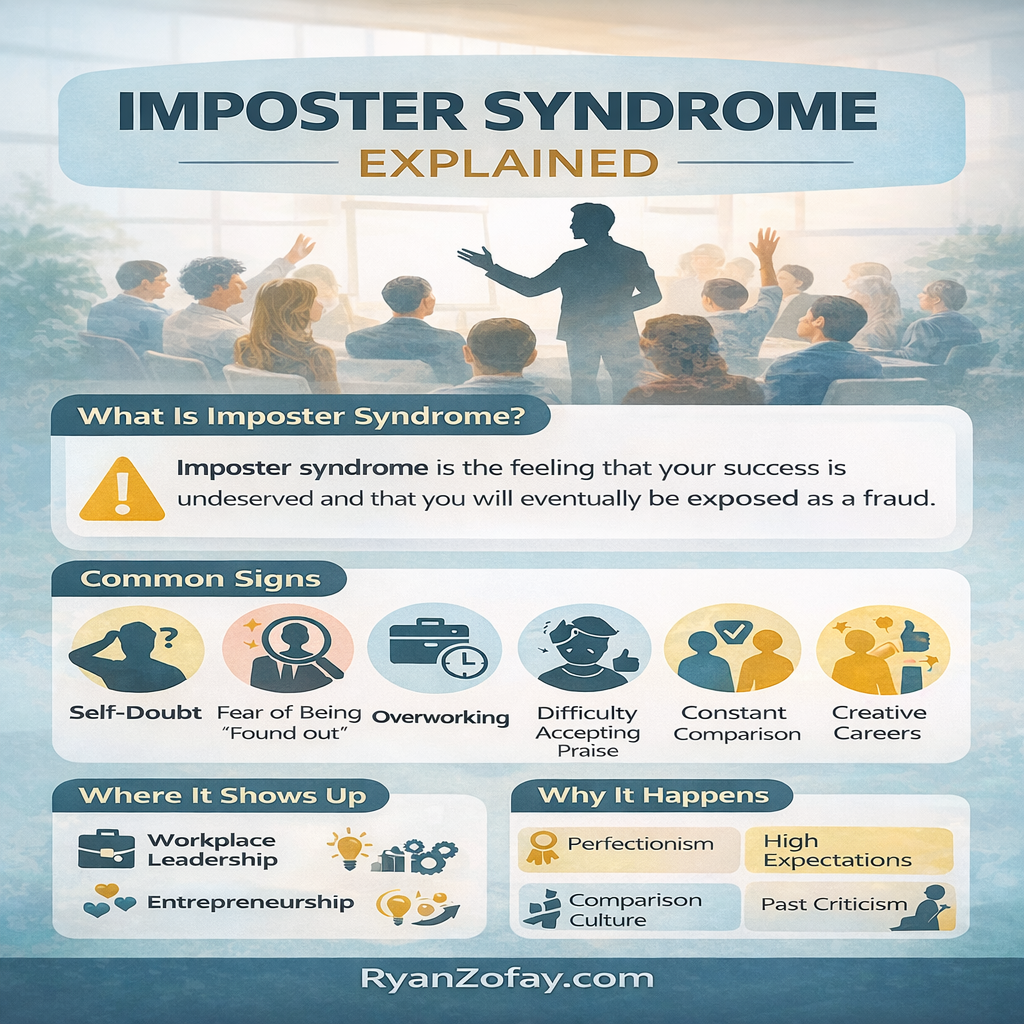
Many people ask me, what is imposter syndrome? It is the feeling that you are not as capable as others think you are. Even when you achieve success, you may believe you simply got lucky.
People with this syndrome often believe they will be exposed as a fraud. They struggle to accept praise or recognize their accomplishments. This experience is also called imposter/fraud syndrome. It can create fear that you are pretending to be someone you are not.
Common signs include
- Doubting your abilities despite success
- Feeling like you do not deserve your achievements
- Believing others are smarter or more talented than you
- Fear that people will discover you are “not good enough”
Many leaders, entrepreneurs, and professionals experience this. The truth is, success often brings more responsibility, which can increase self-doubt.
Many leaders, entrepreneurs, and professionals experience this. The truth is, success often brings more responsibility, which can increase self-doubt.
Is Imposter Syndrome a Mental Illness?
A common question I hear is: is this a mental illness? The answer is no. It is not classified as a mental health disorder. However, it can affect emotional wellbeing. If left unaddressed, it may contribute to anxiety, burnout, or stress.
This is why many people seek support, such as coaching, mentorship, or imposter syndrome therapy. This helps them build healthier thinking patterns.
The Statistics
Research shows fraud syndrome is far more common than most people realize.
• Studies suggest 70% of people experience imposter syndrome at some point in their lives.
• It is especially common among entrepreneurs, executives, and high performers.
• A review in the International Journal of Behavioral Science found that self-doubt despite success leads to burnout, anxiety, and perfectionism.
These numbers show that feeling like a fake does not mean you lack ability. It often means you are pushing yourself into new levels of growth.
Imposter Syndrome at Work
Many professionals experience imposter syndrome at work.
This often happens when someone receives a promotion, starts a new role, or joins a competitive industry.
Some common experiences include:
- Feeling you are not qualified for your position
- Hesitating to speak in meetings
- Overworking to prove your value
- Fear of making mistakes
This is why understanding what is imposter syndrome at work is important. Awareness helps you challenge these thoughts before they limit your growth.
Imposter Syndrome in Leaders and Entrepreneurs
Many of the leaders I coach experience imposter syndrome at higher levels of success.
Entrepreneurs, executives, and founders often feel pressure to perform while making difficult decisions that affect entire teams. This can create internal questions like:
• “Am I really qualified to lead this organization?”
• “What if I make the wrong decision?”
• “Do I deserve this level of success?”
Ironically, these thoughts often appear right when someone is growing the fastest.
Why High Performers Experience Success-Related Self-Doubt
Many people assume limiting beliefs about success only affects beginners. In reality, it often appears at higher levels of success.
In my experience coaching entrepreneurs and executives, fear of being exposed tends to increase when someone enters unfamiliar territory. This happens for several reasons:
Success pushes you into new environments
When you grow your career or business, you suddenly compare yourself to people with more experience.
High standards create pressure
Leaders often hold themselves to extremely high expectations.
Responsibility increases fear of mistakes
When decisions affect employees, clients, or investors, the pressure can trigger self-doubt.
Ironically, leadership confidence struggles often appears right when someone is expanding their capabilities.

Claim Your Call
Claim your free next level strategy call. Select your date and time. Get guidance and insights. Find answers to your questions. Gain focus, and belief in yourself with No excuses holding you back.

Join the 1%
Seize opportunity. Make the Most of Your Life! Live Without Limitations. Overpower Challenges. Grasp Opportunities to make the Most of Each Moment. Propel & Surpass Others.
Examples
To better understand this challenge, let’s look at some real xamples.
Example 1: The High Achiever
A successful executive receives praise for leading a major project. Instead of accepting the compliment, they believe the success happened only because the team carried the work.
Example 2: The Entrepreneur
A business owner grows their company but still believes they are not as capable as other entrepreneurs.
Example 3: The Creative Professional
A talented designer worries that one day clients will discover they are not as talented as people believe.
These situations show how adult imposter syndrome behaviors can affect anyone, even highly successful individuals.
Symptoms and Causes
Recognizing imposter syndrome symptoms is the first step toward change.
What are Imposter Syndrome Symptoms?
Some of the most common symptoms of imposter syndrome include:
- Constant self-criticism
- Fear of failure
- Difficulty accepting compliments
- Comparing yourself to others
- Overworking to prove your worth
Many people also show signs of imposter syndrome, like perfectionism. They may avoid new opportunities because they fear they are not ready.
What Causes Imposter Syndrome?
Several psychological and social factors can contribute to this pattern of thinking.
Common causes include:
• Perfectionism and unrealistic expectations
• Comparing yourself to others
• Major career transitions or promotions
• Growing up with high pressure to succeed
• Entering competitive environments
Understanding these triggers helps people recognize that this internal struggle is often a learned thought pattern rather than reality.
Science Behind Imposter Syndrome
Psychologists have studied internalized self-doubt for decades. The term for this was first introduced in 1978 by psychologists Pauline Clance and Suzanne Imes. They observed that many high-achieving individuals believed their success was undeserved. Even when people had clear achievements, they often credited luck, timing, or outside factors, not their abilities.
The Psychology Behind Imposter Syndrome
Research has since linked this confidence barrier to several recurring psychological patterns:
- Cognitive distortions – Individuals underestimate their abilities while exaggerating mistakes or failures.
- Perfectionism – Many people believe anything short of perfection equals failure.
- External attribution bias – Success is credited to luck or outside factors instead of skill or effort.
Understanding these patterns is powerful because it shows that self-doubt despite success is not a reflection of your ability. Instead, it is a learned mental habit, and like most mental habits, you can change it. You can do this through awareness, cognitive reframing, and behavioral practice.
The Studies
| Psychological Research & Findings | Insights, Exercises & Guides |
|---|---|
| Clance & Imes (1978) – The Impostor Phenomenon in High Achieving Women. Found that many high-performing individuals believe they are intellectual frauds despite objective success. Key finding: Individuals attribute achievements to luck or deception rather than competence. Stats: Study observed strong imposter feelings among high-achieving professionals and graduate students. https://paulineclance.com/pdf/ip_high_achieving_women.pdf | Insight: I teaches that imposter thoughts come from conditioned beliefs about worth and success. Recognizing them as conditioned patterns removes their authority. DIY Exercise: “Evidence Log” – Write down three accomplishments each day and the skills that created them. This retrains the brain to attribute success to internal ability. Guide: Keep a journal as your evidence. |
| Sakulku & Alexander (2011) – The Impostor Phenomenon. Research review identifying common traits among people experiencing this pattern of thinking. Findings: Perfectionism, fear of evaluation, and overwork are common coping strategies. Stats: Up to 70% of people experience imposter feelings at some point in their career. https://doi.org/10.1016/j.sbspro.2011.11.205 | Insight: Perfectionism often masks a deeper fear of rejection or failure. Releasing perfectionism allows authentic growth. DIY Exercise: “Imperfect Action Practice.” Deliberately complete a small task at 80% instead of 100% to retrain tolerance for imperfection. Guide: Become high achieving and accountable. |
| Bravata et al. (2020) – Prevalence, Predictors, and Treatment of Impostor Syndrome. Systematic review analyzing this confidence barrier across multiple populations. Findings: this pattern of thinking is associated with anxiety, burnout, and depression but also appears in highly competent individuals. Stats: Review of 62 studies involving over 14,000 participants. https://www.sciencedirect.com/science/article/pii/S073839912030238X | Insight: I emphasize that these doubts are often amplified by chronic stress and comparison culture. Developing emotional regulation reduces its impact. DIY Exercise: “Identity Reframe” – Replace “I’m not good enough” with “I’m learning and growing.” Repeat daily during journaling or meditation. Guide: Adopt morning routine for success along with meditation. |
| Parkman (2016) – The Imposter Phenomenon in Higher Education. Explores how success-related self-doubt appears among professionals and students in competitive environments. Findings: Social comparison and high expectations increase imposter thoughts. Stats: Imposter feelings correlate strongly with low self-efficacy and high perfectionism scores. https://doi.org/10.1007/s10755-016-9367-5 | Insight: Zofay encourages individuals to shift from comparison to personal progress metrics. Growth is measured against your past self, not others. DIY Exercise: “Progress Reflection” – Weekly journaling on skills improved or lessons learned instead of outcomes achieved. Guide: Adopt bullet journaling to capture any improvements. |
The fear of being exposed is not simply a lack of confidence. Research shows it is tied to specific psychological patterns such as cognitive distortions, perfectionism, and external attribution bias. These patterns can distort how individuals interpret success and failure.
The key takeaway from psychology research and my mindset work is that leadership confidence struggles are learned. That means it can change. Through awareness, reframing thoughts, and regular self-reflection, people can slowly replace self-doubt. They can build a more accurate and empowering view of their abilities.
4 Types of Imposter Syndrome
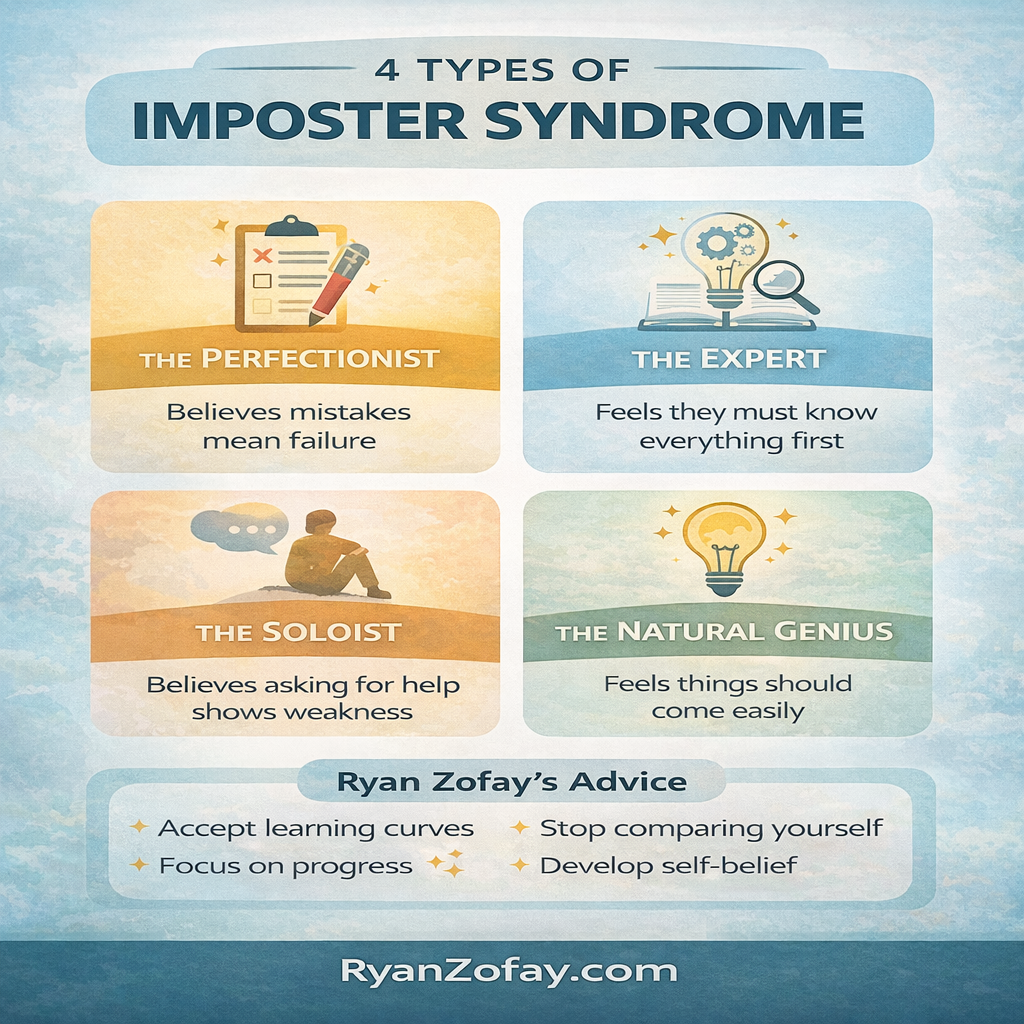
Experts often describe different types of fraud syndrome. Each reflects a different thinking pattern comes with wrongheaded negative deep-rooted beliefs.
| Type | Core Belief | Common Behavior |
|---|---|---|
| Perfectionist | Mistakes mean failure | Overworking |
| Expert | Must know everything | Constant learning |
| Soloist | Help equals weakness | Avoiding support |
| Natural Genius | Success should be easy | Fear of challenges |
Here’s the breakdown and definitions for each type:
The Perfectionist
Believes mistakes are unacceptable and feels like a failure when things are not perfect.
The Expert
Believes they must know everything before taking action.
The Soloist
Feels they must accomplish everything alone.
The Natural Genius
Believes success should come easily. When something requires effort, they feel like a fraud.
Understanding these patterns helps people begin dealing with this internal struggle in healthier ways.
Fraud Syndrome and ADHD
Some people also experience ADHD imposter syndrome.
People with ADHD may struggle with focus, organization, or time management. These challenges can create feelings of inadequacy.
When someone constantly compares themselves to others, they may develop imposter syndrome ADHD thinking patterns.
Coaching, structure, and supportive environments can help build confidence and reduce these feelings.
Imposter Syndrome in Relationships
Self-doubt does not only affect careers. Many people experience imposter syndrome in relationships.
This can appear as thoughts like:
- “My partner deserves someone better.”
- “If they really knew me, they would leave.”
These beliefs often come from past experiences or low self-esteem. Building self-worth is essential for healthier relationships.
How to Overcome Imposter Syndrome
Many people ask me how to overcome this confidence barrier. The truth is that confidence is not built overnight. It develops through consistent mindset work.
Here are some steps I teach my clients.
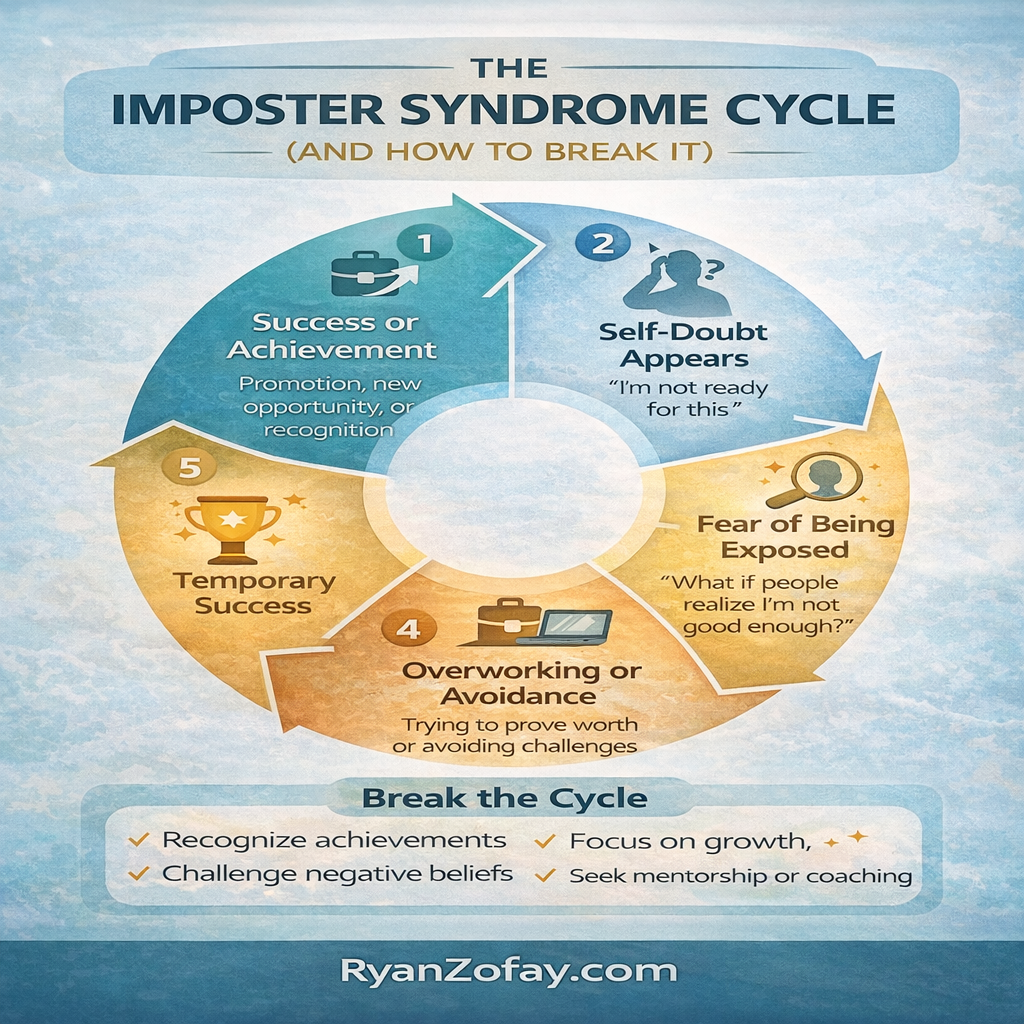
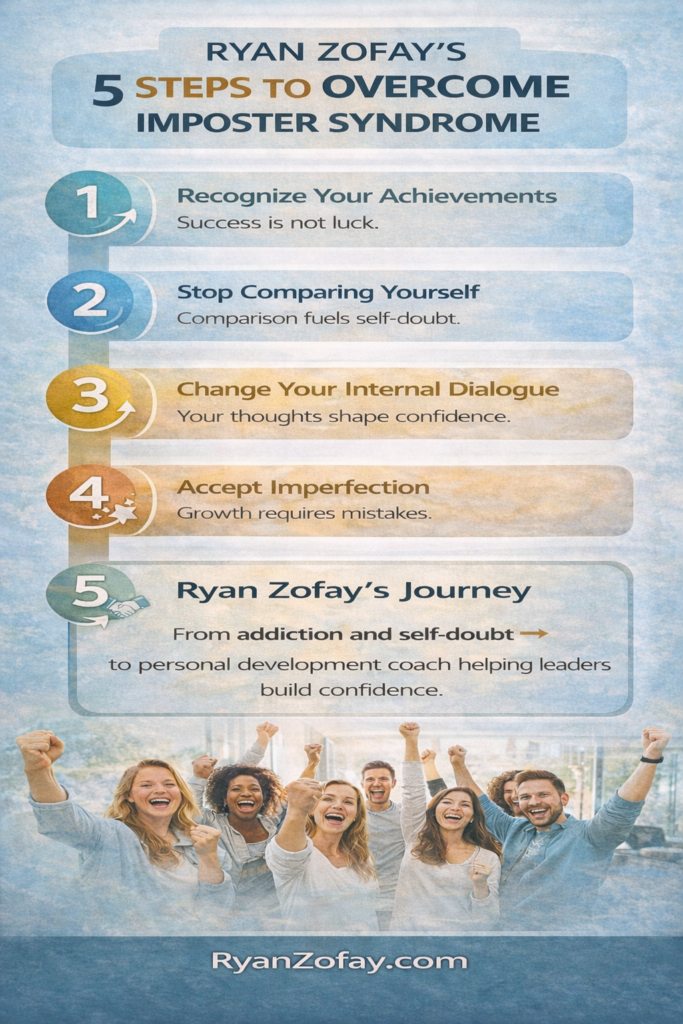
Step 1: Recognize Your Achievements
Write down your accomplishments. Seeing your progress on paper helps break the illusion of self-doubt.
Step 2: Stop Comparing Yourself
Comparison fuels imposter syndrome. Focus on your own growth.
Step 3: Change Your Internal Dialogue
Replace negative thoughts with supportive ones. This is a key part of overcoming imposter syndrome.
Step 4: Accept Imperfection
Growth always includes mistakes. Success requires learning.
Step 5: Seek Coaching or Mentorship
Support can accelerate transformation. Coaching helps people learn how to deal with these doubts with practical tools.
How to Be Kinder With Ourselves to Avoid Fraud Syndrome
Self-compassion is powerful.
Learning how to be kinder with ourselves to avoid this internal struggle means recognizing that growth takes time.
Instead of criticizing yourself, ask better questions:
- What can I learn from this?
- What progress have I made?
- How can I improve next time?
This mindset builds resilience and confidence.
Imposter Syndrome Test
Many people ask, do I have imposter syndrome?
An imposter syndrome test can help identify patterns of self-doubt. These tests often evaluate beliefs about success, failure, and personal ability.
If you frequently feel like a fraud despite achievements, you may be experiencing this mindset challenge.
Recognizing it is the first step toward change. Take the below test to assess where you stand and where you can make improvements today.
Quick Self-Assessment
Ask yourself these questions:
• Do you feel like your success is due to luck rather than skill?
• Do you worry people will discover you are not qualified?
• Do you downplay achievements when others praise you?
• Do you feel pressure to constantly prove your worth?
If you answered yes to several of these questions, you may be experiencing this negative pattern of thinking.
Imposter Syndrome Treatment and Support
While there is no single imposter syndrome treatment, several approaches can help.
Common solutions include:
- Coaching and leadership development
- Therapy or counseling
- Personal development programs
- Mindset training
Many people also read imposter syndrome books to understand their thinking patterns. A few that I often recommend include: The Secret Thoughts of Successful Women by Valerie Young. It which explains the different types of imposter syndrome. Next, The Imposter Cure by Dr. Jessamy Hibberd. It provides practical tools to break cycles of self-doubt. And Own Your Greatness by Lisa Orbé-Austin and Richard Orbé-Austin. It explores the psychology behind this thinking and how to build real confidence. These books can help people recognize patterns of self-doubt and begin developing a stronger, more confident mindset.
Growth begins when people commit to changing their beliefs.
Why Choose Ryan Zofay for Imposter Syndrome Coaching
Overcoming limiting beliefs about success requires more than motivation. It requires deep mindset transformation. My coaching combines personal experience, neuroscience, and behavioral strategies to help people break through self-doubt.
As a neuro-linguistic specialist and personal development coach, I help entrepreneurs, executives, and professionals reach their full potential.
My coaching programs focus on:
- Leadership development
- Business growth mindset
- Confidence and identity work
- Personal transformation strategies
I do not teach theory. I teach the strategies that changed my life. Because I lived through self-doubt and rebuilt my life from the ground up, I understand exactly what my clients are facing.
The Opposite of Imposter Syndrome
Many people ask me about the opposite of imposter syndrome. The opposite is not arrogance. It is grounded confidence. It is knowing your strengths while continuing to grow. True confidence means accepting both your talents and your areas for improvement.
Powerful Imposter Syndrome Quotes
Sometimes a simple insight can shift perspective.
Here are a few imposter deficiency quotes that I often share with clients:
- “Confidence is built through action.”
- “Success belongs to those who keep learning.”
- “You are more capable than your doubts suggest.”
These reminders help people stay focused on growth instead of fear.
Frequently Asked Questions
What is imposter syndrome?
It is the feeling that you are not as capable as others think. It can happen even when evidence shows you are successful.
What are the signs of imposter syndrome?
Common signs include self-doubt, perfectionism, fear of failure, and difficulty accepting praise.
How can I get over imposter syndrome?
Learning how to get over fraud syndrome starts with getting to know yourself better. It also means challenging negative thoughts. You build confidence by taking action and continuing to grow.
How does Ryan Zofay help people overcome imposter syndrome?
Ryan Zofay helps individuals combat fraud syndrome through coaching programs. These focus on mindset transformation, leadership development, and personal growth strategies. His approach combines real-life experience, neuroscience-based techniques, and business leadership training.
Is imposter syndrome common in business leaders?
Yes. Many successful entrepreneurs experience this syndrome at work, especially when facing new levels of responsibility.
Are there books on imposter syndrome?
Yes. Many experts have written books on this pattern of thinking. Books on fraud syndrome explain the psychology behind self-doubt and offer strategies for growth.
Can therapy help with imposter syndrome?
Yes. Some people benefit from imposter syndrome therapy, coaching, or counseling to develop healthier thought patterns and build confidence.
Final Thoughts
Self-doubt can feel powerful, but it does not define who you are.
If you struggle with imposter syndrome, remember that growth begins with awareness. The same mindset patterns that once held you back can become the fuel that drives your transformation.
Your story is not finished. In fact, it may just be beginning.
After years of coaching entrepreneurs, executives, and leaders, I have seen one truth often. Overcoming confidence struggles is not about becoming someone else. It is about finally recognizing the capability that has been there all along.
If imposter syndrome has been holding you back, I want you to know something important. The voice that tells you that you are not good enough is not the truth. I believed that lie for many years. Breaking free changed my life. It can change yours too. If you are ready to step into your real potential, let’s work together. My coaching is designed to help you build confidence, clarity, and purpose. Reach out today and start rewriting the story you tell yourself about who you are capable of becoming.
