
I’m Ryan Zofay, a life, business, accountability and personal development coach. I help people learn how to take control of your life through structure, discipline, and proven systems.
My journey began with real struggles, a lack of direction, poor habits, and setbacks that forced me to rebuild from the ground up. Through years of mentorship, self-study, and action, I built a results-driven approach. I now use it in my personal development coaching programs. I’ve since helped individuals and business leaders break limiting patterns, build confidence, and create lasting success. My work is grounded in real-world experience, not theory.
What Does It Mean to Take Control of Your Life?
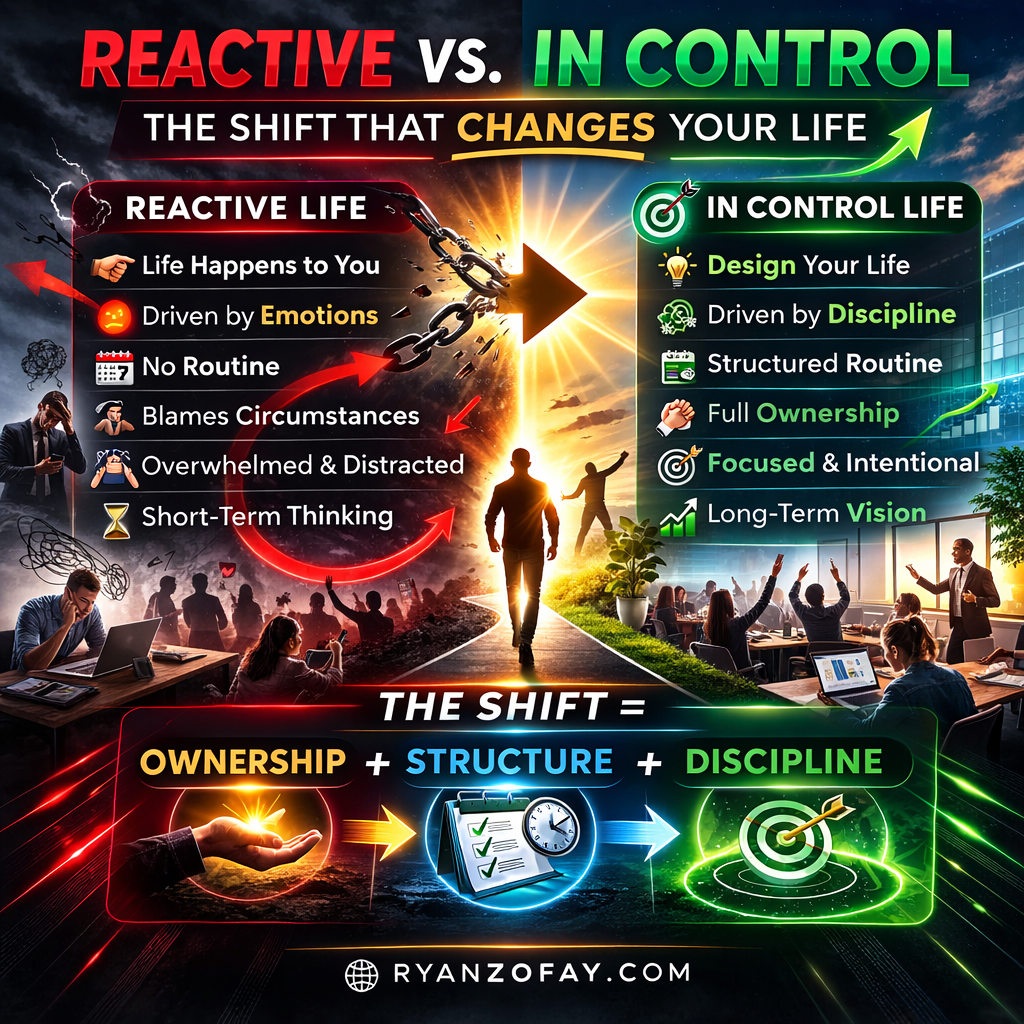
Taking control of your life means shifting from a reactive mindset, where life happens to you. It also means being intentional, so you can shape your future.
How to take control of your life?
Go from reactive to in control mindset. This involves:
- making conscious decisions
- building disciplined habits
- managing your time and emotions
- focusing only on what you can control
- taking full ownership
- becoming focus and intentional
- adopting discipline and structured routines
- navigating to long term vision and goals
When you take control, you stop waiting for change and start creating it through consistent action.
Jump To
Table of Contents
How to Take Control of Your Life: The Ryan Zofay System (21 Ways That Work)
I learned how to take control of your life when everything around me felt out of control.
There was a time when I didn’t believe I had power over my choices. I was stuck in patterns that held me back. I made decisions that kept me in the same place. I didn’t know what it meant to nor how to take control back of your life. That lack of direction showed in every part of my life.
Today, I help people rebuild their lives through structure, discipline, and purpose. But I didn’t start here.
I had to learn how to take control of your life again step by step. I had to rebuild my mindset, my habits, and my identity. That journey became the system I now teach to others.
This is not theory. This is a proven path to help you take control of your life, create success, and build a future you’re proud of.
My story for how to take back control of your life
My Story: Learning to Take Back Control of My Life
There was a point in my life where I felt completely lost. I lacked discipline. I reacted instead of leading. I chased short-term wins instead of long-term growth. Every time I tried to improve, I slipped back into old habits.
The truth is, I didn’t know how to take back control of your life. I thought change would come from outside. I was wrong. Everything shifted when I took ownership.
I stopped blaming others. I stopped waiting. I made a decision to take back control of your life—starting with my thoughts, my actions, and my daily habits.
That decision changed everything.
I invested in growth. I studied personal development. I worked with mentors. I built discipline one day at a time.
Over time, I transformed my life. I also founded the successful 9-figure We Level Up organization. I began helping others do the same through personal development coaching.
What It Really Means to me to Take Control of Your Life
People often ask me, how do you take control of your life? The answer is simple, but not always easy. You take control by:
- making smart decisions that align with your future, not your current feelings.
- acting with purpose, even when it’s uncomfortable.
- building habits that support growth.
If you want to know how to take control of your life and be happy, understand this: happiness comes from progress, not perfection.
About the author: I’m an entrepreneur, a coach and a leader. With years of experience in behavior change, leadership development, and recovery-based transformation, I help individuals grow and develop. I also help business leaders rebuild their lives. I do this through structured systems and disciplined action.
My approach combines real-world experience, neuro-linguistic strategies, and performance psychology—not theory.
The Ryan Zofay System: 21 Steps to Take Control of Your Life
This system is built from real experience. I used these exact steps to rebuild my life, and I still apply them daily. Each step is simple, but when combined, they create powerful change.
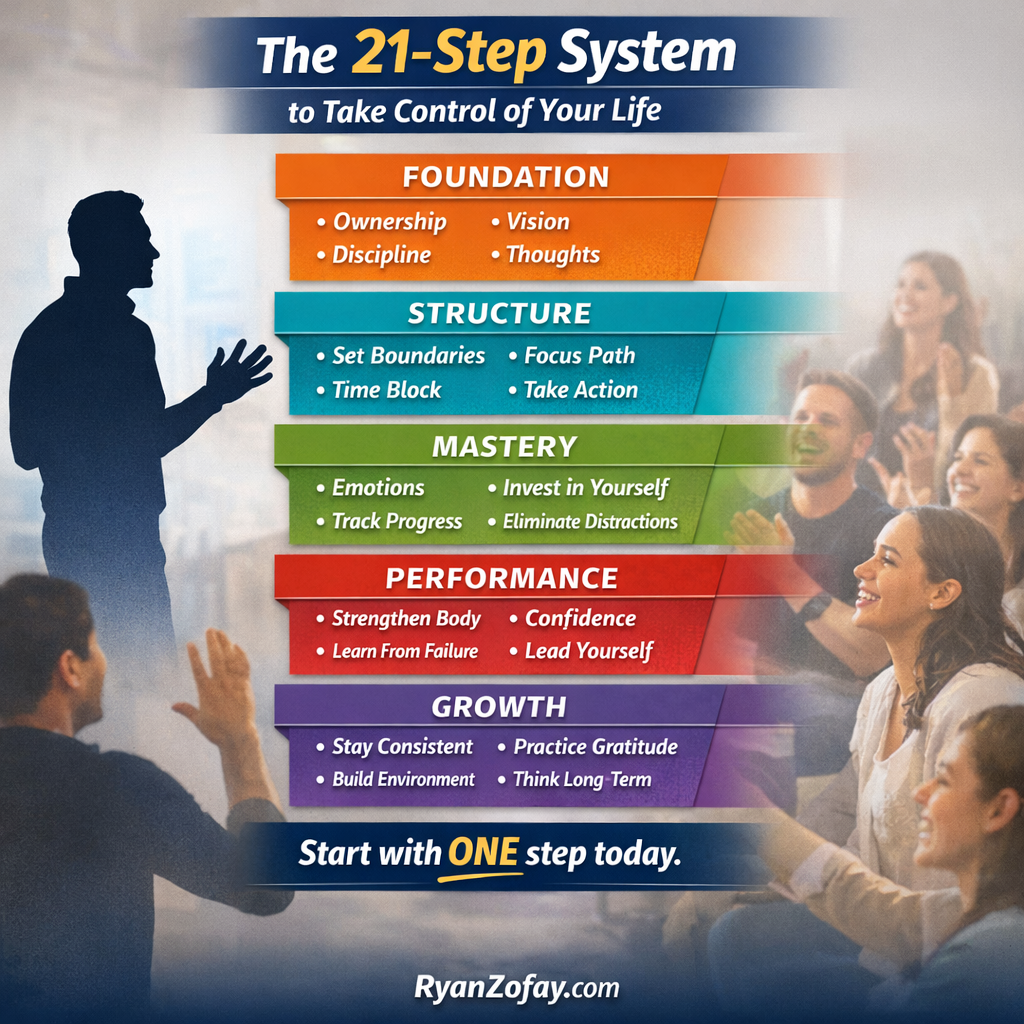
Powerful 21 Steps to Take Control of Your Life
Use this table as a guide to move from thinking to action.
| Step | Insight & Tips (Ryan in First Person) | Activity & Related Guide |
|---|---|---|
| 1. Take Full Ownership | Taking control of your life starts with moving out of victim mode. For years, life felt like it was happening to me. I blamed my past, my circumstances, and other people. Nothing changed until I owned my decisions, my reactions, and my habits. That’s when I shifted from reactive to proactive. | Do a responsibility audit. Write one area where you’ve been blaming others (work, money, family). Under it, list three things that are 100% in your control and one action you’ll take today. Then learn how radical responsibility changed my life. Read How to Be Successful in Life & Business (https://ryanzofay.com/how-to-be-successful/). |
| 2. Define a Clear Vision | When I felt lost, it’s because I had no vision. I learned to define my “rich life” in detail, down to what a normal Tuesday looks like. When your vision is clear, your decisions get easier and your anxiety drops. | Do the “Rich Life Tuesday” exercise. Write a detailed vision for your life one year from now. Then describe a typical Tuesday in that future. Say when you wake up. Explain what you do during the day. Share who you are with. Describe how you feel. Re‑read it every morning for one week and let it guide your daily choices. |
| 3. Build Daily Discipline | Discipline is how I stopped living on impulse and started designing my days. Little daily habits, done even when I didn’t feel like it, turned chaos into structure. That structure then became momentum. | Pick one small habit (like a 10‑minute morning routine, journaling, or stretching) and track it for 30 days on a simple calendar. Treat each checked day as a win. Then strengthen your discipline with tools from Self Mastery Guide to the Mind & Emotions. |
| 4. Control Your Thoughts | I used to let my thoughts run me. I’d replay worst‑case scenarios and old stories. Now I focus on my “three controllables”: my thoughts, my actions, and my responses. When I choose my thoughts, I choose my life. | Run a “sphere of influence” scan. Make two columns: “In My Control” and “Out of My Control.” For one current problem, list everything on your mind, then sort each item into a column. Pick one thought and one action from the “In My Control” side to focus on today. Let yourself release the rest for the next 24 hours. |
| 5. Set Strong Boundaries | Before I set boundaries, my calendar belonged to everyone else. I said yes to things that did not align with my values and ended up burned out and resentful. Boundaries are how I protect my energy from being hijacked by other people’s agendas. | Use the “Hell Yes Rule” once, then practice strategic quitting. Review your current commitments and ask, “If I were starting from zero, would I say yes to this?” If the answer is no, make a simple plan to step away or renegotiate that commitment over the next 30 days. For more on aligned action, see How to Be the Change You Want to See in the World (https://ryanzofay.com/how-to-be-the-change-you-want-to-see-in-the-world/). |
| 6. Focus on One Path | When I chased ten different goals at once, I never felt in control. When I picked one main path and aligned my choices with it, my life became simpler and more powerful. Focus is a form of self‑respect. | Try the One‑Goal Rule for 90 days. Choose one main goal (health, income, recovery, etc.). Write three supporting actions and circle the one you’ll do today. Say no to at least one task, event, or opportunity that doesn’t serve that goal. |
| 7. Create Structure in Your Day | My calendar used to be a suggestion box. Now I treat it like a sacred document. Time blocking for deep work, exercise, and family keeps me from falling into reactive mode. It also helps me put my priorities first. | Use time blocking for one full day. Divide your day into blocks: deep work, admin, health, and family/connection. Put each block on your calendar with start and end times and follow them like real appointments. Get more structure ideas from Time Management Training for Managers & Teams (https://ryanzofay.com/time-management-training/). |
| 8. Take Action Without Delay | Overthinking used to paralyze me. I would wait for the perfect time, the perfect plan, or perfect confidence. Real control came when I started taking action, even small steps, instead of living in my head. | Use “action over rumination” on one decision you’ve been stuck on. Set a 10‑minute timer and take the smallest possible step before it ends—send the email, start the document, make the call. For extra fire, revisit the mindset in Nobody Cares, Work Harder (https://ryanzofay.com/nobody-cares-work-harder/). |
| 9. Master Your Emotions | When I was younger, my emotions ran the show. I acted out of anger, fear, and ego, and then felt out of control. Emotional mastery is how I stopped reacting and started responding with intention. | Practice the 5-5-5 breathing rule when you feel triggered. Inhale for 5 seconds. Exhale for 5 seconds. Then pause for 5 seconds before you speak or act. Repeat this cycle three times. After that, ask, “What response would my best self choose here?” Go deeper with How to Master Your Emotions (https://ryanzofay.com/how-to-master-your-emotions/). |
| 10. Invest in Yourself | My life only changed when I started investing in my growth—books, coaching, events, mentorship. Taking control means you stop waiting for a rescue and become your own greatest project. | Block 60 minutes this week labeled “Self‑Investment” on your calendar. Use it for learning: a course, a book, or structured reflection on your goals. Treat it as non‑negotiable. Then explore the next level inside Success Ed Program for Adult Achievers (https://ryanzofay.com/success-ed-education/). |
| 11. Track Your Progress | When you don’t measure anything, it feels like nothing is working. Tracking my habits, finances, and key actions showed me I was moving forward, even on days it didn’t feel like it. | Create a simple weekly tracker for three areas: health, work, and relationships. For each, pick one metric (steps, deep work hours, quality time). Update it daily for 30 days. Pair this with tools from my Free Time Management Worksheet (https://ryanzofay.com/free-time-management-worksheet/). |
| 12. Eliminate Distractions | Your environment will beat your willpower over time. When I removed constant distractions—notifications, drama, low‑value tasks—I finally had time for what actually mattered. | Do a 10‑minute environment audit. List your top five distractions (phone, apps, TV, certain people). Choose one rule for the next 7 days.Make it clear and easy to follow.For example: “No phone in the bedroom.”Or: “Social media for 20 minutes after 6 p.m. only.” Use the freed‑up time for your top priority. |
| 13. Strengthen Your Body | I can’t lead or serve at a high level if my energy is low. When I dialed in sleep, movement, and nutrition, my stress dropped and my clarity increased. | For the next 7 days, set a body baseline. Move at least 20 minutes each day. Drink more water than you did yesterday. Aim for a consistent sleep schedule. Journal briefly each night about your energy and mood so you can see the change. |
| 14. Build Confidence Through Action | Most people wait to feel confident before they act. I’ve learned it works the opposite way. Small wins—what I call “mastery experiences”—rebuild self‑trust and confidence. | Each morning, set one 100% achievable mastery task (make your bed, 10‑minute walk, one hard email). Do it and check it off. At night, write one sentence about how keeping that promise felt. Stack these for 7 days and notice your confidence shift. |
| 15. Learn From Failure | I’ve failed more times than I can count. The shift came when I stopped making failure mean “I am broken” and started using it as feedback for my next attempt. That’s how I turned setbacks into a 9‑figure blueprint. | Choose one past failure that still stings. Write what happened, what part you were responsible for, and three lessons you can now use. Turn that moment into a mental “training rep.” For more on converting failure into insight, see Lifecoach Business Analysis & Insights (https://ryanzofay.com/lifecoach-business-analysis/). |
| 16. Lead Yourself First | I tell my clients: you cannot lead a team, a family, or a company if you can’t lead yourself. Self‑leadership means your actions line up with your values, even when no one is watching. | Set one non‑negotiable standard (wake‑up time, no alcohol, daily reading, etc.). Keep it for 7 straight days. Each night, rate your self‑leadership from 1–10 and write one thing you did well. Use that score as feedback, not judgment. |
| 17. Stay Consistent Daily | The difference between busy and in control is consistency. It’s not what you do sometimes; it’s what you do daily that creates your identity and your results. | For the next week, choose your “One Key Task” every morning—the single action that would move your life or work forward the most. Write it down and don’t go to bed until it’s done. Review your wins at the end of the week. |
| 18. Practice Gratitude | In my darkest seasons, gratitude felt fake. But when I practiced it anyway, my focus slowly shifted from everything that was wrong to what was still possible. Gratitude calms your nervous system and widens your perspective. | Do a 7‑day gratitude practice. Each night, write three things you’re grateful for and one thing you did today that you’re proud of. Read them out loud slowly, using deep breaths as you do, to send your nervous system a signal of safety. |
| 19. Build a Winning Environment | I became a different man when I changed my environment. I changed who I spent time with, what I consumed, and how my space was set up. A winning environment supports good choices and makes old habits harder. | Do a People & Places audit with two columns: “Helps Me Grow” and “Pulls Me Back.” Move one item from the “Pulls Me Back” column out of your daily life this week. Consider plugging into Ryan Zofay’s Breakthrough Coaching Center (https://ryanzofay.com/coaching-center/) for a growth‑focused environment. |
| 20. Think Long-Term | When I lived only for short‑term comfort, I kept creating long‑term pain. Thinking long‑term changed how I handle money, health, recovery, and relationships. | Use the 1‑Year Test on one decision today. Ask, “How will this affect me a year from now?” If it matters, give it more thought and care. If it doesn’t, let it go faster. Write down one long‑term commitment (health, finance, relationship, growth) you’re ready to make. |
| 21. Keep Evolving | Taking control of your life is not a one‑time project. Even after getting sober and building companies, I still refine my habits, beliefs, and standards. Growth is how you stay in the driver’s seat. | Choose one life area you’ve had on autopilot (health, money, relationships, purpose). Set a specific 90‑day goal and break it into three monthly milestones. When you reach one milestone, immediately set the next so your evolution never stalls. |
Taking control of your life comes down to structure, discipline, and consistent action. These 21 steps give you a clear path. When you apply them, you build confidence, clarity, and direction. You don’t need more information. You need to start.
Start with one step today.
What You Can and Can’t Control in Life – Ryan Zofay Framework
One of the biggest breakthroughs in taking control of your life is understanding where your power actually lies.
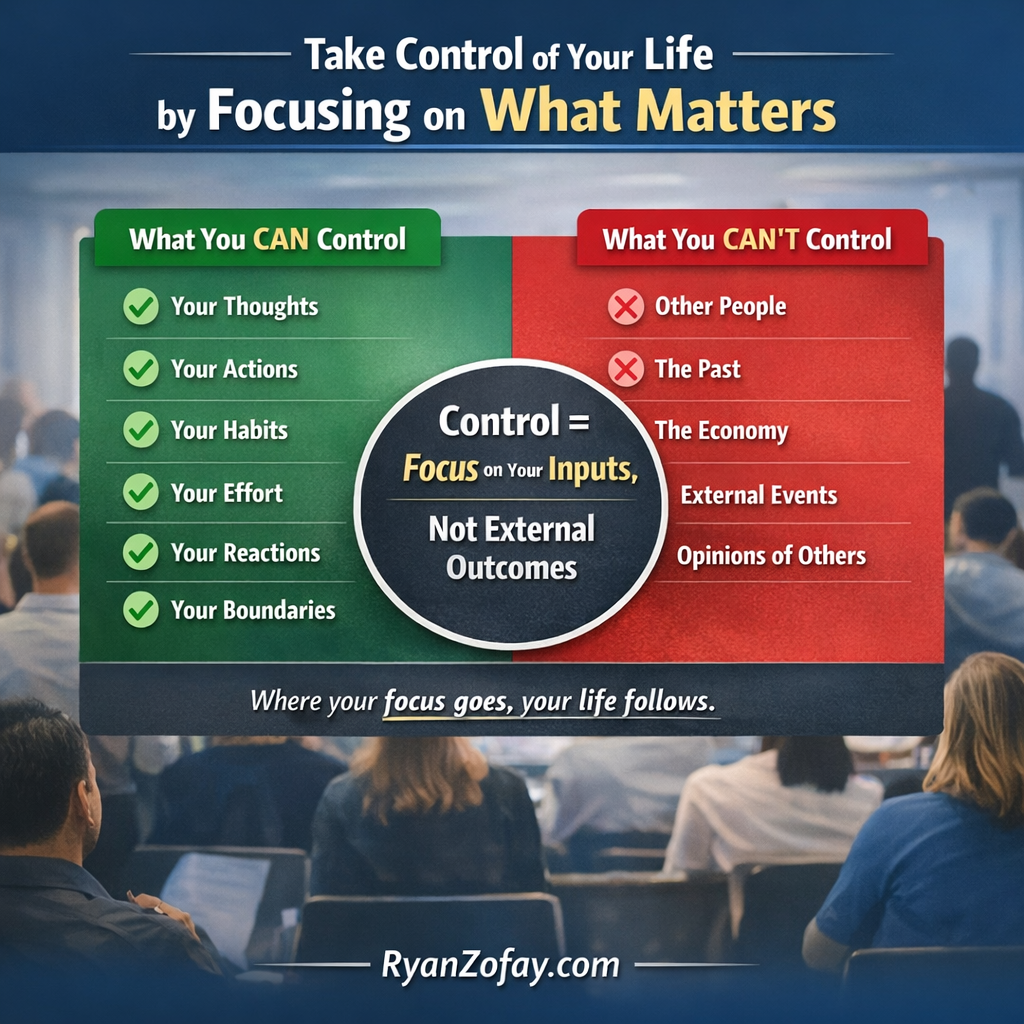
What You Can Control:
- Your thoughts and mindset
- Your daily habits
- Your effort and consistency
- Your reactions
- The boundaries you set
What You Can’t Control:
- Other people’s opinions
- The past
- The economy
- Unexpected events
When you focus only on what you can control, you reduce stress and increase clarity. That’s where real power comes from.
Framework by Ryan Zofay, personal development and accountability coach focused on behavior change and self-mastery
How to Take Control of Your Life Again After Setbacks
At some point, everyone loses control. You may feel stuck. You may feel behind. You may feel like you’ve failed. This is where people ask, how to take control of your life again.
The answer is not to restart everything. It is to reset your mindset.
Start small. Focus on one habit. Take one action. Momentum builds quickly when you stay consistent.
by Ryan Zofay, personal development and accountability coach
How to Take Control Back of Your Life and Be Happy
Many people believe happiness comes after success. I believe it comes during growth.
If you want to know how to take control of your life and be happy, focus on:
- progress over perfection
- discipline over motivation
- purpose over comfort
Happiness is not something you find. It is something you build through action and growth. When you grow, you feel better. That’s how happiness is created.
for how to take control of your life Choose Ryan Zofay
If you’re serious about learning how to take control of your life, you need more than ideas. You need a system that works.
I’ve lived through failure and built success from the ground up. I understand what it takes to take back control of your life and create real change.
Through my personal development coaching, I help you:
- Break negative patterns
- Build discipline and structure
- Develop leadership and business skills
- Stay accountable to your goals
- Create lasting transformation
This is not guesswork. This is a proven process.
Services That Help You Take Back Control
I offer structured coaching programs designed for real results:
- One-on-one coaching
- Business and leadership coaching
- Mindset and performance coaching
- Group programs and workshops
- Speaking and training sessions
Each program is designed to help you take control of your life and move forward with clarity.
Example: Taking Control in Real Life
A client came to me feeling stuck and overwhelmed. He didn’t know how to take back control of your life.
We focused on just a few steps:
- building a clear vision
- creating daily structure
- removing distractions
Within months, his business improved, as his mindset became stronger.
The system works when you apply it.
FAQs: How to Take Control of Your Life
How do you take control of your life?
You take control by making intentional decisions, building discipline, and taking consistent action.
How to take control of your life again after failure?
Start small. Focus on daily habits. Rebuild your confidence through action.
How to take back control of your life when you feel stuck?
Remove distractions, create structure, and focus on one goal at a time.
Can I take control of my life without motivation?
Yes. Discipline matters more than motivation.
How to take control of your life and be happy?
Focus on growth, consistency, and purpose. Happiness comes from progress.
Is it ever too late to take back control of your life?
No. You can start at any time. The best moment is now.
Your Next Step: Take Back Control Today
Learning how to take control of your life is not about changing everything overnight. It’s about making better choices every day. When you decide to take control of your life, you take control of your future. That decision changes everything.
You already know something needs to change. You feel it in your thoughts, your habits, and your daily life. The truth is, you don’t need more time—you need a decision. I’ve lived the struggle of feeling stuck, and I’ve built a system that works. If you are ready to stop repeating the same cycle and finally take control of your life, I’m here to guide you. Reach out today, and let’s build a life where you lead with clarity, strength, and purpose.
