
101 Team Building Activities for Work to Boost PRODUCTIVITY, Results, Morale & Fun
I know what it feels like when life is broken. Years ago, I was lost in addiction, trauma, and pain. I had no direction and no belief in myself. Everything changed when I chose growth, faith, and responsibility. I rebuilt my life step by step.
Growing into leadership, founding the 9-figure We Level Up detox centers, I learned an important truth. The strongest teams are built the same way strong lives are built. With trust, purpose, and shared challenges. That is why many leaders seek the best team building activities. They want their teams to grow together and win together. Today, I help companies do exactly that through coaching and transformational events. We practice the best team building activities in real time.
The most important investment you can make is in your people. When your team feels united, supported, and understood, there’s nothing you can’t achieve together.
Jump To
Table of Contents
Why Team Building Matters for Leadership and Growth
A team is not just a group of people working in the same place. A real team shares goals, trust, and responsibility.
When I started building businesses, I learned quickly that culture matters more than talent alone. The right environment helps people grow. The wrong one breaks morale.
That is why the best team building activities are powerful tools for companies. They improve communication, build trust, and create energy inside the workplace.
Many organizations use best team building activities for companies to:
- Improve teamwork
- Build trust
- Reduce stress
- Increase productivity
- Strengthen leadership
If you’re wondering how to choose the best team building activity in 30 seconds. The decision tree infographic can help you choose the right team building corporate exercises for your organization. It uses time, team size, and goals. Goals include communication, creativity, trust, and team bonding.
You’ll find below some of the best team building activities for companies, remote teams, leadership groups, and small workplace teams.

When done well, the best corporate team building activities create stronger leaders and more connected teams.
My Personal Experience and Lessons About Building a Team
My Personal Lessons About Teamwork
When I was rebuilding my life, I learned something important. Transformation never happens alone. I needed mentors. I needed structure. I needed accountability. Those same principles apply in business leadership.
The best activities for team building help people practice trust and communication in a safe way. They create shared wins. Over time, those small wins change the entire culture of a company.
That is why many organizations now focus on best team building activities for work as part of leadership development.
I remember the early days of building We Level Up. We were a small, passionate group, but we faced immense challenges. There were times when the pressure felt overwhelming. But what carried us through wasn’t just hard work; it was the trust and camaraderie we built. We learned to lean on each other, celebrate small wins, and communicate openly, even when it was hard. That foundation of teamwork is what allowed us to grow into a company with over 600 employees today.
That’s why I’m so passionate about team building. It’s not just about playing games or having a fun day out of the office. It’s about creating shared experiences that forge lasting bonds and improve the way your team works together. These activities are designed to build the essential “7 C’s” of a high-performing team: communication, collaboration, commitment, competence, confidence, creativity, and cohesion. Whether you’re a startup or a large corporation, investing in your team is investing in your success. This guide offers 101 team building activities to help you do just that.
Best Team Building Activities for Work (Virtual & In-Person)
Strong teams are not built by accident. They are built through shared experiences, communication exercises, and collaborative challenges that strengthen trust. The best team-building activities help employees solve problems together. They help employees learn about each other. They also let employees practice teamwork outside their usual roles.
As a neuro-linguistic leadership specialist, I see high-performing teams grow faster. They do best when they focus on psychological safety, communication patterns, and shared problem-solving. The most effective team exercises do three things:
- Create psychological safety
- Encourage open communication
- Build shared wins
When teams experience success together, trust grows faster.
“The fastest way to build trust inside a team is to create experiences where people rely on each other to succeed.” — Ryan Zofay

101+ Team Building Activities Ideas to Improve Collaboration, Communication, and Morale
Boost morale and collaboration with 101 fun team building activities for work. Find virtual, indoor, outdoor, and quick ideas for adults. The following tables organize the best team building activities for companies, corporate teams, small groups, and remote teams.
Best Team Building Activities for Work
These activities consistently appear in corporate workshops, leadership programs, and company retreats because they quickly improve collaboration.
| Team Building Activity | How It Works | Time & Why | Insight |
|---|---|---|---|
| Human Knot for Communication & Teamwork | Participants stand in a circle and grab two different hands from people across the circle. Without letting go, the team must untangle themselves. | 15–30 min. Encourages communication and shared problem-solving. | Physical collaboration quickly exposes communication patterns. Leaders can observe how teams problem solve under pressure. |
| Marshmallow Challenge for Innovation & Collaboration | Teams build the tallest structure using spaghetti, tape, string, and a marshmallow on top within a time limit. | 20 min. Teams must prototype ideas quickly rather than over-plan. | Highlights experimentation and rapid iteration—skills often emphasized in leadership development. |
| Escape Room for Problem Solving | Teams solve puzzles and clues to escape a themed room before the time limit expires. | 60–90 min. Encourages strategic thinking and cross-functional collaboration. | Teams must combine different skill sets to succeed, mirroring real business challenges. |
| Scavenger Hunt for Team Bonding | Teams search for objects or complete clues around an office, campus, or outdoor location. | 30–60 min. Movement and discovery keep engagement high. | Shared exploration reduces barriers between departments and builds informal connections. |
| Minefield (Blindfold Game) for Trust Building | One participant is blindfolded while teammates guide them through obstacles using only verbal instructions. | 20 min. Requires trust and clear communication between team members. | Teams learn how precise guidance and trust improve performance. |
| Build a Tower for Creativity | Teams use limited materials such as paper, cups, or straws to construct the tallest freestanding tower. | 20 min. Resource limits encourage innovation and teamwork. | Constraints force teams to collaborate and experiment with creative solutions. |
| Egg Drop Challenge for Strategy | Teams design a structure that protects an egg from breaking when dropped from a height. | 30 min. Encourages structured thinking and engineering creativity. | Leaders can observe whether teams plan carefully or improvise under pressure. |
| Reverse Charades for Communication | The entire group acts out a clue together while one person guesses the phrase. | 20 min. Promotes laughter and shared energy. | Humor reduces workplace tension and strengthens team cohesion. |
| Puzzle Race for Cooperation | Teams compete to finish the same puzzle as quickly as possible. | 20–40 min. Encourages strategic division of work. | High-performing teams naturally assign roles and coordinate efficiently. |
| Storytelling Circle for Creativity & Culture | Team members take turns adding one sentence to create a shared story. | 30 min. Encourages listening and collaborative creativity. | Shared storytelling strengthens team identity and emotional connection. |
These exercises are frequently included in best company team building activities and best corporate team building activities because they promote collaboration and communication quickly.
Quick 5-Minute Team Building Exercises
Sometimes, all you need is a quick, fun team building activities for adults to break the tension and get everyone talking. These 5-minute team building activities are perfect for starting a meeting or a long workshop. They are simple, require minimal setup, and can be done virtually or in person. These five minute team building exercises are ideal for meetings, workshops, and leadership retreats.
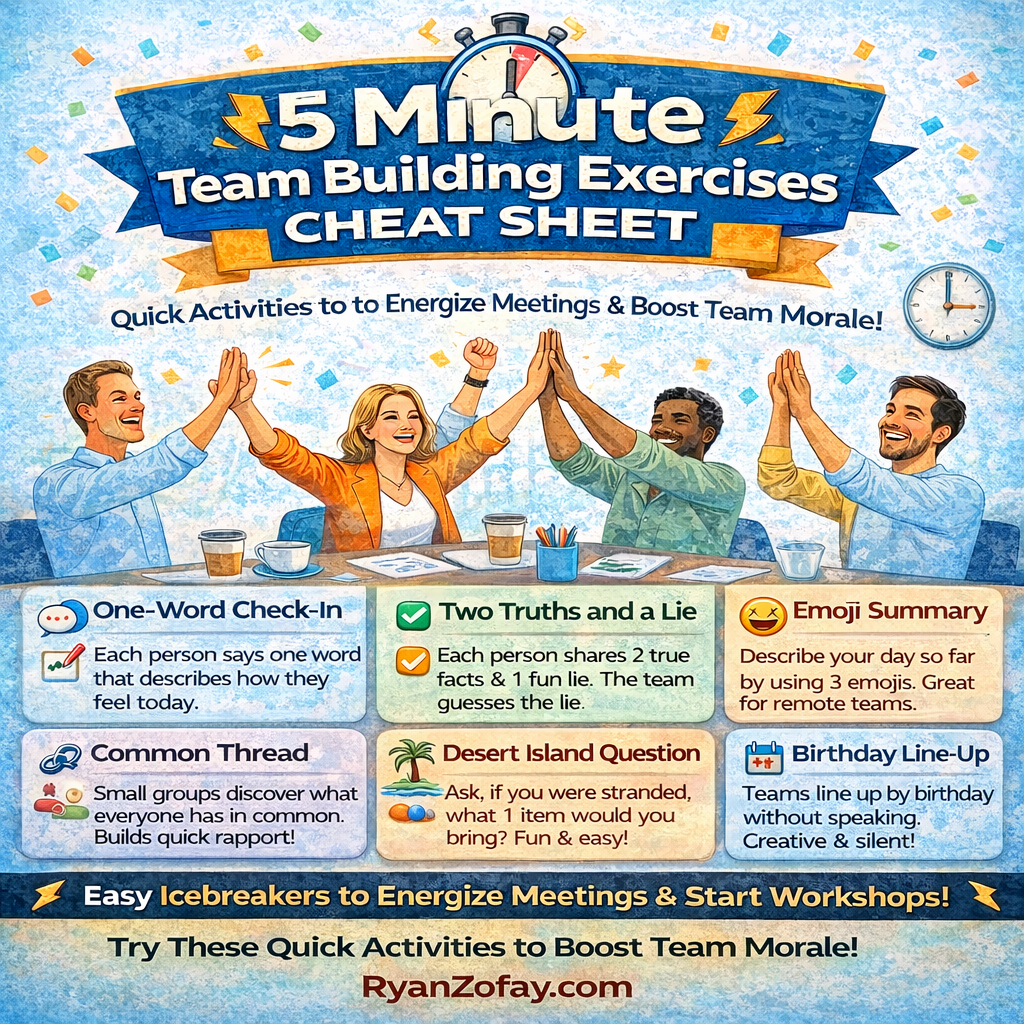
| Team Building Activity | How It Works | Time & Why | Insight |
|---|---|---|---|
| Two Truths and a Lie for Icebreakers. Great way to start meetings. | Each participant shares two true statements and one false statement about themselves while the group guesses which one is the lie. | 5–10 min. Helps coworkers learn unexpected facts about one another and quickly breaks the ice. | Reveals personality and encourages curiosity, helping teams become more comfortable communicating. |
| One-Word Check-In for Emotional Awareness. Great Team check-ins. | Ask each team member to describe how they feel about the week or project using just one word. | 5 min. Quickly gauges team morale and emotional energy at the start of meetings. | Leaders can instantly assess team energy levels, sentiment and identify when support or encouragement may be needed. |
| Emoji Summary for Virtual Teams. For Virtual communication. | Participants summarize their weekend, workday, or mood using three emojis in a chat or video call. | 5 min. Perfect for remote meetings because it encourages quick participation from everyone. | Reinforces concise communication and helps remote teams stay socially connected. |
| Birthday Line-Up for Non-Verbal Collaboration. | Team members must organize themselves in order of birthday without speaking. | 5–10 min. Encourages non-verbal problem solving and collaboration. | Demonstrates how teams coordinate through gestures, observation, and shared problem solving. |
| Common Thread for Team Connection | Small groups talk briefly to discover something all members have in common beyond work. | 5–10 min. Helps new teams find shared experiences and build rapport quickly. | Shared similarities reduce social barriers and help teams form connections faster. |
| Desert Island Question for Creativity | Ask each person what one item they would bring to a deserted island and why. | 5 min. Encourages imaginative thinking and light conversation. | Reveals personality and decision-making styles in a relaxed setting. Encourages imaginative thinking. |
| Best and Worst of the Week for Emotional Intelligence | Each team member shares one highlight and one challenge from the past week. | 10 min. Builds empathy and awareness of teammates’ experiences. | Open reflection builds empathy between teammates and trust within teams. |
| Map It Out for Personal Storytelling | Participants share where they are from or mark meaningful locations on a map. | 10–15 min. Helps remote and hybrid teams share personal stories. | Personal storytelling strengthens identity and connection among remote team members. |
These quick five-minute team building exercises are popular in meetings and workshops. They energise groups, improve communication, and build rapport. They also need no preparation or materials. Many offer great indoor team building activities for HR and leadership to try.

The 8 Best Virtual Team Building Activities
As remote work grows, companies search for best virtual team building activities and virtual team building exercises.
| Team Building Activity | How It Works | Time | Why | Goal | Size | Insight |
|---|---|---|---|
| Virtual Trivia Night for Team Engagement | Teams join a live trivia session using platforms like Kahoot or a Zoom-hosted quiz. Participants answer questions individually or in small groups across categories such as pop culture, company knowledge, or industry topics. | 20–40 min. Friendly competition energizes remote meetings and keeps participants engaged. Goal: Active listening Size: Pairs | Light-friendly competition boosts energy and participation, helping remote teams feel more connected during virtual gatherings. |
| Online Pictionary for Creativity | Participants use a Zoom whiteboard or online drawing tool while teammates guess the word or phrase being illustrated. | 15–25 min. Encourages fast thinking and visual communication in a fun environment. Goal: Active listening Size: Pairs | Creative games reveal how teams communicate visual ideas quickly, even with limited information. |
| Virtual Escape Room for Problem Solving | Teams work online to solve puzzles, decode clues, and unlock digital challenges. They aim to “escape” within a time limit. | 45–60 min. Requires collaboration, critical thinking, and time management. | Simulates real workplace problem solving where teams must combine different skills under pressure. |
| Virtual Coffee Break for Culture Building | Team members join a short video call focused purely on casual conversation rather than work tasks. Prompts or questions may help start discussion. | 15–20 min. Informal conversations help remote employees connect socially. | Regular informal interactions strengthen trust and reduce feelings of isolation in remote teams. |
| Guess the Desk for Personal Connection | Employees submit photos of their desks or workspace. The group tries to guess which workspace belongs to each teammate. | 10–15 min. Encourages light interaction and curiosity about coworkers’ environments. | Sharing personal workspace details helps remote teams build familiarity and comfort. |
| Online Game Tournament for Team Bonding | Teams compete in multiplayer games such as Jackbox, Codenames, or other collaborative online games. | 30–45 min. Interactive gameplay promotes teamwork and shared enjoyment. | Laughter and friendly competition help remote teams build stronger social connections. |
| Virtual Talent Show for Creativity | Team members perform short talents during a video meeting—such as music, magic tricks, or creative hobbies. | 30–45 min. Provides a platform for self-expression and entertainment. | Encourages confidence and highlights individual strengths beyond workplace roles. |
| Remote Show-and-Tell for Personal Storytelling | Participants briefly share a meaningful object, hobby item, or story during a video meeting. | 15–20 min. Encourages personal storytelling and authentic conversations. | Personal stories help humanize remote colleagues and strengthen emotional connection |
Many organizations now include these activities when planning team building exercises for remote employees and remote teams.
Top 6 Best Team Building Exercises for Communication
Communication breakdown is one of the biggest causes of team dysfunction. These communication team building exercises improve clarity and listening.
| Team Building Activity | How It Works | Time | Why | Goal | Size | Insight |
|---|---|---|---|
| Blind Drawing for Active Listening | Partners sit back-to-back. One person describes a picture while the other attempts to draw it based only on verbal instructions. | 10–15 min. Highlights how clearly instructions must be delivered and interpreted. | Goal: Active listening and clear instructions. | Size: Pairs. | Shows how communication quality directly affects outcomes. Small misunderstandings can quickly change results. |
| Back-to-Back Drawing for Communication Accuracy | Similar to blind drawing, one participant describes a simple image while their partner recreates it without seeing the original. | 10–15 min. Strengthens descriptive communication and attention to detail. | Goal: Communication accuracy. | Size: Pairs. | Forces teams to slow down and communicate precisely rather than assume shared understanding. |
| Word Association Relay for Creative Thinking | Participants stand in a circle or small group and quickly say a word related to the previous word spoken by a teammate. | 5–10 min. Fast-paced activity that encourages spontaneous thinking. | Goal: Creative thinking. | Size: Small groups (4–8). | Builds quick collaborative thinking and shows how ideas evolve through group participation. |
| Message Scramble for Team Coordination | Teams receive a scrambled sentence or message and must work together to rearrange the words into the correct order. | 10–15 min. Requires strategy, discussion, and group problem solving. | Goal: Team coordination. | Size: Small teams (3–6). | Encourages teams to organize ideas collectively and approach problems strategically. |
| Salt and Pepper for Relationship Building | Participants get a card with one half of a well-known pair, like “salt” or “pepper.” They must find their match by asking questions. | 10–15 min. Encourages interaction and conversation among unfamiliar coworkers. | Goal: Relationship building. | Size: Large groups. | Helps teams connect quickly and interact with people outside their usual work circles. |
| Silent Line Up for Non-Verbal Communication | Without speaking, participants must line up in order based on a set rule. They may use birthdays, height, or years at the company. | 10–15 min. Demonstrates the importance of observation and collaboration without verbal cues. | Goal: Non-verbal communication. | Size: Large groups. | Shows how teams coordinate through gestures, visual cues, and shared understanding when words are removed. |
These are considered some of the best team building exercises for adults in the workplace.
Trust Building Team Exercises
Trust is essential in leadership teams, executive teams, and cross-department collaboration.
| Team Building Activity | How It Works | Time | Why | Goal | Size | Insight |
|---|---|---|---|
| Trust Walk for Psychological Safety | One participant is blindfolded while a partner verbally guides them through a space or simple obstacle course. Partners switch roles after completing the walk. | 15–20 min. Builds trust by requiring participants to rely on another person’s guidance. | Goal: Trust building. | Size: Pairs or small groups. | Demonstrates how psychological safety develops when teammates depend on one another and communicate clearly. |
| Willow in the Wind for Vulnerability | One participant stands at the center of a circle and leans gently in different directions. The teammates around them support and guide them back upright. | 15–20 min. Encourages vulnerability and mutual support among participants. | Goal: Building vulnerability and reliance on teammates. | Size: Groups of 6–10. | Teaches teams how trust grows when individuals feel safe relying on others for support. |
| Active Listening Pairs for Empathy | Participants pair up and take turns talking about a topic. The other person listens without interrupting. Then, they summarize what they heard. | 10–15 min. Strengthens listening skills and encourages empathy in conversations. | Goal: Improve emotional intelligence and listening. | Size: Pairs. | Reinforces that effective leadership depends on understanding others rather than simply responding. |
| Appreciation Circle for Recognition | Team members stand or sit in a circle. They take turns sharing appreciation for a colleague’s contribution or positive trait. | 15–20 min. Reinforces positive feedback and recognition within the group. | Goal: Encourage recognition and gratitude. | Size: Small to medium groups (6–15). | Positive feedback strengthens morale and helps build a culture of appreciation. |
| Life Map for Personal Connection | Participants draw or describe a simple “map” of important life events or experiences and share it with the group. | 20–30 min. Encourages storytelling and deeper understanding among teammates. | Goal: Personal connection and perspective sharing. | Size: Small groups or leadership teams (4–10). | Sharing personal experiences helps leaders better understand colleagues’ motivations and backgrounds. |
These activities are commonly used in executive team building exercises and leadership development workshops.
Top 5 Best Team Building Activities for Small Groups
| Team Building Activity | How It Works | Time | Why | Goal | Size | Insight |
|---|---|---|---|
| Reverse Engineering for Analytical Thinking | Teams receive a finished structure, object, or process description. They must work backwards to figure out how it was made. Participants analyze steps, materials, or strategies used to produce the result. | 15–20 min. Encourages logical reasoning and structured problem solving. | Goal: Analytical thinking and strategy development. | Size: 4–6 participants. | Shows how teams break complex problems into manageable steps and evaluate solutions collaboratively. |
| Sneak a Peek for Strategy Communication | One teammate briefly looks at a hidden structure or design. Then they return to the group. They describe how to recreate it without touching the materials. | 15–20 min. Requires clear communication and collaborative planning. | Goal: Strategy communication and teamwork. | Size: 4–6 participants. | Demonstrates how clear instructions and shared understanding improve team execution. |
| Build a Tower for Creativity Challenge | Teams get simple materials like paper, straws, tape, or cups. They must build the tallest freestanding tower within a time limit. | 15–20 min. Limited materials encourage innovation and creative problem solving. | Goal: Creativity and resourcefulness. | Size: 4–8 participants. | Constraints force teams to collaborate and experiment with different approaches. |
| Puzzle Race for Collaboration | Small groups compete to complete identical puzzles as quickly as possible by dividing tasks and coordinating efforts. | 15–25 min. Encourages cooperation and strategic division of work. | Goal: Collaboration and efficiency. | Size: 4–8 participants. | High-performing teams naturally organize roles and work together efficiently. |
| Egg Drop Challenge for Innovation | Teams design a protective structure using limited materials to keep an egg from breaking when dropped from a height. | 20–30 min. Combines creativity, engineering thinking, and teamwork. | Goal: Innovation and problem solving. | Size: 4–8 participants. | Leaders can observe how teams balance planning with experimentation under time pressure. |
Small groups allow deeper collaboration and stronger individual participation, which often produces faster trust building.
The 5 Best Team Building Activities for SEO and Marketing Teams
Marketing teams operate differently from traditional departments because they combine creativity, analytics, and experimentation.
| Team Building Activity | How It Works | Time | Why | Goal | Size | Insight |
|---|---|---|---|
| Keyword Challenge Game for SEO Research | Teams compete to brainstorm and organize the best keyword ideas for a specific topic, product, or industry. Groups may use SEO tools or manual brainstorming to build a keyword list. | 15–20 min. Encourages fast keyword research and idea generation. | Goal: Improve keyword brainstorming and search intent analysis. | Size: Small teams (3–5). | Highlights how collaboration can uncover more diverse keyword opportunities than individual research alone. |
| Content Brainstorming Competition for Creativity | Small groups compete to create engaging blog topics, social media campaigns, or content angles for a specific theme. Ideas are then shared and voted on by the team. | 15–20 min. Encourages creative thinking and collaborative ideation. | Goal: Generate fresh content ideas. | Size: Small teams (3–6). | Creative competition often produces stronger marketing ideas and unexpected campaign concepts. |
| Website Audit Challenge for SEO Analysis | Teams review a sample website and find technical SEO issues. These include broken links, slow pages, missing metadata, and structure problems. | 20–30 min. Improves analytical thinking and technical SEO awareness. | Goal: Strengthen website auditing skills. | Size: Small teams (3–5). | Encourages marketers to think critically about site performance and user experience. |
| Strategy Puzzle Exercise for Campaign Planning | Teams get parts of a marketing strategy, like audience, messaging, channels, budget, and timeline. They must put them together into a clear campaign plan. | 20–30 min. Reinforces strategic thinking and collaborative planning. | Goal: Improve marketing strategy development. | Size: Small teams (4–6). | Demonstrates how successful campaigns require coordination across multiple marketing elements. |
| Marketing Trivia for Industry Knowledge | Teams compete in a trivia game covering marketing trends, SEO principles, advertising platforms, and digital strategy topics. | 15–20 min. Reinforces shared knowledge in an engaging way. | Goal: Strengthen industry expertise. | Size: Small to medium teams (4–8). | Friendly competition helps teams retain industry knowledge and stay current with marketing trends. |
Leaders often search:
- best team building activities for seo teams
- what are the best team building activities for seo teams
These exercises help digital teams collaborate on strategy, analytics, and content creation.
The 7 Best Team Building Activities in Major Cities
Companies often plan local corporate retreats and team events.
| Team Building Activities by City | How It Works | Time | Why | Goal | Size | Insight |
|---|---|---|---|
| Best Team Building Activities in NYC | Teams join activities like escape rooms, guided food tours, or scavenger hunts in Central Park. They solve clues together. | 60–120 min. Large urban environments create interactive experiences that require collaboration and exploration. | Goal: Team bonding and problem solving. | Size: Medium to large groups (6–20). | Urban activities encourage teams to work together while exploring iconic locations. |
| Best Team Building Activities in Atlanta | Companies often organize outdoor adventure courses, cooking competitions, or collaborative food experiences across the city. | 60–90 min. Hands-on challenges combine creativity with teamwork. | Goal: Collaboration and shared experiences. | Size: Small to medium groups (6–15). | Food and adventure-based activities create relaxed environments where teams naturally interact. |
| Best Team Building Activities in Chicago | Groups participate in architecture-themed scavenger hunts, improv workshops, or city exploration challenges. | 60–120 min. Combines creativity, communication, and urban discovery. | Goal: Communication and creative collaboration. | Size: Medium groups (8–20). | Improv and exploration activities help teams think quickly and communicate effectively. |
| Best Team Building Activities in Los Angeles | Teams organize beach Olympics, outdoor challenges, or studio tour experiences across Los Angeles. | 60–120 min. Outdoor environments promote energetic group participation. | Goal: Team bonding and friendly competition. | Size: Medium to large groups (10–30). | Physical outdoor activities increase engagement and help teams build camaraderie. |
| Best Team Building Activities in Dallas | Popular options include BBQ competitions, leadership games, and outdoor group challenges. | 60–90 min. Cooking and competition encourage collaboration and friendly rivalry. | Goal: Leadership development and teamwork. | Size: Medium groups (8–20). | Cooking competitions reveal natural leadership and coordination skills within teams. |
| Best Team Building Activities in San Francisco | Teams participate in tech innovation challenges, startup-style problem solving activities, or urban treasure hunts across the city. | 60–120 min. Innovation-driven exercises encourage creative thinking and collaboration. | Goal: Innovation and strategic thinking. | Size: Medium groups (8–20). | Tech-inspired activities mirror the collaborative culture common in startup environments. |
| Best Venues for Team Building Activities in Birmingham | Companies host retreats at corporate event venues, outdoor parks, or team challenge centers designed for group activities. | 60–120 min. Dedicated venues provide structured environments for group exercises. | Goal: Team bonding and leadership development. | Size: Medium to large groups (10–30). | Structured retreat environments allow teams to focus on collaboration away from daily work distractions. |
Collaborative Games for Small and Large Groups (20-60 Minutes)
These team building activities for work require more collaboration and problem-solving. They are fantastic for strengthening communication, building trust, and encouraging teamwork.
| Team Building Activity | How It Works | Time | Why | Goal | Size | Insight |
|---|---|---|---|
| Lost at Sea Survival Game for Strategic Collaboration | Teams get a list of survival items after a fictional shipwreck. They must rank the items by importance for survival. Groups compare their answers to expert rankings. | 30–45 min. Requires debate, reasoning, and consensus building. | Goal: Strategic thinking and group decision-making. | Size: 4–10 participants. | Highlights how collective reasoning often leads to stronger decisions than individual thinking. |
| Paper Airplane Competition for Innovation | Teams design and build paper airplanes to compete for distance, accuracy, or airtime using limited materials. | 20–30 min. Encourages experimentation and iterative improvement. | Goal: Creative problem solving and innovation. | Size: 4–8 participants. | Shows how rapid testing and iteration often outperform long planning cycles. |
| Bridge Building Challenge for Collaboration | Teams build separate halves of a bridge using limited materials. At the end, the two halves must connect and support weight. | 30–45 min. Requires coordination between teams and shared planning. | Goal: Cross-team collaboration. | Size: 6–12 participants. | Demonstrates the importance of communication between teams working on interconnected projects. |
| Debate Challenge for Communication Skills | Teams are assigned a topic and must prepare short arguments supporting or opposing a position. Groups present their case to the rest of the team. | 30–45 min. Encourages structured thinking and persuasive communication. | Goal: Communication and critical thinking. | Size: 6–12 participants. | Encourages teams to listen to opposing viewpoints and articulate ideas clearly. |
| Team Trivia Tournament for Collaboration | Teams answer trivia questions across different topics while collaborating to reach consensus on answers. | 30–40 min. Promotes discussion, teamwork, and shared knowledge. | Goal: Collaboration and knowledge sharing. | Size: 4–16 participants. | Friendly competition increases engagement and strengthens team morale. |
| Collaborative Story Building for Creativity | Each participant contributes one part of a story, building on what the previous person said. The group must create a coherent narrative together. | 20–30 min. Encourages active listening and creative collaboration. | Goal: Creative teamwork and communication. | Size: 5–12 participants. | Reinforces how collaborative creativity can generate ideas that individuals might not produce alone. |
Outdoor Team Building Activities
Getting outside can be a refreshing change of pace. These outdoor team building activities are great for encouraging teamwork in a new environment.
| Team Building Activity | How It Works | Time | Why | Goal | Size | Insight |
|---|---|---|---|
| Company Field Day for Friendly Competition | Teams rotate through classic outdoor games such as tug-of-war, relay races, and sack races while earning points for their team. | 60–120 min. Outdoor games encourage movement, laughter, and group participation. | Goal: Team bonding and friendly competition. | Size: Large groups (10–50). | Physical challenges break down workplace hierarchy and encourage natural collaboration. |
| Hiking or Nature Walk for Connection | Teams walk a local trail together, often incorporating conversation prompts or reflection exercises along the way. | 60–90 min. Nature provides a relaxed environment for conversation and connection. | Goal: Relationship building and wellness. | Size: Small to medium groups (4–15). | Informal conversations during shared experiences often strengthen workplace relationships. |
| Team Sports Game for Collaboration | Organize a friendly match such as soccer, volleyball, or softball where teams compete while focusing on cooperation and teamwork. | 45–60 min. Sports require coordination, communication, and shared strategy. | Goal: Collaboration and team coordination. | Size: Medium to large groups (8–20). | Team sports reveal leadership, coordination, and support roles naturally within groups. |
| Volunteer Day for Community Impact | Teams work together on a community service project. For example, they may clean a park, build homes, or support a local nonprofit. | 2–4 hours. Shared service projects build purpose and collaboration. | Goal: Team bonding through meaningful work. | Size: Medium to large groups (8–30). | Working toward a shared purpose strengthens connection and company culture. |
| Ropes Course for Trust and Challenge | Participants complete outdoor obstacle challenges, like rope bridges, climbing walls, or balance tasks. Teammates offer encouragement and guidance. | 60–90 min. Physical challenges build trust and confidence. | Goal: Trust building and overcoming challenges. | Size: Small to medium groups (6–15). | Shared challenges help teams build resilience and mutual support. |
| Kayaking or Canoeing for Coordination | Teams paddle together in pairs or small groups, navigating a lake or river while coordinating their movements. | 60–90 min. Requires synchronized effort and communication. | Goal: Team coordination and cooperation. | Size: Small to medium groups (4–12). | Success depends on synchronization and communication between teammates. |
| Group Jump Rope for Team Coordination | Teams attempt to achieve the longest series of consecutive jumps using a large rope while coordinating timing and rhythm. | 15–20 min. Simple but engaging challenge requiring synchronization. | Goal: Team coordination and rhythm. | Size: Medium groups (6–12). | Demonstrates how small adjustments and teamwork improve group performance. |
| Go-Kart Racing for Friendly Competition | Teams compete in timed races or relay-style competitions at a go-kart track. | 30–60 min. Fast-paced activity that energizes teams. | Goal: Friendly competition and excitement. | Size: Small to medium groups (6–15). | Competitive activities boost engagement and team morale. |
| Company Picnic for Culture Building | Employees gather outdoors for food, casual games, and informal conversation in a relaxed environment. | 60–120 min. Social events encourage natural relationship building. | Goal: Strengthen workplace culture. | Size: Large groups (10–50). | Informal gatherings help coworkers interact outside structured work roles. |
| Build a Raft Challenge for Innovation | Teams receive limited materials and must design and build a raft capable of floating and supporting a teammate. | 45–60 min. Encourages creative engineering and teamwork. | Goal: Innovation and problem solving. | Size: Small to medium groups (4–10). | Resource constraints encourage experimentation and collaborative problem solving. |
| Beach Day for Team Bonding | Teams spend time at the beach participating in casual activities such as volleyball, sandcastle building, and swimming. | 60–120 min. Relaxed outdoor environment promotes social interaction. | Goal: Team bonding and recreation. | Size: Medium to large groups (10–30). | Informal outdoor activities create shared experiences that strengthen relationships. |
| Outdoor Yoga or Meditation for Wellness | A guided yoga or meditation session held in a park or outdoor space to help teams relax and refocus. | 30–45 min. Encourages mindfulness and stress reduction. | Goal: Team wellness and mental clarity. | Size: Small to medium groups (5–20). | Wellness activities improve focus, reduce stress, and support workplace wellbeing. |
| Company Garden Project for Collaboration | Teams work together to plant and maintain a small garden at the workplace or community location. | 60–90 min. Hands-on collaboration encourages patience and teamwork. | Goal: Long-term collaboration and sustainability. | Size: Small to medium groups (4–12). | Shared projects create ongoing opportunities for collaboration and connection. |
Creative and Funny Team Building Activities
Sometimes the best way to bond is through laughter and creativity. These funny and creative team building ideas are sure to lighten the mood.
| Team Building Activity | How It Works | Time | Why | Goal | Size | Insight |
|---|---|---|---|
| Improv Workshop for Creative Thinking | A facilitator leads improv games where participants respond to prompts, act out scenes, and build ideas together. | 45–60 min. Encourages spontaneity and active listening. | Goal: Creative thinking and communication confidence. | Size: Small–medium groups (6–20). | Improv builds comfort with uncertainty and helps teams practice supportive collaboration. |
| Lip Sync Battle for Team Entertainment | Teams choreograph and perform lip-sync routines to popular songs, often adding costumes or creative staging. | 30–45 min. Humor and performance create shared energy and excitement. | Goal: Team bonding and creative expression. | Size: Medium groups (8–20). | Shared laughter lowers social barriers and strengthens group cohesion. |
| Office “Chopped” Cooking Challenge for Collaboration | Teams receive a mystery basket of ingredients and must create a dish within a limited time. | 45–60 min. Cooking challenges require planning, creativity, and teamwork. | Goal: Creative collaboration and problem solving. | Size: Small teams (4–8). | Limited ingredients encourage quick experimentation and shared decision making. |
| Collaborative Mural for Team Identity | Team members contribute artwork to a large shared mural representing company values or goals. | 30–60 min. Collective creativity builds shared ownership and team identity. | Goal: Creativity and team culture. | Size: Medium–large groups (8–25). | Visual collaboration reinforces shared vision and collective contribution. |
| Role Reversal Skits for Workplace Empathy | Employees act out scenes representing another coworker’s role or department responsibilities. | 30–40 min. Role-playing builds understanding across teams. | Goal: Empathy and cross-department awareness. | Size: Small–medium groups (6–15). | Seeing work from another perspective builds appreciation and cooperation. |
| Company Theme Song for Creative Collaboration | Teams write lyrics and perform a humorous or motivational song about the company culture or mission. | 30–45 min. Music and humor encourage creativity and participation. | Goal: Creative teamwork and cultural engagement. | Size: Small–medium groups (5–12). | Creative expression helps teams build shared identity. |
| Sales Pitch for a Useless Object for Persuasion Skills | Teams create persuasive sales pitches for everyday objects like paperclips or rubber bands. | 20–30 min. Combines humor with presentation skills. | Goal: Communication and persuasion. | Size: Small teams (4–8). | Playful presentations strengthen storytelling and confidence. |
| Two-Headed Expert for Improvisation | Pairs answer audience questions while alternating one word at a time to form complete sentences. | 15–20 min. Requires careful listening and coordination. | Goal: Communication and improvisation. | Size: Pairs or small groups. | Demonstrates how effective communication requires careful listening and timing. |
The 7 C’s of High Performing Teams
In my experience coaching leaders and organizations, high-performing teams rarely succeed by accident. The strongest teams share a set of core qualities that shape how they communicate, collaborate, and solve problems together.
I often describe these principles as the 7 C’s of High Performing Teams. These qualities create the foundation for strong leadership, healthy culture, and sustainable results.
When teams focus on these seven areas, they build stronger bonds, make better choices, and perform better.
| The C | Meaning |
|---|---|
| Communication | Clear, open dialogue between team members |
| Collaboration | Working together to solve problems |
| Commitment | Dedication to shared team goals |
| Competence | Skilled and capable team members |
| Confidence | Trust in each other and the team’s ability |
| Creativity | Innovation and new ideas |
| Cohesion | Strong unity and team identity |
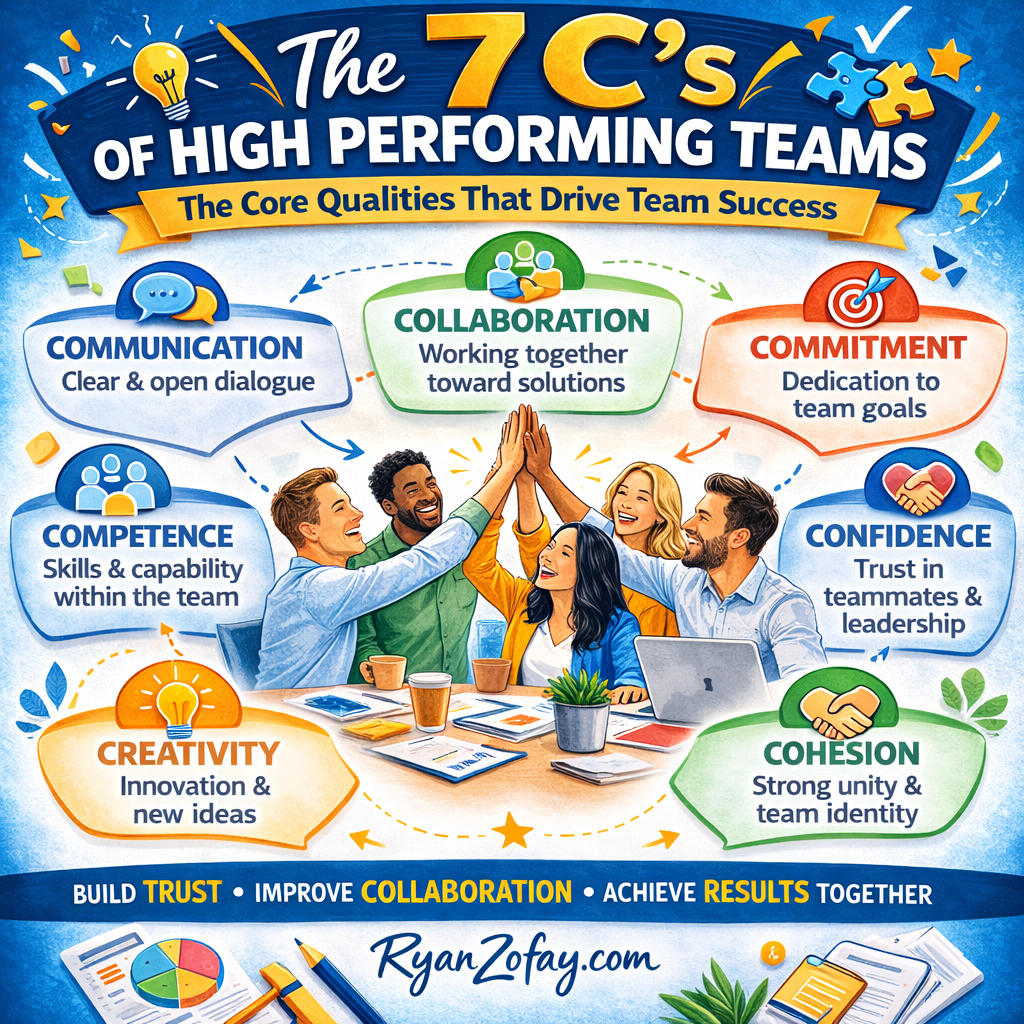
This infographic highlights the best team building activities for work I teach. Building trust, improving collaboration, and for achieving real results together.
These seven elements help teams develop trust, productivity, and shared accountability.
In my coaching work, I often see that when one of these elements is missing, teams struggle with performance or morale. But when leaders intentionally develop all seven, the entire organization benefits
The Science of Team Building
In my leadership coaching and team development work, I often see organizations underestimate team building activities. They do not realize how much these activities can matter. Many people think they are simply workplace games or morale boosters. In reality, the best team building exercises are grounded in psychology and behavioral science.
When teams take part in structured activities, they build communication, trust, creativity, and collaboration. These skills improve the core dynamics that drive workplace performance.
Research from groups like Google, Harvard Business Review, MIT, and Gallup supports what I have seen. Teams do better when people feel safe, connected, and comfortable sharing ideas.
In my coaching programs, I stress that the best team building comes from shared challenges and meaningful interactions. When people solve problems together, they build stronger work relationships. They listen to each other and celebrate wins as a group.
Below are several research studies that explain why team building activities improve workplace performance. I also include practical exercises I often recommend to leaders.
The Science of Team Building: Why Team Building Activities Improve Workplace Performance.

Research Behind Team Building Workplace Performance
In my leadership coaching work, I often tell executives that strong teams are not built by accident. They are built intentionally through communication, trust, shared goals, and collaboration.
Below are several statistics that show why team building activities are more than workplace exercises. They are essential tools for building high-performing teams.
| Research Study | My Insights, Tips, and DIY Team Building Exercises |
|---|---|
| Google Project Aristotle. Finding: Psychological safety is the most important factor in high-performing teams. Key Insight: Teams perform better when members feel safe sharing ideas, admitting mistakes, and asking questions. Research: Google Project Aristotle Research | In my leadership workshops, I constantly emphasize psychological safety. When people feel judged or afraid to speak up, innovation stops immediately. One simple exercise I recommend is Active Listening Pairs. One person speaks for two minutes about a challenge or idea while their partner listens without interrupting. Then the listener summarizes what they heard. This exercise strengthens empathy and communication quickly. Learn more about my leadership training approach here: Leadership Training for High Performing Teams |
| Harvard Business Review Collaboration Study Finding: Teams that collaborate effectively are significantly more productive. Key Stat: Collaborative teams are five times more likely to perform at a high level. Research: Harvard Business Review Collaboration Study | One of the biggest mistakes leaders make is assuming collaboration happens automatically. It doesn’t. Teams must practice solving problems together. A powerful exercise I often use is an Escape Room challenge or problem-solving simulation. These activities force teams to communicate, share ideas, and coordinate strategies under pressure. I share more exercises leaders can implement here: Team Vision Quest Activities for Leaders |
| Gallup Employee Engagement Research. Finding: Employee engagement strongly correlates with business performance. Key Stat: Companies with highly engaged teams see 21% higher profitability and 17% higher productivity. Research: Gallup Employee Engagement Research | Engagement is not just about motivation. It is about people feeling valued and connected to their team. A simple activity I recommend is an Appreciation Circle. Each team member acknowledges a positive contribution from another colleague. Recognition builds trust and strengthens relationships quickly. I discuss leadership culture and engagement strategies here: Leadership Development and Team Culture |
| MIT Human Dynamics Laboratory Study Finding: Communication patterns were the strongest predictor of team success. Key Insight: Teams perform best when communication is frequent, balanced, and inclusive. Research: MIT Sloan Team Science Research | One leadership habit I encourage is rotating participation during discussions, so every team member contributes ideas. A fun exercise I use is Word Association Relay. Each participant adds a connected idea to a chain of words that relate to solving a challenge. It encourages fast thinking and collaboration. I share additional communication strategies here: Communication Skills for Leadership |
| Deloitte Global Human Capital Trends Study Finding: Organizations that prioritize collaboration and culture outperform competitors. Key Stat: 94% of executives say culture and collaboration are critical to business success. Research: Deloitte Human Capital Trends | One activity I recommend for building culture is a Team Values Workshop. Each team member identifies their top personal values, and the group discusses how those align with company values. This exercise builds alignment and shared purpose. Discover more leadership culture strategies and identify What is your leadership style? |
What the Science of Team Building Shows
Across these studies, one thing becomes clear: strong teams share four core characteristics.
- Communication: Exercises like Blind Drawing and Active Listening Pairs teach teams how to listen carefully and communicate clearly.
- Trust: Activities such as Trust Walk and Willow in the Wind create psychological safety and reliance between teammates.
- Creativity: Creative exercises like improv workshops or storytelling challenges unlock innovation and idea generation.
- Collaboration: Problem-solving activities like escape rooms or strategy puzzles teach teams how to coordinate and make decisions together.
When teams practice these skills regularly, they become more confident working together and better prepared to handle challenges.
My Perspective on Team Building
From my experience coaching leaders and teams, the goal of team building is not just entertainment. It is about creating experiences that help people understand each other, communicate better, and solve problems together.
The strongest teams I work with are the ones that intentionally invest in communication, trust, creativity, and collaboration.
When leaders create those conditions, performance improves naturally. And in many cases, a single well-designed team building activity can start that transformation.
Leadership Insight from Ryan Zofay
One of the biggest mistakes I see leaders make is treating team building as a one-time event. It should be an ongoing practice. Strong teams are developed through consistent experiences that encourage communication, trust, and shared problem solving.
Even small exercises, like a five-minute check-in or a team challenge, can build relationships. They can also improve team dynamics. When leaders create chances for teams to connect, the results often include higher engagement, better collaboration, and stronger performance.
And over time, those improvements compound into something every organization wants: a high-performing team. I emphasize that team building is most effective when it builds emotional connection, not just entertainment. My leadership coaching programs often use exercises that strengthen:
- trust
- communication
- shared responsibility
- emotional intelligence
When leaders intentionally choose the best team building activities for companies, they accelerate team cohesion and performance.
Paving the Way for a Stronger Team
Building a strong, cohesive team doesn’t happen by accident. It takes intentional effort, and that’s what these team-building activities are all about. From quick 5-minute icebreakers to full-day workshops, each activity helps strengthen relationships. They also improve communication and build trust, which is essential for high performance.
My journey has shown me that being open, connecting with others, and supporting each other are not just soft skills. They are the key parts of resilience and success. When you invest in your team’s relationships, you improve morale. You also build a more agile, innovative, and strong organization.
Start small. Pick one or two activities from this list and try them with your team. Observe the impact. I promise you, the investment you make in your people will pay dividends you can’t even imagine. If you’re ready to take your team to the next level, let’s connect. Through my leadership coaching and events, I can help you build a team. Join my seminars t & learn how teams can overcome obstacles to achieve extraordinary things—together.
Additional Resources
- How to Recover from Burnout at Work & Life
- Free Online Ryan Zofay Relationship Quiz
- Exceptional Leadership Coaching Top Winning Strategies
